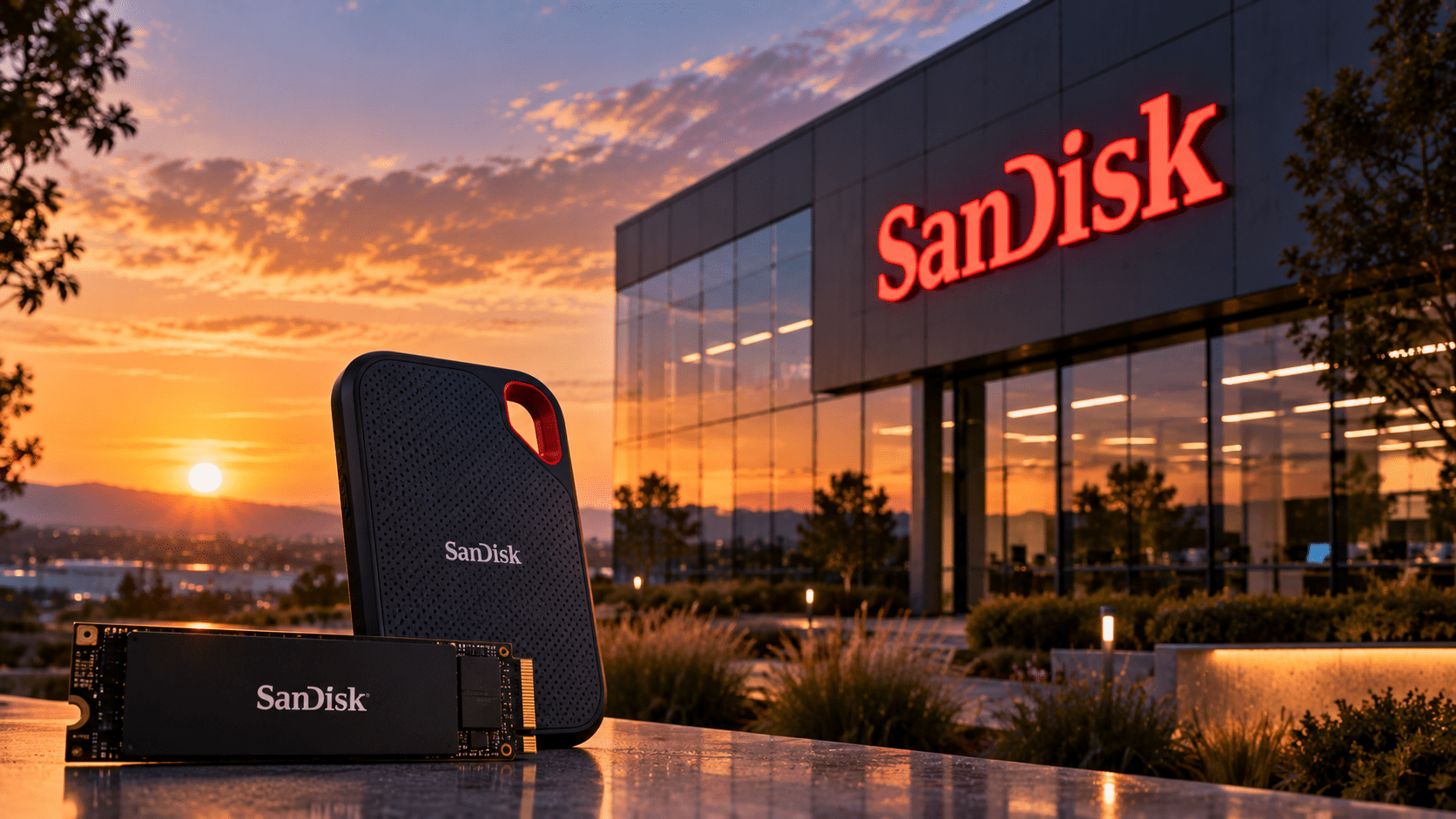
Sandisk stock surged more than 11% on Friday, September 18, 2026, closing at $1,791.82 as renewed enthusiasm for artificial intelligence infrastructure and semiconductor storage companies helped drive a powerful recovery across the technology sector. The advance followed a gain of approximately 6% in the previous session, marking a sharp turnaround after two weeks of losses and bringing fresh attention to one of the stock market’s strongest-performing technology companies of 2026. With Sandisk (NASDAQ: SNDK) benefiting from rising demand for NAND flash memory, improving pricing conditions, and expanding investment in AI data centers, investors are reassessing how much growth the company’s storage business could generate in the coming years.
The rally extended beyond Sandisk, with other semiconductor and storage-related companies attracting buying interest as investors returned to businesses positioned to benefit from expanding data-center infrastructure. Micron Technology (NASDAQ: MU), Western Digital (NASDAQ: WDC), and semiconductor equipment manufacturers have also attracted attention as the technology industry continues investing in the infrastructure required to support artificial intelligence workloads. However, Sandisk’s double-digit advance stood out against a relatively modest increase in the broader Nasdaq Composite, demonstrating how strongly investors responded to the company’s exposure to the evolving memory and storage market.
For Sandisk shareholders, Friday’s surge raises a more complicated question than whether demand for data storage will continue growing. The company’s financial performance has improved dramatically, but its share price has already experienced an extraordinary advance during 2026, increasing the importance of future earnings growth, sustainable profit margins, and the durability of current NAND pricing conditions. As investors prepare for another trading week, the central question is whether Sandisk’s expanding business can continue supporting the expectations now reflected in its stock-market valuation.
Sandisk Stock’s 11% Rally Reveals Wall Street’s Renewed Appetite for AI Storage
Sandisk’s September 18 advance came during a session in which technology shares helped the Nasdaq Composite finish modestly higher despite continued pressure from rising Treasury yields and concerns about inflation. While the broader market remained relatively subdued, investors showed renewed interest in companies connected to artificial intelligence infrastructure, including semiconductor manufacturers, memory suppliers, and businesses providing the equipment required to expand data-center capacity. Sandisk’s share-price increase followed a strong rebound in the previous session, suggesting that investors were reassessing the company’s outlook after its recent period of weakness.
The enthusiasm surrounding Sandisk reflects an important shift in how investors view the role of storage technology in the artificial intelligence industry. Much of the market’s attention has historically concentrated on advanced processors produced by companies such as Nvidia and AMD, but the expansion of AI computing infrastructure also creates substantial demand for memory and storage systems capable of handling increasingly large quantities of data. Training sophisticated AI models, operating data-intensive applications, and deploying AI services at scale require more than computing power alone, making storage capacity and performance important considerations for companies building next-generation data centers.
Related articles


Sandisk’s exposure to NAND flash memory places it within this expanding infrastructure market. NAND technology is widely used in solid-state drives and other storage products, providing the capacity required to retain, access, and manage digital information. As data-center operators expand their computing infrastructure, demand for high-capacity storage can create additional commercial opportunities for suppliers capable of meeting performance, reliability, and efficiency requirements. However, the financial benefits depend on product pricing, manufacturing costs, and the balance between industry supply and demand, which means that rising AI investment does not automatically guarantee continued earnings growth for every storage manufacturer.
Sandisk’s $8.97 Billion Quarter Shows Why Investors Are Paying Attention
The foundation for Sandisk’s recent stock-market performance lies in a substantial improvement in its financial results. On August 5, the company reported fiscal fourth-quarter revenue of $8.97 billion, representing a 51% increase from the preceding quarter, while GAAP net income reached $6.90 billion, equivalent to diluted earnings of $43.97 per share. Adjusted earnings came in at $39.25 per share, reflecting the scale of the company’s profitability as rising storage demand and stronger pricing supported its business.
Sandisk’s full-year results demonstrated an even more dramatic expansion. Fiscal 2026 revenue reached $20.25 billion, an increase of 175% compared with the previous year, while GAAP net income totaled $11.43 billion. The company’s financial performance benefited from stronger NAND pricing, higher shipment volumes, and a shift toward customers purchasing higher-value storage products. These developments illustrate why investors have increasingly viewed Sandisk as an important participant in the broader AI infrastructure investment cycle rather than simply a manufacturer of consumer storage devices.
The composition of Sandisk’s quarterly growth is particularly important because approximately two-thirds of its sequential revenue increase came from higher pricing, while roughly one-third resulted from increased shipment volumes. That distinction highlights the financial leverage available to memory manufacturers when demand strengthens faster than available supply. Higher selling prices can translate into substantial improvements in profitability, particularly when manufacturers are able to control production expenses and maintain favorable product mixes. However, the same mechanism can work in reverse if industry supply expands more quickly than demand, making the sustainability of current pricing conditions a central issue for investors assessing Sandisk stock.
AI Data Centers Are Transforming Sandisk’s Business
Sandisk’s financial results reveal how rapidly the company’s exposure to data-center infrastructure has expanded. During fiscal 2026, data-center revenue reached approximately $5.15 billion, an increase of 437% from $960 million in the previous year. In the fourth quarter alone, the segment generated nearly $2.98 billion in revenue, more than doubling from approximately $1.47 billion in the preceding quarter. These figures demonstrate that enterprise storage has become an increasingly important contributor to Sandisk’s growth, providing the company with greater exposure to the infrastructure requirements of cloud computing and artificial intelligence.
The expansion reflects the growing importance of efficient data storage as technology companies increase investment in AI systems. Large-scale computing environments require substantial storage capacity to manage datasets, support applications, and preserve information generated during processing. Solid-state storage can provide performance and efficiency advantages for workloads where rapid data access is important, creating opportunities for manufacturers developing advanced NAND technologies and enterprise storage products. Sandisk’s growing data-center revenue indicates that the company has been capturing a portion of this demand, although future performance will depend on customer investment decisions and competition across the storage industry.
The company’s broader business has also benefited from stronger demand outside traditional consumer products. Its Edge segment, which includes storage used across a range of computing applications and connected devices, generated approximately $12.16 billion in fiscal 2026 revenue, representing growth of 195% year over year. Meanwhile, consumer revenue reached approximately $2.94 billion, an increase of 29%. The difference in growth rates illustrates how enterprise and computing-related storage demand has become a more significant driver of Sandisk’s financial performance, potentially changing how investors assess the company’s long-term growth prospects.
Sandisk’s Long-Term Customer Agreements Could Change the NAND Market Equation
One of the most significant developments in Sandisk’s business strategy is its increasing use of long-term customer agreements designed to provide greater visibility into future demand and financial performance. During its August investor day, the company disclosed that it had signed agreements with eight customers covering approximately half of its expected memory-bit output for fiscal 2027 and roughly two-thirds for fiscal 2028. These arrangements represent a substantial shift toward more predictable commercial relationships in an industry historically characterized by significant fluctuations in supply, demand, and pricing.
The agreements could help Sandisk manage production planning and capital investment by providing greater visibility into customer requirements over multiple years. Traditional memory markets can experience periods of oversupply that place substantial pressure on selling prices and profitability, particularly when manufacturers expand production capacity during periods of strong demand. Longer-term customer arrangements may reduce some of that uncertainty by establishing commercial relationships that extend beyond individual purchasing cycles, although their effectiveness will depend on contractual terms, customer commitments, and the company’s ability to meet agreed performance requirements.
For investors, the potential significance lies in whether Sandisk can convert its current pricing strength into a more durable earnings profile. The company’s recent results demonstrate how strongly profitability can improve when storage demand and selling prices rise simultaneously, but the long-term value of its customer agreements will depend on their ability to support revenue and cash flow across changing market conditions. As artificial intelligence infrastructure becomes a larger component of the storage market, these arrangements may provide an important measure of how effectively Sandisk can balance growth opportunities with the cyclical characteristics of semiconductor manufacturing.
Sandisk’s S&P 100 Promotion Adds Another Catalyst to the Rally
Sandisk’s stock-market momentum is also attracting attention ahead of a significant index change. S&P Dow Jones Indices announced that Sandisk will join the S&P 100 effective September 21, 2026, replacing Colgate-Palmolive as part of a broader series of index adjustments. The inclusion marks an important development for a company whose market capitalization has expanded substantially alongside its share-price performance and improving financial results.
Membership in a major equity index can influence trading activity because investment funds and other financial products tracking that benchmark may need to adjust their holdings to reflect changes in its composition. However, inclusion does not guarantee a sustained increase in a company’s share price, as market participants can anticipate index adjustments before they become effective. The actual impact depends on trading activity, existing investor positioning, and the broader financial environment.
For Sandisk, the timing creates an additional point of interest immediately following Friday’s double-digit advance. The company’s shares enter the new trading week with investors assessing both the fundamentals of its rapidly expanding storage business and the potential trading effects associated with its addition to the S&P 100. While the index change does not alter Sandisk’s revenue, earnings, or underlying demand for NAND flash memory, it could contribute to near-term trading activity as investment portfolios adjust to the new benchmark composition.
Sandisk’s Valuation Faces a Bigger Test After Its Extraordinary 2026 Rally
Despite the strength of Sandisk’s recent financial performance, its share-price appreciation creates important questions about the expectations investors are placing on future earnings. The stock has risen approximately 655% during 2026, a substantial advance that reflects enthusiasm surrounding the company’s exposure to AI infrastructure and improving NAND market conditions. Such an increase means that investors are no longer evaluating Sandisk solely on its historical financial results, but also on whether its future profitability can continue expanding sufficiently to support its current valuation.
The company’s own guidance provides a benchmark for assessing those expectations. Sandisk forecasts fiscal first-quarter 2027 revenue of $10.3 billion to $10.8 billion, compared with $8.97 billion in the preceding quarter, while anticipating adjusted diluted earnings of $44 to $46 per share. The company also expects non-GAAP gross margins between 83% and 85%, indicating that management anticipates continued strong profitability during the upcoming reporting period.
However, the financial outlook also demonstrates why future results will be closely scrutinized. A company experiencing substantial revenue growth and elevated margins can still face stock-market pressure if its results fall short of increasingly ambitious investor expectations. Sandisk’s August earnings announcement illustrated that sensitivity, as its shares declined following the release despite substantial revenue growth and strong quarterly profitability. The upcoming reporting period will therefore provide another opportunity to assess whether rising storage demand and higher selling prices are translating into the financial performance reflected in the company’s valuation.
The Next NAND Pricing Cycle Could Determine What Happens to SNDK Stock
The greatest uncertainty surrounding Sandisk’s longer-term outlook lies in the sustainability of favorable NAND flash memory pricing. The company’s fiscal fourth-quarter results demonstrated that higher selling prices were responsible for a substantial portion of its revenue expansion, making future pricing conditions particularly relevant to its earnings trajectory. As data-center operators continue investing in AI infrastructure, strong demand for enterprise storage could support additional growth, but the relationship between demand and profitability will also depend on manufacturing capacity across the wider memory industry.
Competitors including Samsung Electronics, SK Hynix, Micron Technology, and Kioxia operate in a global market where production decisions can influence available supply and selling prices. Increased manufacturing capacity, improvements in production efficiency, or changes in customer purchasing patterns could alter the balance that has recently benefited NAND producers. Conversely, continued demand growth combined with disciplined production expansion could support a more favorable operating environment for storage manufacturers.
Sandisk’s long-term customer agreements and efforts to develop advanced memory technology may provide additional stability, but they do not eliminate the industry’s exposure to changing market conditions. Investors will therefore be monitoring NAND pricing, data-center investment, customer commitments, and competitor production plans to assess whether the company’s recent financial performance can be sustained beyond the current period of strong demand.
Sandisk Stock’s Next Test Goes Far Beyond Friday’s 11% Surge
Sandisk enters the new trading week with its shares at $1,791.82, a rapidly expanding data-center business, and a scheduled addition to the S&P 100. The company’s recent financial results demonstrate how substantially its business has benefited from stronger storage demand and higher NAND pricing, while its growing portfolio of long-term customer agreements provides additional visibility into future commercial activity.
The immediate focus will be on whether Friday’s rally is followed by continued investor interest as the S&P 100 adjustment takes effect on September 21. Beyond short-term trading activity, attention will turn toward Sandisk’s fiscal first-quarter results, where management’s revenue and earnings guidance will provide a benchmark for evaluating the company’s operating performance.
For shareholders, the central question is whether the current combination of strong AI storage demand, elevated NAND pricing, and expanding customer commitments can support sustainable earnings growth over the coming years. The company’s recent results provide substantial evidence of improving financial performance, but future profitability will remain sensitive to market conditions, manufacturing capacity, and the spending decisions of major technology customers.
Friday’s 11% surge demonstrated the strength of investor interest in Sandisk and the broader storage sector. The more important test will come as the company attempts to translate its extraordinary 2026 performance into a durable business capable of supporting the expectations now reflected in its stock price.
Disclaimer
This article is for informational purposes only and does not constitute financial or investment advice. Readers should conduct their own research or consult a qualified financial advisor before making investment decisions. This article was researched and drafted with the support of AI and fact-checked against publicly available sources; final editorial review and approval must be completed before publication.