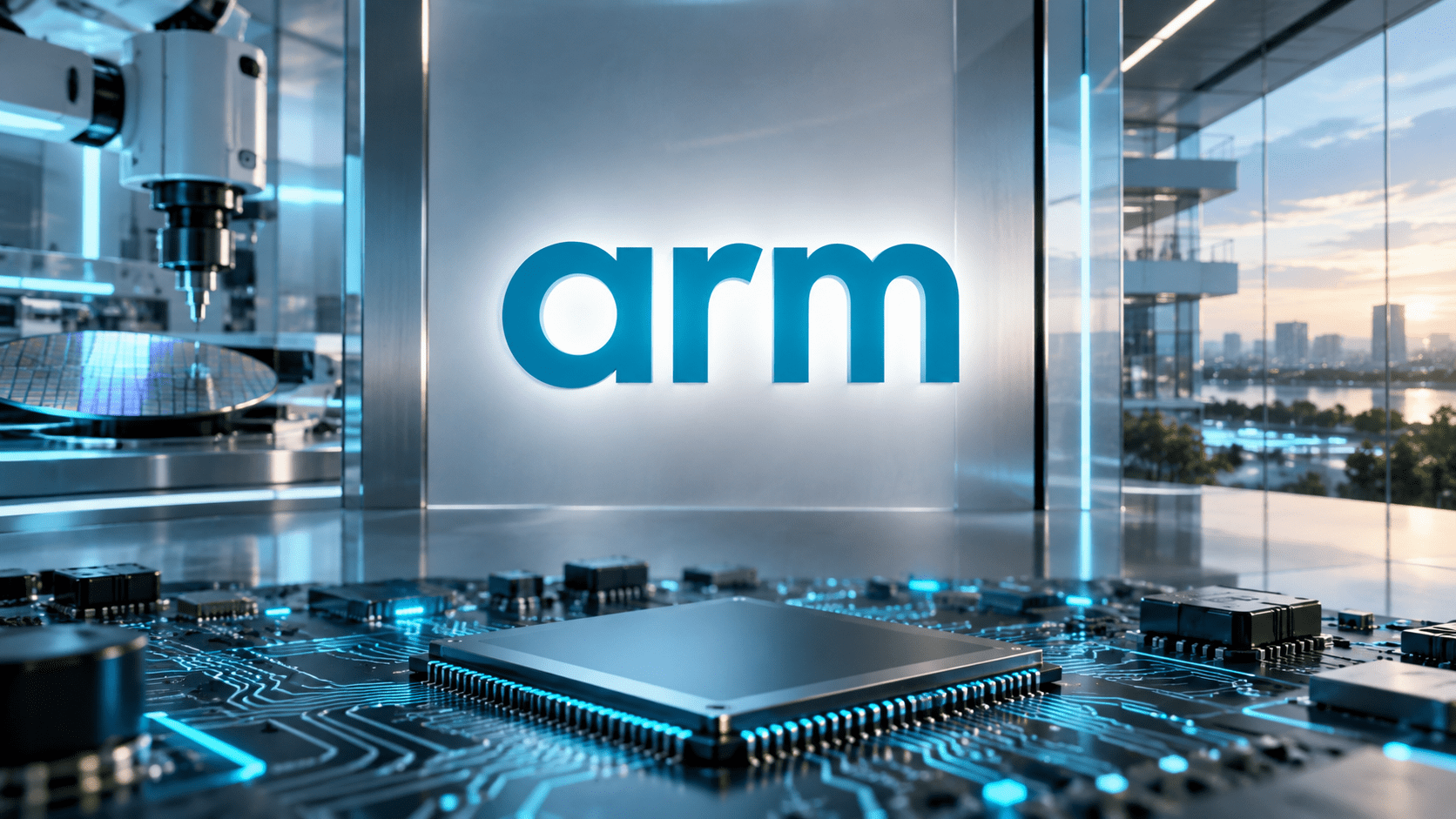
Arm stock surged approximately 17% on Monday, September 21, 2026, closing at $322.35 as renewed enthusiasm for artificial intelligence infrastructure triggered a powerful rally across the semiconductor sector. Arm Holdings (NASDAQ: ARM) gained $46.74 during the session, joining Advanced Micro Devices, Intel, and other major chip companies in a broad technology rebound that pushed the Nasdaq Composite to a record closing high. The rally comes as investors increasingly recognize the importance of energy-efficient processors in supporting a new generation of AI applications, creating opportunities for a company whose technology already powers billions of devices worldwide.
The latest advance reflects a significant shift in how investors view Arm’s role in the artificial intelligence industry. Historically associated with smartphone processors, the British semiconductor designer has expanded its presence in data centers, cloud computing, automotive technology, and advanced AI infrastructure. The growing popularity of AI agents capable of performing complex tasks has brought renewed attention to the central processing units required to support these applications, strengthening expectations for companies developing the technologies behind next-generation computing systems.
However, the extraordinary increase in Arm’s share price raises an important question about its valuation. With investors assigning greater value to its expanding AI opportunities, the company’s future financial performance will need to demonstrate that demand for its processor technology can translate into sustained revenue and earnings growth. The next phase of Arm’s development will depend on how effectively it converts its established licensing and royalty business into a broader commercial platform capable of benefiting from the global expansion of artificial intelligence.
Arm Stock’s 17% Rally Reveals a Major Shift in AI Investment
Arm’s September 21 advance came during a particularly strong session for semiconductor companies, with investors returning to businesses supplying the computing infrastructure required for artificial intelligence. AMD climbed approximately 10% and crossed the $1 trillion market capitalization threshold, while Intel gained roughly 12% as expectations for stronger server processor demand helped drive its recovery. The PHLX Semiconductor Index advanced approximately 4.3%, demonstrating that the buying extended across the wider chip industry rather than remaining concentrated in a single company.
The rally also reflected improving conditions in broader financial markets. Oil prices declined during Monday’s session, while U.S. Treasury yields retreated, helping ease some of the concerns surrounding inflation and borrowing costs that had weighed on technology stocks. The Nasdaq Composite gained approximately 2.3%, supported by advances across semiconductor manufacturers, artificial intelligence companies, and other technology businesses.
Related articles




Yet Arm’s performance stood out even against that favorable market backdrop. Its double-digit advance reflected growing investor interest in the company’s exposure to an increasingly important component of AI infrastructure: the central processing unit. Although graphics processors have dominated discussions about artificial intelligence investment, conventional CPUs remain essential to data-center operations, particularly as AI applications evolve beyond model training toward services that perform continuous tasks for users.
That distinction is becoming increasingly relevant as technology companies develop AI agents capable of coordinating applications, managing information, and completing complex workflows. These systems require substantial computing resources, creating opportunities for processor manufacturers and architecture developers positioned to support the expanding infrastructure.
Meta’s AI Breakthrough Could Create a New Growth Opportunity for Arm
One of the developments attracting attention across the semiconductor industry is the growing popularity of Meta Platforms‘ Muse AI assistant. The application has gained substantial consumer interest since its introduction, encouraging investors to reassess the computing requirements associated with increasingly sophisticated artificial intelligence services.
Unlike traditional chatbots that primarily respond to individual questions, AI agents are designed to perform sequences of tasks, interact with applications, and process information continuously. As these systems become more widely deployed, they could increase demand for the processors responsible for coordinating computing workloads alongside the specialized accelerators used to execute demanding AI calculations.
For Arm, the commercial significance lies in its processor architecture, which is widely used in energy-efficient computing systems and increasingly deployed within data centers. The company’s designs provide a technological foundation for processors developed by major semiconductor manufacturers and cloud computing providers, allowing Arm to participate in different segments of the computing market through its licensing and royalty business.
The growing popularity of AI agents has therefore introduced another potential source of demand for Arm-based technology. However, consumer enthusiasm for individual AI applications does not automatically guarantee a corresponding increase in Arm’s revenue. The financial benefits will depend on the processors selected by data-center operators, the volume of Arm-based chips deployed, and the licensing and royalty arrangements associated with those products.
The company’s latest financial results provide evidence that its expansion into data-center computing is already generating measurable commercial progress.
Arm’s Data-Center Royalty Revenue Doubles as Its Business Expands Beyond Smartphones
Arm’s fiscal first-quarter 2027 results demonstrate how the company’s business has evolved as artificial intelligence becomes increasingly important across multiple computing markets. For the quarter ended June 30, 2026, Arm reported revenue of $1.29 billion, representing a 22% increase from the comparable period a year earlier. Royalty revenue rose 22% to $715 million, while licensing revenue increased 23% to $574 million, establishing record first-quarter results across both revenue categories.
The most significant development was the continued expansion of the company’s data-center business, where royalty revenue more than doubled year over year. This performance reflects growing adoption of Arm-based processors in cloud computing and AI infrastructure, supporting the company’s efforts to establish a larger presence in markets historically dominated by other processor architectures.
Arm’s revenue model makes these developments particularly important. Rather than manufacturing the majority of the chips that incorporate its technology, the company licenses its processor designs and intellectual property to semiconductor manufacturers and technology businesses. It then generates royalty revenue when eligible chips incorporating its technology are shipped.
As more companies deploy Arm-based processors across data centers and other computing applications, the company can benefit from additional licensing opportunities and recurring royalty payments. However, the financial contribution depends on shipment volumes, product specifications, contractual terms, and the adoption of newer technologies that may generate higher royalty rates.
The latest results suggest that demand for Arm’s technology is expanding beyond its established smartphone business, although the pace of future growth will depend on continued customer investment and the commercial performance of the products incorporating its designs.
Arm’s New AI Processor Could Transform Its Revenue Model
Arm’s ambitions extend beyond licensing semiconductor designs to other manufacturers. In March 2026, the company introduced its Arm AGI CPU, marking an important expansion into the development and commercialization of complete processor products designed for artificial intelligence infrastructure.
The initiative represents a significant change in Arm’s business strategy. By developing its own AI-focused processors, the company is seeking to capture additional value from the technology it creates rather than relying exclusively on licensing agreements and royalties generated by third-party manufacturers.
During its July earnings announcement, Arm disclosed that customer demand for its AGI CPU had exceeded $2 billion across fiscal 2027 and fiscal 2028. The company also confirmed that initial products had been delivered to multiple customers and that it had secured sufficient manufacturing capacity to support the $1 billion commercial opportunity outlined in the preceding quarter.
More recently, Chief Executive Rene Haas expressed increased confidence in the company’s ability to achieve its $2 billion AI chip sales target, although manufacturing capacity remains an important consideration as demand expands.
The commercial opportunity could become substantial if Arm successfully establishes its processor products within the growing market for AI infrastructure. However, developing and selling complete chips introduces financial and operational requirements that differ from the company’s traditional intellectual property business.
Manufacturing arrangements, production capacity, inventory management, product development expenses, and customer support will become increasingly relevant as Arm expands its activities. Investors will therefore need to evaluate whether the additional revenue opportunities associated with complete processor products can generate sufficient profitability to justify the investment required.
Nvidia, AMD and Intel Face a Changing Competitive Landscape
Arm’s expansion comes as the semiconductor industry experiences substantial changes in the technologies used to build data centers. Nvidia continues to dominate much of the market for advanced AI accelerators, while AMD is expanding its Instinct GPU and EPYC server processor businesses. Intel remains an important supplier of traditional server CPUs and is pursuing opportunities associated with growing demand for computing infrastructure.
Arm occupies a different position because its processor architecture can be incorporated into products developed by other semiconductor companies and major cloud computing providers. This allows the company to participate in multiple parts of the computing industry without necessarily competing directly with every business using its technology.
However, the introduction of Arm’s own AI-focused processors creates additional competitive considerations. As the company expands beyond licensing intellectual property, it may increasingly compete for commercial opportunities with manufacturers that have historically relied on its architecture.
The broader market is also changing as companies such as Amazon and other major cloud providers develop custom processors designed around their specific computing requirements. These investments can create opportunities for Arm when customers adopt its technology, but they also increase the importance of maintaining strong commercial relationships across an increasingly complex semiconductor ecosystem.
For investors, the central question is whether Arm can continue expanding its licensing and royalty business while successfully developing new revenue streams through its own processor products.
Arm’s Valuation Creates a New Challenge After Its Extraordinary Rally
Arm’s September 21 closing price of $322.35 reflects substantial expectations for the company’s future participation in artificial intelligence infrastructure. The stock has experienced significant appreciation during 2026, supported by growing investor interest in data-center processors and the company’s expanding commercial opportunities.
However, rising share prices also increase the importance of future financial performance. Arm generated $4.92 billion in revenue during fiscal 2026, while its latest quarterly results demonstrated continued double-digit growth. Investors must assess those figures against a valuation that increasingly reflects expectations for substantial expansion over the coming years.
The company’s first-quarter results also highlight the importance of distinguishing between different measures of profitability. Arm reported adjusted operating income of $531 million, representing a margin of 41.2%, while GAAP operating income reached $91 million, equivalent to a margin of 7.1%. The difference demonstrates why shareholders must examine the effects of stock-based compensation and other adjustments when evaluating the company’s financial performance.
As Arm increases investment in complete processor products, its operating expenses and capital requirements could evolve alongside its revenue opportunities. The company’s ability to maintain attractive profitability while developing new commercial activities will therefore remain an important consideration.
A substantial increase in AI processor sales could contribute to revenue growth, but investors will also need to examine production costs, operating margins, and cash generation to understand the financial value created by that expansion.
Arm Stock’s Next Test Will Reveal Whether the AI Rally Has Financial Support
Arm enters the final weeks of September with renewed investor enthusiasm, expanding demand for its data-center technology, and growing commercial opportunities associated with its AI processor business. The company’s latest financial results demonstrate continued growth in licensing and royalty revenue, while its AGI CPU initiative introduces a potentially significant new source of sales.
Attention will now turn toward Arm’s next quarterly earnings report, tentatively scheduled for November 4, 2026. Investors will be looking for updated information about data-center royalty growth, demand for the AGI CPU, manufacturing capacity, and the financial contribution of its expanding processor business.
The broader semiconductor environment will also remain important. Continued investment in AI infrastructure could support demand for Arm-based computing systems, while changes in cloud spending, manufacturing availability, and competitive conditions could influence the pace of adoption.
For Arm shareholders, Monday’s 17% rally reflects growing expectations that the company’s technology will play an increasingly important role in the next generation of artificial intelligence infrastructure. The challenge is to demonstrate that this expanding role can deliver sustainable financial growth.
Arm has already established a substantial presence in smartphones and is gaining ground in data centers. Its next phase involves turning that technological position into a larger commercial business as AI computing becomes increasingly widespread.
The market has responded enthusiastically to that opportunity. Arm’s upcoming financial results will provide the next indication of how quickly the company can turn investor expectations into measurable revenue and earnings.
Disclaimer
This article is for informational purposes only and does not constitute financial or investment advice. Readers should conduct their own research or consult a qualified financial advisor before making investment decisions. This article was researched and drafted with the support of AI and checked against publicly available company disclosures and financial reporting. Final editorial review, fact-checking, and approval should be completed before publication.