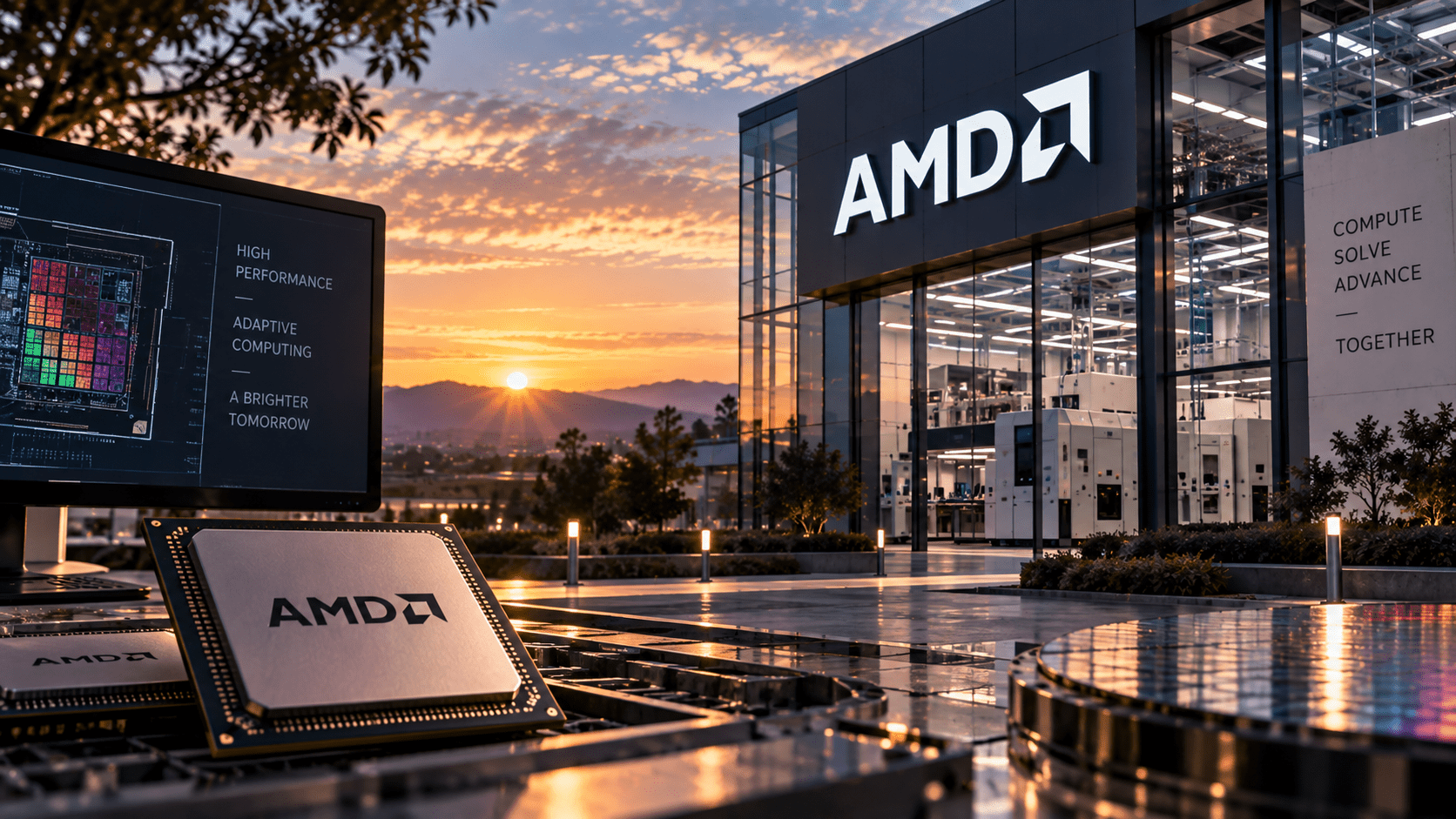
AMD stock surged to a record high on Monday, September 21, 2026, pushing Advanced Micro Devices (NASDAQ: AMD) past $1 trillion in market capitalization for the first time as investors returned to artificial intelligence and semiconductor companies. Shares climbed approximately 9.6% to $613.50 during the session, placing the chipmaker among a small group of technology companies that have reached the trillion-dollar milestone. The rally also lifted other semiconductor stocks, including Intel and Arm Holdings, as improving market sentiment and expectations for continued AI infrastructure investment helped drive a broader technology-sector recovery.
The milestone represents a remarkable transformation for a company that has spent years challenging Intel in computer processors while expanding its presence in the rapidly growing market for artificial intelligence accelerators. AMD has increasingly positioned itself as an alternative to Nvidia in AI computing, developing advanced graphics processors, server CPUs, and integrated systems designed to support the enormous computing requirements of modern data centers. Investors are now assigning substantially greater value to those opportunities, even as competition, export restrictions, and the financial demands of developing next-generation technology continue to shape the company’s outlook.
Yet crossing $1 trillion creates a new challenge for AMD shareholders. The company’s share price has advanced dramatically during 2026, while its latest financial results demonstrate substantial revenue growth and accelerating demand for data-center products. With expectations rising alongside its valuation, investors must now consider whether AMD’s expanding AI business can generate enough additional revenue and earnings to support its new position among the world’s most valuable semiconductor companies.
AMD’s $1 Trillion Breakthrough Signals a Major Shift in the AI Chip Market
AMD’s historic move above $1 trillion came during a strong session for semiconductor stocks, with investors increasing their exposure to companies supplying the processors, memory, networking equipment, and computing infrastructure required for artificial intelligence. The company’s shares reached a record high above $613, extending a substantial rally that has made AMD one of the most closely watched technology stocks of 2026. Its valuation has expanded dramatically as investors have become increasingly confident that the company can capture a larger share of spending on AI infrastructure while continuing to strengthen its position in traditional computing markets.
The significance of the milestone extends beyond the headline valuation. AMD has joined Nvidia, Broadcom, and Micron among U.S. semiconductor manufacturers that have reached the trillion-dollar threshold, illustrating how strongly financial markets have responded to the expansion of artificial intelligence infrastructure. Demand for AI computing has created opportunities across multiple parts of the semiconductor industry, from the processors used to train and operate sophisticated models to the networking and memory technologies required to connect increasingly powerful data centers.
Related articles



AMD’s position within that ecosystem has become particularly important because the company competes across several computing categories rather than relying exclusively on a single product line. Its EPYC server processors serve enterprise and cloud computing customers, while its Instinct accelerators are designed for demanding AI workloads. By combining those technologies with networking capabilities and complete computing systems, AMD is pursuing a broader role in the infrastructure supporting artificial intelligence development and deployment.
The company’s new valuation reflects expectations that this expansion will continue, but the financial results provide a more concrete way to measure how quickly AMD is turning those opportunities into revenue.
AMD’s Data-Center Revenue Doubles as AI Demand Transforms Its Business
AMD’s latest financial results provide important context for the enthusiasm surrounding its stock. In the second quarter of 2026, the company reported record revenue of $11.54 billion, representing a 50% increase from the $7.69 billion generated in the comparable period a year earlier. GAAP net income reached $2.30 billion, while diluted earnings increased to $1.38 per share from $0.54. On an adjusted basis, AMD reported earnings of $1.66 per share, demonstrating that the company’s expansion has been accompanied by substantial improvements in profitability.
The strongest contribution came from AMD’s data-center business, where quarterly revenue reached $6.7 billion, an increase of 107% year over year. The division accounted for approximately 58% of total company revenue, reflecting how dramatically AI and server computing have changed AMD’s business. Demand for EPYC processors and Instinct MI350 graphics processors supported the expansion, while data-center operating income reached $2.1 billion, compared with an operating loss of $155 million in the corresponding quarter of 2025.
These results provide evidence that AMD’s AI ambitions are translating into measurable financial performance rather than remaining dependent on expectations about future technology adoption. The company is generating substantial revenue from products used in cloud computing and AI infrastructure, while its broader processor portfolio continues supporting growth across additional markets. However, the comparison with the previous year also reflects the absence of an $800 million charge related to U.S. export restrictions that affected the corresponding 2025 quarter, making it important to distinguish recurring operational improvements from the effects of exceptional expenses.
For investors, the central question is whether AMD can maintain this momentum as its revenue base becomes considerably larger. Doubling a business generating several billion dollars in quarterly sales is substantially more demanding than expanding from a smaller starting point, particularly when customers must continue investing in expensive computing infrastructure and competitors are developing increasingly capable alternatives.
Nvidia’s Dominance Makes AMD’s Next Growth Phase More Complicated
Although AMD has achieved a historic valuation, Nvidia remains a major force in artificial intelligence computing, supported by its established GPU portfolio, software ecosystem, and relationships with leading data-center operators. The competition between the two companies extends beyond processor performance because customers purchasing AI infrastructure must also consider software compatibility, networking capabilities, operating efficiency, and the costs associated with deploying and maintaining large computing systems.
AMD has responded by expanding its ambitions beyond selling individual processors. Its strategy increasingly emphasizes complete AI computing platforms that combine accelerators, server CPUs, and supporting technologies, allowing customers to purchase integrated infrastructure rather than assemble every component separately. The approach could create opportunities for AMD to participate in a larger portion of data-center spending, although commercial success will depend on system performance, software support, manufacturing capacity, and customer adoption.
The competitive environment also extends into the traditional server CPU market, where AMD has strengthened its position against Intel. Growing demand for EPYC processors has supported the company’s data-center revenue, creating an additional source of growth alongside its AI accelerators. This combination gives AMD exposure to both conventional cloud computing and the expanding infrastructure required for AI training and inference, where models process information and generate responses after their initial development.
However, strong demand across the industry does not automatically guarantee that AMD will capture a consistent share of future spending. Nvidia continues developing new computing platforms, Intel is pursuing its own product and manufacturing strategies, and major technology companies are investing in custom processors designed for their internal workloads. AMD’s ability to sustain its current growth trajectory will therefore depend on continued product development and the commercial performance of its expanding portfolio.
The Broader Semiconductor Rally Reveals Why AMD Wasn’t Alone
AMD’s trillion-dollar milestone coincided with a substantial advance across semiconductor stocks, suggesting that Monday’s buying reflected renewed enthusiasm for the wider AI infrastructure market rather than developments affecting a single company. Intel shares climbed by double digits, while Arm Holdings also recorded a substantial gain as investors returned to businesses supplying computing technologies used in servers, data centers, and next-generation electronic devices. The PHLX Semiconductor Index advanced approximately 3%, highlighting the sector-wide nature of the rally.
The strength in semiconductor shares coincided with a broader stock-market recovery as declining oil prices and easing Treasury yields helped improve sentiment toward technology companies. The Nasdaq Composite gained more than 2% during the session, while the S&P 500 also advanced. Lower borrowing costs can influence how investors value businesses whose share prices reflect expectations of substantial future earnings, although the relationship between bond yields and individual technology stocks is neither automatic nor consistent.
The rally also reflects continued interest in the infrastructure required to support increasingly sophisticated AI applications. As technology companies develop advanced models and expand commercial services, demand extends beyond high-performance accelerators to include conventional processors, memory, networking equipment, and data storage. AMD’s diversified product portfolio places it within several of these markets, while the simultaneous advance across other semiconductor companies demonstrates that investors are assessing opportunities throughout the broader computing supply chain.
Nevertheless, industry-wide enthusiasm can increase expectations for companies whose financial performance may develop at different rates. The next earnings announcements across the semiconductor sector will provide additional evidence about how effectively suppliers are converting AI infrastructure investment into revenue, operating profit, and cash flow.
AMD’s $1 Trillion Valuation Raises the Stakes for Its Next Earnings Report
AMD’s latest earnings guidance provides an important benchmark for evaluating its new valuation. In August, the company projected third-quarter revenue of approximately $12.1 billion, plus or minus $300 million, representing expected year-over-year growth of approximately 50%. Management also forecast an adjusted gross margin of approximately 56%, reflecting continued expectations of strong demand for higher-value computing products.
The guidance followed a second quarter in which AMD generated $3.1 billion in adjusted operating income and reported a 27% adjusted operating margin. Continued growth in data-center revenue could support further earnings expansion, but investors will also be examining the company’s operating expenses, product mix, and ability to maintain profitability as it invests in new technologies.
The company’s valuation makes those considerations increasingly important. A $1 trillion market capitalization represents the combined market value of AMD’s outstanding equity, not its annual revenue or the amount of cash available to shareholders. At that valuation, investors are assigning substantial value to the company’s future earnings potential, creating sensitivity to changes in growth expectations.
An earnings report demonstrating continued expansion in AI processor demand could provide additional support for those expectations, while weaker revenue growth, lower margins, or cautious management commentary could prompt investors to reassess the valuation they are willing to assign to the business.
What Comes Next for AMD Stock After Its Historic Breakthrough?
AMD’s move above $1 trillion represents a defining moment in its transformation from a processor manufacturer challenging Intel into a major supplier of artificial intelligence and data-center infrastructure. Its latest financial results demonstrate that demand for EPYC processors and Instinct accelerators has translated into substantial revenue and earnings growth, while the broader semiconductor rally reflects continued investor interest in the technologies supporting AI development.
The next important developments will involve AMD’s third-quarter financial results, the deployment of its next-generation computing platforms, and the pace at which customers expand their AI infrastructure. Investors will also be monitoring competition from Nvidia, developments affecting semiconductor exports to China, and the broader economic conditions influencing technology-sector valuations.
For AMD shareholders, the trillion-dollar milestone changes the scale of expectations surrounding the company. Its growth is no longer being evaluated solely against the performance of traditional processor manufacturers, but increasingly against the enormous revenue and profitability opportunities associated with the global expansion of artificial intelligence.
Monday’s rally demonstrated how strongly investors have responded to AMD’s growing role in that market. The next test will be whether the company’s financial performance can continue expanding fast enough to support the valuation that Wall Street has now placed on its future.
Disclaimer
This article is for informational purposes only and does not constitute financial or investment advice. Readers should conduct their own research or consult a qualified financial advisor before making investment decisions. This article was researched and drafted with the support of AI and checked against the financial disclosures and reporting available at the time of writing. Final editorial review and approval should be completed before publication.