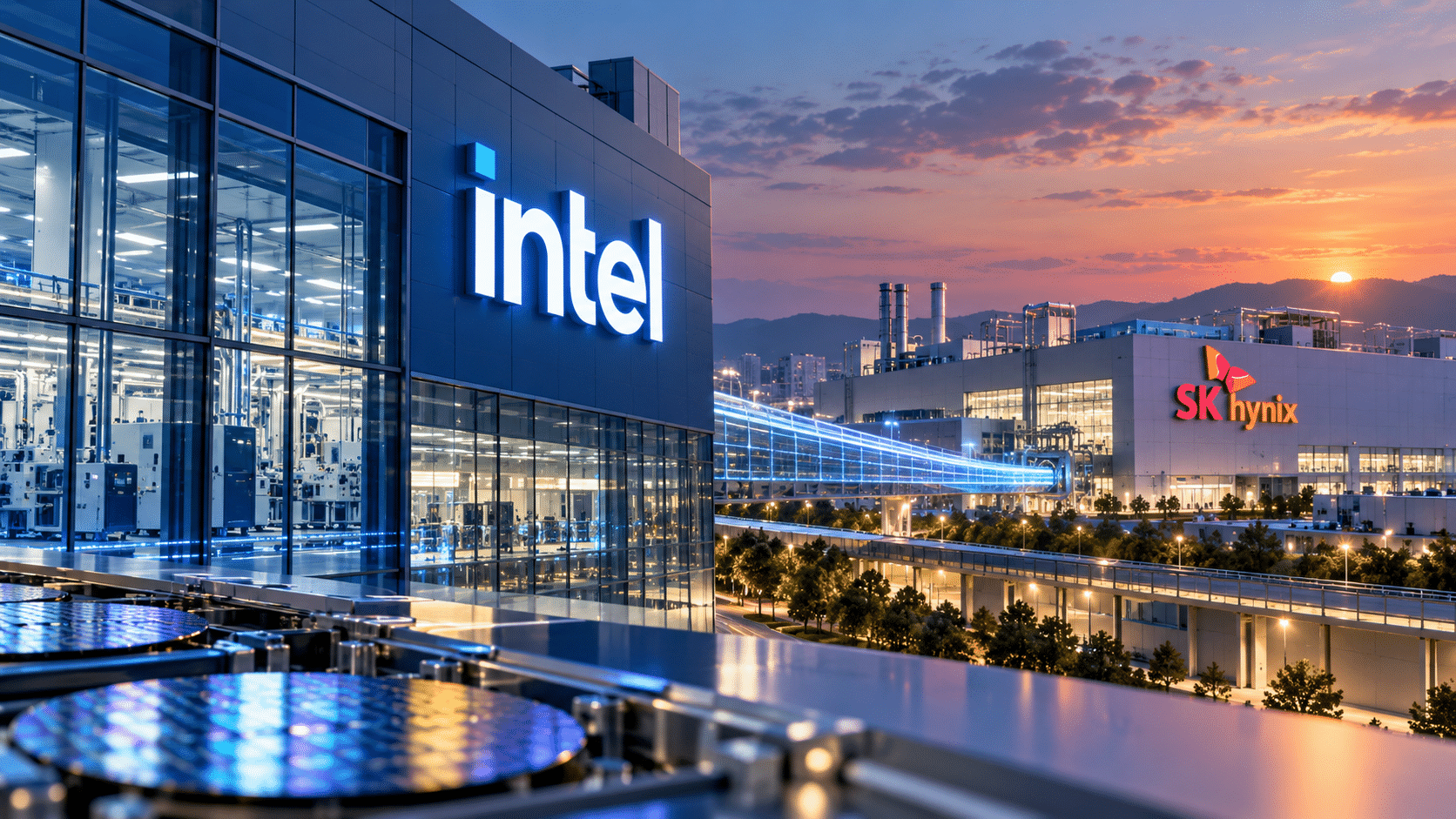
Intel (NASDAQ: INTC) has spent years trying to convince Wall Street that its enormous manufacturing investments will eventually pay off. Now, an unexpected potential partner could give that argument considerably more credibility. SK Hynix, one of the world’s largest memory-chip manufacturers and a crucial supplier of high-bandwidth memory for artificial intelligence systems, is in exploratory talks with Intel about producing memory chips in the United States for the first time. One possibility under discussion would involve SK Hynix leasing part of Intel’s long-planned Ohio manufacturing complex; another could involve a joint venture between SK Hynix, Intel and major cloud companies eager to secure memory supplies.
Nothing has been signed. SK Hynix explicitly said that no specific plans or arrangements have been finalized, and no decision has been made regarding either of the scenarios reported. That distinction matters because Intel stock initially jumped as much as 5% in premarket trading when news of the discussions emerged before paring some of those gains after SK Hynix clarified the preliminary nature of the talks.
Yet the market’s enthusiasm was understandable. Intel’s biggest strategic problem has not simply been whether it can manufacture advanced semiconductors. It has been whether the company can attract enough outside demand to justify the tens of billions of dollars required to maintain leading-edge fabrication facilities. Intel itself has warned that it has not yet secured a significant external foundry customer for its advanced nodes and could reconsider future investments if that situation does not change.
An SK Hynix partnership would not automatically solve that problem, particularly because memory manufacturing is different from winning a major logic customer for Intel’s 14A process. But it could accomplish something almost as important: put more of Intel’s expensive American manufacturing footprint to productive use while positioning the company at the center of one of the AI boom’s most severe supply constraints.
Ohio Problem Could Suddenly Become an Opportunity
Intel’s Ohio semiconductor project was originally supposed to symbolize the rebirth of American advanced chip manufacturing. Instead, repeated delays and changing investment plans have turned the site into a reminder of just how expensive Intel’s turnaround has become.
Related articles





The company has slowed construction of its new leading-edge Ohio facilities as management becomes more disciplined about capital spending. Intel’s own filings make the reasoning clear: semiconductor manufacturing requires enormous upfront investment, and those investments can take years to produce returns. The company has therefore tied future capacity expansion more closely to demonstrated customer demand rather than simply building factories and hoping customers eventually arrive.
That is why the SK Hynix discussions could be strategically significant. Reuters reported that one potential arrangement would allow the South Korean company to lease part of Intel’s Ohio complex to manufacture memory chips. Another possibility could bring Intel, SK Hynix and major cloud-computing companies together in a joint venture designed to secure memory supplies. The discussions remain exploratory, and the specific type of memory that might be produced has not been determined.
For Intel, however, the appeal is obvious. Leasing space or participating in a joint venture could reduce some of the financial burden associated with Ohio while giving the site a commercially important role in the rapidly expanding AI supply chain.
It would also represent a dramatic shift in how investors should think about Intel’s manufacturing footprint. Instead of viewing excess fab capacity purely as a financial liability, Intel could potentially use that infrastructure to attract global semiconductor companies seeking American production.
And right now, few semiconductor markets are more strategically valuable than memory.
AI Has Turned Memory Chips Into One of the Industry’s Biggest Bottlenecks
The timing of the discussions is not accidental. Artificial intelligence has created extraordinary demand not only for GPUs from Nvidia and other accelerator manufacturers, but also for the memory chips required to keep those processors supplied with data.
High-bandwidth memory, or HBM, has become particularly important because modern AI accelerators require enormous quantities of data to move rapidly between memory and processing units. SK Hynix has emerged as one of the major beneficiaries of that shift, becoming a leading HBM supplier as the AI infrastructure boom strains global semiconductor capacity.
The company itself acknowledged the broader shortage during its latest earnings call. Management said industry-wide constraints across wafers, memory and substrates remained the dominant challenge facing customers attempting to expand AI infrastructure.
That environment makes additional U.S. memory capacity potentially valuable to both chip companies and cloud providers. Hyperscalers are committing extraordinary amounts of money to AI data centers, and securing access to critical components has become strategically important as infrastructure expansion accelerates.
Reuters reported that major cloud companies interested in locking in memory supply could potentially participate in an Intel-SK Hynix venture. Such an arrangement could give the project something Intel desperately wants for its broader manufacturing strategy: committed customers before enormous amounts of additional capital are deployed.
There is still no confirmation that HBM itself would be manufactured at Intel’s Ohio site, and investors should not assume that from the reports. But even conventional DRAM production could place Intel’s American facilities directly inside a memory market whose importance has risen sharply because of AI.
The Deal Means Returning to Its Old Memory Business
There is a historical irony to the discussions. Intel originally built its business around memory chips before famously abandoning DRAM manufacturing decades ago and focusing its resources on microprocessors. That decision helped create the Intel that eventually dominated the PC processor industry.
A partnership with SK Hynix would not necessarily represent a reversal of that strategy.
The company would not need to develop its own competing memory products or rebuild a traditional Intel-branded DRAM business. Instead, the company could monetize manufacturing infrastructure by providing facilities or participating in a joint venture with an established memory specialist.
That distinction is important for investors because the economics could be very different. Rather than taking on the full technological and market risk of competing directly with SK Hynix, Samsung and Micron, Intel could potentially benefit from increased utilization of its U.S. manufacturing assets.
The market immediately recognized that possibility. Intel shares initially rose as much as 5% following Reuters’ report, while SK Hynix finished the session in South Korea 4.1% higher. Intel’s gain moderated after SK Hynix emphasized that nothing had been finalized.
The reaction showed how hungry investors are for evidence that Intel’s massive manufacturing footprint can attract commercially meaningful partners.
But that still leaves the company’s much bigger foundry question unanswered.
Foundry Still Needs the Customer Wall Street Has Been Waiting For
The company’s turnaround ultimately depends on more than filling unused factory space. CEO Lip-Bu Tan is trying to establish Intel Foundry as a credible alternative to Taiwan Semiconductor Manufacturing Company for advanced chip manufacturing, particularly as governments and technology companies seek more geographically diversified supply chains.
Intel has made measurable technical progress. The company said during its second-quarter earnings call that output on its 18A process increased meaningfully, yields were tracking ahead of expectations and multiple products were ramping on the node. Intel also began risk production of 18A-P, an enhanced version designed partly to appeal to external customers.
Meanwhile, Intel’s next-generation 14A process is approaching another important milestone. Management said its 0.9 process design kit remained on track for October, with risk production targeted for the second half of 2027 and committed volume production expected in 2028. CEO Lip-Bu Tan said external customer engagement has been encouraging as potential customers evaluate the technology.
Intel and ASML also announced this month that more than one million wafers had been processed using High-NA EUV technology across certification, research, development and selected production activities. Intel is already using High-NA on selected layers of some Panther Lake processors, giving the company valuable experience with a lithography technology expected to become increasingly important for future advanced nodes.
Those are important technical achievements, but Wall Street is still waiting for something more tangible: a major outside customer committing significant production volume to Intel’s advanced foundry nodes.
An SK Hynix memory arrangement would be commercially useful, but it should not be confused with such a win. SK Hynix leasing factory space would not prove that Intel can manufacture advanced logic chips for Nvidia, AMD, Apple or another leading semiconductor designer.
That remains the much larger prize.
Turnaround Is Already Getting Help From the AI Boom
Even without a major external foundry breakthrough, Intel’s underlying business has begun benefiting from the extraordinary investment pouring into AI infrastructure.
After Intel’s second-quarter results in July, the company forecast stronger-than-expected third-quarter revenue and increased its planned 2026 capital expenditures from $18 billion to $20 billion. Reuters reported that demand for Intel’s server CPUs was outpacing production as data-center operators continued expanding AI infrastructure. Intel shares had more than doubled during 2026 by that point, reflecting renewed investor optimism about the turnaround.
That development is important because Nvidia’s dominance in AI accelerators does not eliminate the need for traditional processors. AI servers still require CPUs to manage workloads, coordinate systems and support the enormous computing environments surrounding GPUs and specialized accelerators.
Intel therefore does not need to defeat Nvidia in GPUs to benefit from the AI investment cycle. Stronger server CPU demand, improving manufacturing yields and greater utilization of its factories could all contribute to the turnaround.
The SK Hynix discussions potentially add another layer. AI demand is simultaneously tightening supply across processors, wafers, memory and packaging, creating opportunities for manufacturing assets that only a few years ago appeared dangerously underutilized.
Washington Would Have Plenty to Like About an Intel-SK Hynix Partnership
There is also a geopolitical dimension to the talks.
The United States has spent years trying to reduce its dependence on Asian semiconductor manufacturing, particularly for technologies considered strategically important to AI, defense and advanced computing. A major memory producer establishing U.S. manufacturing for the first time would therefore align closely with Washington’s effort to expand domestic semiconductor capacity.
Reuters reported that the Trump administration has been pressing chipmakers to increase American production as AI investment creates acute demand for memory. Intel already occupies a unique position in that strategy because it remains the only major American company simultaneously designing advanced processors and operating leading-edge logic manufacturing facilities in the United States.
The U.S. government also holds a 9.9% equity stake in Intel following an $8.9 billion transaction involving the Commerce Department, further tying the company’s fortunes to America’s semiconductor industrial strategy.
But Washington’s enthusiasm could collide with concerns in Seoul.
South Korea considers advanced memory technology strategically important, and Reuters reported that government opposition could become one of the largest obstacles to a deal. Moving sensitive manufacturing technology to the United States could raise concerns about weakening South Korea’s domestic semiconductor ecosystem.
SK Hynix has already committed to a U.S. presence through an advanced packaging facility in Indiana. Full-scale memory manufacturing, however, would represent a substantially larger strategic shift.
That means any eventual agreement would need to make economic sense for the companies while also navigating competing national industrial priorities.
The Biggest Risk Is That Investors Are Getting Ahead of the Deal
For Intel shareholders, the most important fact remains the simplest one: there is no deal yet.
SK Hynix said it is exploring various options to strengthen its global competitiveness but stressed that nothing has been finalized regarding cooperation with Intel or memory-chip production in the United States. No decision has been made about leasing Intel’s Ohio facilities or creating a joint venture.
That leaves substantial uncertainty around what an agreement might eventually look like, how much capital each company would contribute, what products would be manufactured, when production could begin and how profitable the arrangement might become.
The economics of American semiconductor manufacturing are another potential obstacle. Building and operating fabs in the United States can be more expensive than doing so in established Asian manufacturing hubs. Any project would therefore need sufficient customer commitments, government support or strategic benefits to compensate for those higher costs.
Intel’s stock performance adds another layer of risk. Shares have already staged a dramatic recovery in 2026 as investors price in improving CPU demand and greater confidence in the company’s manufacturing roadmap. That means expectations are no longer as depressed as they were at the beginning of the turnaround.
A partnership announcement could reinforce the bullish narrative, but failed negotiations could remind investors how much of Intel’s long-term foundry thesis still depends on customers that have not yet committed.
What Comes Next for Stock Could Be Much Bigger
The SK Hynix discussions matter because they offer a glimpse of what Intel’s enormous American manufacturing footprint could become if the AI boom continues straining semiconductor supply.
A deal could help Intel put its delayed Ohio investment to work, reduce some of the financial pressure associated with expanding domestic manufacturing and place the company closer to the center of the booming memory market. If cloud companies participated as customers or investors, the arrangement could also provide exactly the kind of demand visibility Intel increasingly requires before committing additional capital.
Investors should watch whether the SK Hynix discussions progress beyond the exploratory stage, whether Intel announces major external customers for 18A-P or 14A, and whether improving yields translate into stronger foundry economics. The upcoming 14A process-design-kit milestone will be particularly important because potential customers need increasingly mature design tools before committing expensive future products to Intel’s manufacturing process.
Intel’s opportunity is becoming clearer. AI has created shortages across CPUs, memory, wafers and advanced semiconductor infrastructure just as governments and technology companies are searching for more U.S.-based manufacturing capacity. Few companies possess Intel’s combination of existing fabs, advanced process technology and political importance.
An SK Hynix partnership could be an important step in that direction, but it would not finish the turnaround. The announcement Wall Street is really waiting for may still be the one that proves Intel can turn its manufacturing comeback into a sustainable external foundry business.
Disclaimer
This article is for informational purposes only and does not constitute financial or investment advice. Readers should conduct their own research or consult a qualified financial advisor before making investment decisions. This article was researched and drafted with the support of AI, but was reviewed, fact-checked, and edited by the editorial team before publication.