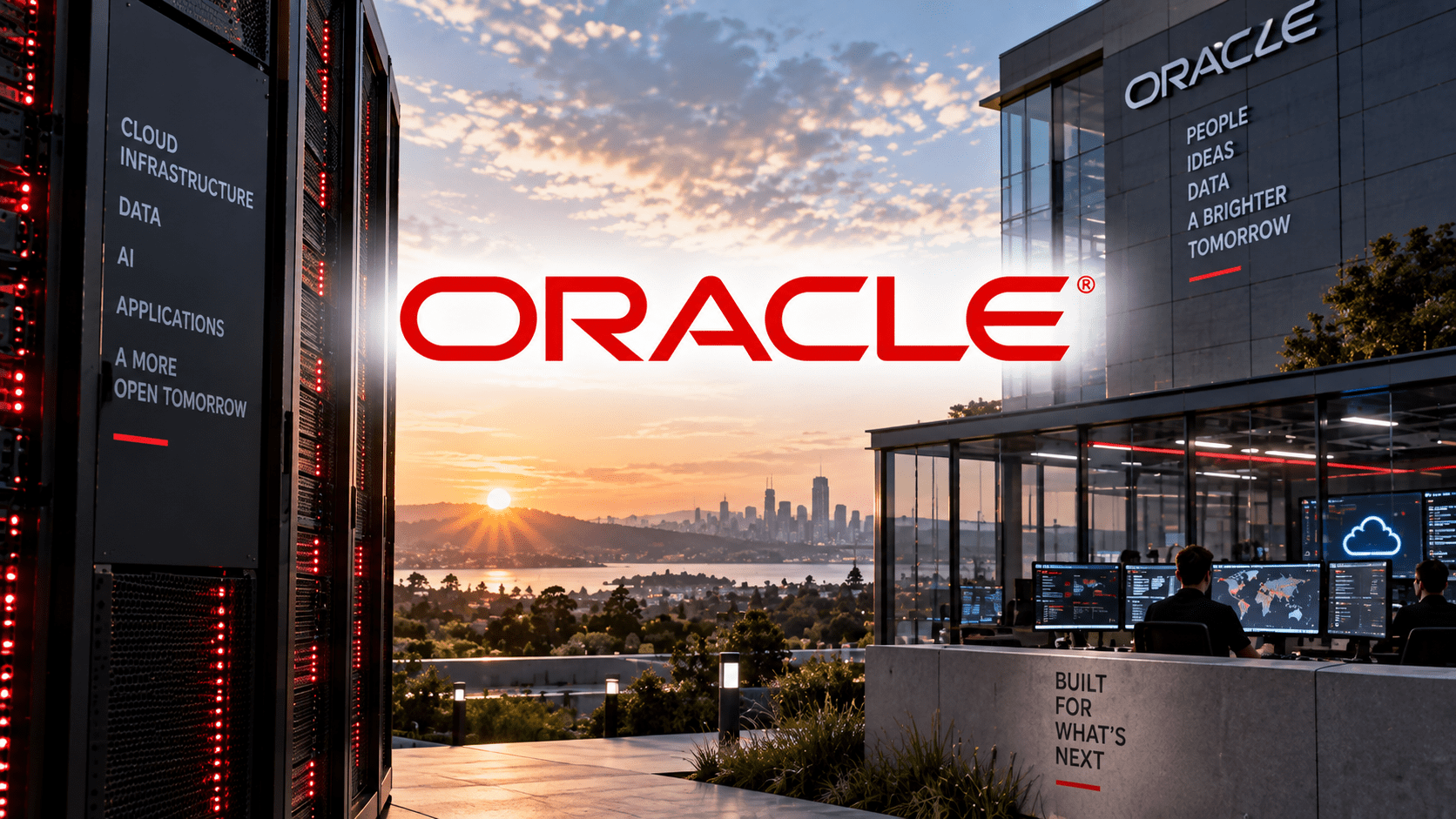
Oracle (NYSE: ORCL) has become one of Wall Street’s most controversial artificial intelligence trades. The company’s cloud infrastructure revenue is exploding, its contracted backlog has reached a staggering $664 billion and demand for AI computing capacity continues to exceed what Oracle can currently supply. Yet instead of celebrating that growth, investors are increasingly focused on something else: how much money Oracle must spend – and potentially borrow – to deliver it.
Those concerns intensified after complications emerged around Project Jupiter, a massive AI data-center campus being developed in New Mexico by a unit of Blue Owl Capital. Oracle issued a force majeure notice connected with potential delays at the project, sending a chill through the fast-growing market for AI infrastructure financing. Blue Owl said the notice did not alter the parties’ commitment to the project, while Oracle has said the development remains on schedule. Nevertheless, lenders and investors are scrutinizing the economics of AI data centers much more closely than they were only months ago.
The controversy has reopened a much larger debate surrounding Oracle stock. Bears see enormous capital expenditures, negative free cash flow and growing financial commitments. Bulls see something very different: a company racing to build infrastructure against hundreds of billions of dollars in contracted demand while its cloud business grows at triple-digit rates.
A recent Yahoo Finance discussion captured that divide. Panelists debated whether investors are overreacting to Oracle’s data-center problems, with the broader argument that major technological revolutions rarely unfold without financial excesses, infrastructure setbacks and periods of market panic.
That argument may prove important well beyond Oracle. If the company’s enormous spending eventually produces the revenue implied by its backlog, today’s financing concerns could look temporary. But if AI infrastructure returns disappoint, Oracle could instead become one of the clearest examples of how the AI boom pushed corporate spending too far.
Related articles





Oracle’s AI Business Is Growing at a Stunning Pace
The numbers behind Oracle’s AI expansion explain why management is willing to spend so aggressively. In its fiscal first quarter of 2027, Oracle reported total revenue of $19.3 billion, up 30% from the previous year. Cloud revenue jumped 62% to $11.6 billion, while Oracle Cloud Infrastructure revenue surged an extraordinary 121% to $7.4 billion.
Those results represent a dramatic transformation for a company that investors historically viewed primarily as a mature database and enterprise software provider. Oracle is increasingly positioning itself as one of the major suppliers of computing infrastructure required to train and operate artificial intelligence models, placing it more directly alongside cloud giants such as Microsoft, Amazon and Alphabet.
The demand appears substantial. Oracle said it booked more than $30 billion of additional AI cloud contracts during the quarter, pushing remaining performance obligations, or RPO, to $664 billion. Since the end of the previous quarter, the company had also delivered more than 300,000 GPUs to AI cloud customers and nearly tripled the amount of capacity delivered during the fourth quarter.
That $664 billion backlog is central to the bullish argument surrounding Oracle. It represents contracted future business rather than current revenue, and its eventual conversion will occur over multiple years. Nevertheless, its scale gives management greater visibility into future demand than a company building data centers purely on speculation.
The problem is that Oracle must build enormous amounts of infrastructure before much of that revenue can be recognized.
And that is where the story becomes considerably more complicated.
Oracle Is Spending Cash Almost as Quickly as AI Customers Arrive
Oracle’s transformation from a software-heavy business into a major AI infrastructure provider requires levels of capital investment that would have seemed almost unimaginable for the company several years ago.
During fiscal 2026, Oracle generated a record $32 billion in operating cash flow, an increase of 54%. Yet free cash flow was negative $23.7 billion because the company was spending so aggressively to expand its cloud infrastructure. Oracle raised $43 billion through debt financing and another $5 billion through equity financing during the year.
The pattern continued into fiscal 2027. Oracle generated a record $23 billion in operating cash flow during the first quarter, but free cash flow remained negative at approximately $5 billion as the company continued investing heavily in new capacity. It also completed a $20 billion at-the-market common stock offering as part of its broader capital investment program.
These figures explain why Wall Street’s attention has shifted from Oracle’s growth rate toward its balance sheet and capital requirements. The company is producing enormous amounts of cash from operations, but its AI ambitions require even greater amounts of investment.
Oracle has attempted to reduce that burden through the structure of its customer contracts. At the end of fiscal 2026, the company said $75 billion of hardware associated with major AI agreements was either funded through customer prepayments or supplied directly by customers. Management argued that these arrangements substantially reduce the amount of capital Oracle itself needs to raise to construct AI data centers.
That distinction is important. The headline size of Oracle’s infrastructure commitments does not necessarily translate dollar-for-dollar into debt Oracle must carry itself. Yet recent developments show that investors are increasingly uncomfortable with the complexity of the financing structures supporting the AI boom.
One $165 Billion Data-Center Project Suddenly Spooked Wall Street
The latest concern centers on Project Jupiter, an enormous data-center campus in New Mexico intended to provide computing infrastructure supporting OpenAI.
Oracle issued a force majeure notice related to the project after potential delays involving power availability raised concerns about whether the campus could open on schedule in 2028. Reuters reported that the move reverberated across the AI infrastructure financing market because investors are becoming increasingly sensitive to construction delays, power constraints and the enormous amount of debt required to fund new data centers.
Blue Owl has said the notice does not alter its commitment to the project. Nevertheless, financing associated with Project Jupiter has come under pressure. Reuters reported earlier in September that approximately $18 billion of loans connected with the development were trading below par at around 89 to 91 cents on the dollar amid concerns surrounding Oracle’s increasing debt burden, regulatory obstacles and difficulties syndicating the loans.
Oracle shares fell 3.3% on September 24 as the project concerns emerged. The reaction was significant because the controversy reached beyond a single construction delay. It raised questions about whether the enormous financing structures underpinning the AI infrastructure boom can withstand higher interest rates, construction problems and changing expectations about future computing demand.
Oracle’s problem, therefore, is not simply whether Project Jupiter eventually opens. Investors want to know whether projects of this scale can generate attractive returns after accounting for financing costs, power infrastructure, GPUs, construction and the risk that technology changes before those investments have fully paid for themselves.
“Every Technological Advancement Had Its Setbacks”
A Yahoo Finance discussion surrounding Oracle presented an important counterargument to the increasingly bearish narrative. Technological revolutions rarely develop smoothly. Railroads, telecommunications networks, the internet and cloud computing all required enormous upfront investment, and each experienced periods when financial markets questioned whether spending had gone too far.
AI infrastructure could follow a similar pattern.
The existence of excessive spending or failed projects would not necessarily mean artificial intelligence itself is a failed technology. Some infrastructure investments could produce poor returns while the broader technological transformation continues. That distinction matters because investors sometimes treat setbacks at individual companies as evidence that an entire investment cycle is collapsing.
Oracle’s operating performance provides evidence supporting the more optimistic interpretation. Cloud infrastructure revenue is not merely projected to grow at some distant point in the future; it already increased 121% in the latest quarter. Oracle’s overall cloud business grew 62%, while its contracted backlog reached $664 billion.
Those are substantial numbers. But they do not make financing risk disappear.
The key question is whether the cash generated from those contracts will ultimately justify the enormous infrastructure investments required to fulfill them. A rapidly growing business can still destroy shareholder value if its cost of expansion consistently exceeds the economic return generated by that expansion.
That is the calculation Wall Street is now attempting to make.
The Bigger Warning Is Coming From the Bond Market
Oracle is not the only company confronting this problem. The entire AI infrastructure ecosystem is becoming increasingly dependent on enormous amounts of external financing.
Reuters reported that corporate bond investors have become more selective toward AI-related borrowers as issuance accelerates. Hyperscaler debt issuance is projected to reach approximately $420 billion next year, around 60% higher than in 2026. Spreads on AI-related corporate bonds have widened to roughly 115 basis points compared with approximately 78 basis points for the broader corporate bond market.
Over the past year, Alphabet, Amazon, Meta, Microsoft and Oracle collectively issued approximately $220 billion in bonds as they expanded their AI infrastructure, according to a separate Reuters analysis. The enormous supply of new technology debt is beginning to distort traditional credit-market relationships and forcing companies to offer investors increasingly attractive terms.
That creates a potential feedback loop. If lenders become more cautious, financing costs rise. Higher financing costs make data centers more expensive. More expensive data centers require stronger economic returns from AI customers. If those returns fail to materialize quickly enough, investors could become even more reluctant to finance the next wave of construction.
Oracle sits directly in the middle of this debate because its transformation is particularly aggressive. It is simultaneously expanding computing capacity, financing enormous infrastructure projects and attempting to convert one of the technology industry’s largest backlogs into revenue.
Oracle’s $664 Billion Backlog Is Both the Opportunity and the Risk
Few numbers better capture the investment debate surrounding Oracle than its $664 billion in remaining performance obligations.
For optimists, the backlog represents extraordinary visibility into future demand. Oracle is not simply constructing AI infrastructure and hoping customers eventually arrive. It already has hundreds of billions of dollars in contracted obligations, while demand for AI training and inference capacity continues to exceed available supply, according to management.
For skeptics, however, the backlog also represents an enormous execution challenge. Oracle must deliver the infrastructure necessary to satisfy those contracts while controlling financing costs, securing sufficient electricity, installing hundreds of thousands of GPUs and managing projects across multiple jurisdictions.
The New Mexico controversy demonstrates how quickly problems outside the traditional software business can become financially significant. Power generation, pipelines, construction schedules and project financing now matter to Oracle investors in ways they never did when the company was primarily selling database licenses.
Oracle is effectively becoming a different type of company.
That transformation could create enormous value if demand materializes as expected. It also exposes shareholders to risks that Oracle historically did not need to manage at anything approaching the current scale.
Oracle Stock Has Become a Test of the Entire AI Boom
The debate surrounding Oracle stock is ultimately about something much larger than one company or one delayed data center.
The AI boom is entering a phase in which investors are beginning to demand evidence that enormous infrastructure spending can produce equally enormous economic returns. Building the computing capacity required for artificial intelligence has already consumed hundreds of billions of dollars, and borrowing requirements are expected to rise further.
Oracle represents perhaps one of the clearest tests of that thesis. Its cloud infrastructure business is growing at triple-digit rates, contracted demand has reached $664 billion and customers continue seeking more computing capacity than the company can currently provide. At the same time, Oracle is generating negative free cash flow, raising enormous amounts of capital and navigating increasingly complicated data-center projects.
The bullish argument is straightforward: Oracle is spending aggressively because it has an extraordinary opportunity in front of it, and temporary financing or construction problems are inevitable when infrastructure is being built at unprecedented speed.
The risk is equally clear. If AI demand slows, projects suffer further delays or financing becomes materially more expensive, the economics supporting this infrastructure expansion could deteriorate rapidly.
That is why Project Jupiter matters. It is not necessarily evidence that Oracle’s AI strategy is failing, but it is a reminder that the transition from software company to AI infrastructure giant comes with enormous financial and operational consequences.
Every major technological revolution may indeed experience setbacks. The question Oracle investors now have to answer is whether today’s problems are simply the cost of building the next computing revolution — or the first indication that Wall Street underestimated how expensive that revolution would become.
Disclaimer
This article is for informational purposes only and does not constitute financial or investment advice. Readers should conduct their own research or consult a qualified financial advisor before making investment decisions. This article was researched and drafted with the support of AI, but was reviewed, fact-checked, and edited by the editorial team before publication.