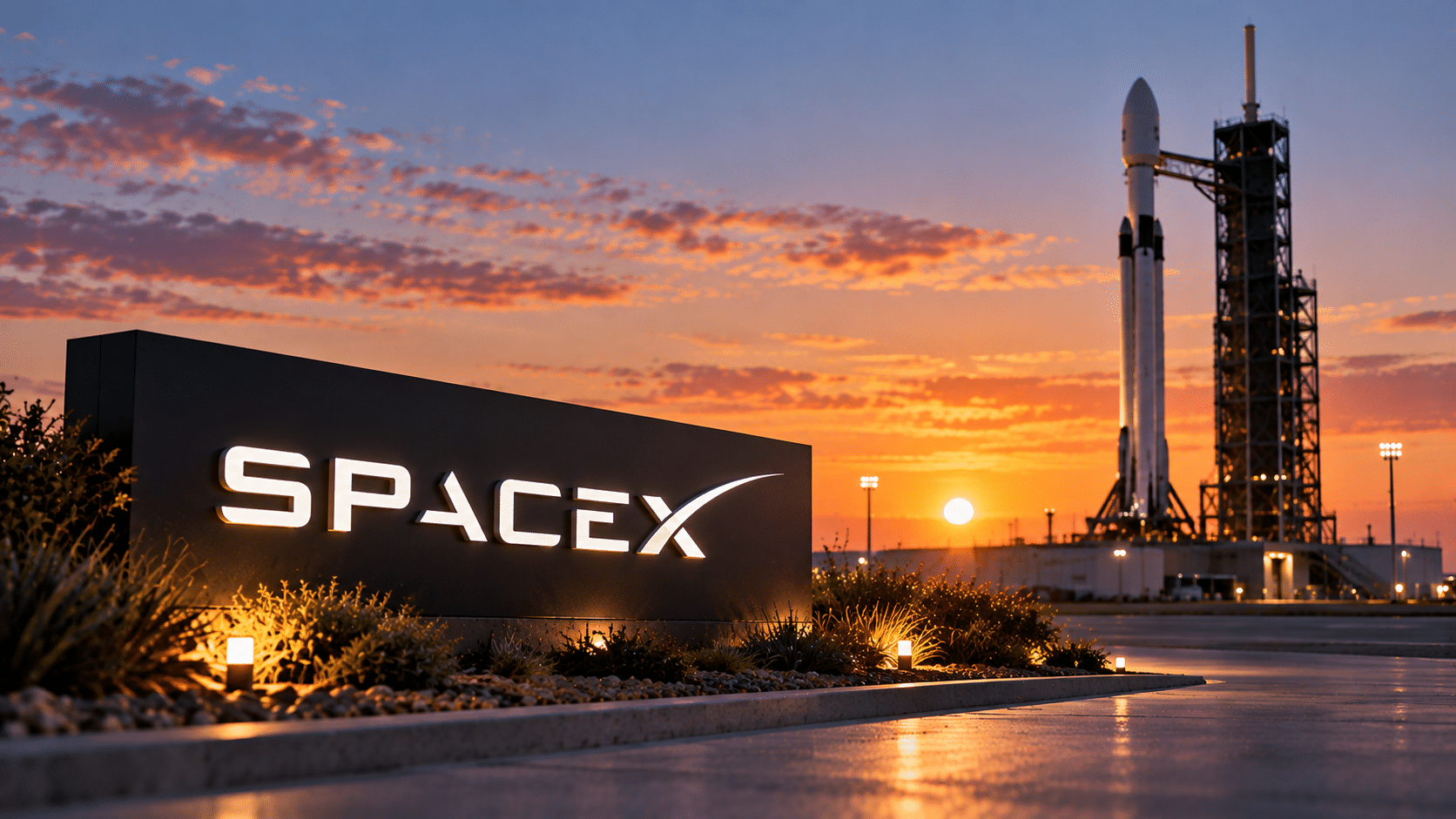
SpaceX (NASDAQ: SPCX) may be best known for rockets and Starlink, but Wall Street is increasingly focused on a very different part of Elon Musk’s sprawling technology empire: artificial intelligence. Evercore ISI says the rapid expansion of SpaceX’s Colossus data-center infrastructure could push the company’s 2027 revenue and EBITDA significantly above current expectations, potentially turning AI into another major earnings engine alongside its satellite and launch businesses.
The numbers behind that argument are enormous. According to Evercore, Musk recently indicated that Colossus 1 and Colossus 2 already have approximately 780,000 GPUs online, with SpaceX expecting at least two additional tranches of roughly 220,000 Nvidia GB300 GPUs before the end of 2026. A third tranche could potentially arrive if deployment progresses faster than expected. Evercore estimates that two additional installations would take computing capacity to roughly 2.3 gigawatts, while all three could push it toward 2.7 gigawatts. Wall Street’s current estimate is closer to 2.1 gigawatts.
That difference may sound technical, but the financial implications could be dramatic. Evercore estimates SpaceX’s AI Solutions & Infrastructure business could generate approximately $83 billion in 2027 revenue under its base assumptions, compared with a Wall Street consensus of roughly $47 billion. The firm argues that faster deployment could therefore create substantial upside to earnings before interest, taxes, depreciation and amortization, or EBITDA.
There is a catch, however. Building that capacity requires extraordinary amounts of capital before the corresponding revenue arrives. Evercore estimates SpaceX could spend approximately $53 billion on AI infrastructure during the second half of 2026 alone, roughly 70% above consensus expectations. That leaves investors confronting a familiar question in the AI boom: how much spending is justified today by profits that may not arrive until tomorrow?
Colossus Is Becoming Much Bigger Than Wall Street Expected
Evercore’s increasingly bullish outlook begins with the speed at which SpaceX is expanding Colossus. Based on Musk’s latest comments, the investment bank believes the company could exit 2026 with substantially more computing capacity than analysts previously modeled, giving it a much larger infrastructure base from which to generate revenue during 2027.
Related articles





The firm estimates that two additional 220,000-GPU tranches would increase capacity to approximately 2.3 gigawatts. If a third installation is completed, capacity could reach around 2.7 gigawatts. Either scenario would put SpaceX ahead of the roughly 2.1 gigawatts currently embedded in Wall Street estimates, while also moving the company closer to its longer-term ambition of reaching between 5 and 10 gigawatts by the end of 2027. Consensus expectations currently sit near 5.9 gigawatts.
That faster expansion matters because SpaceX has already demonstrated an ability to monetize available computing capacity. During the second quarter, the company said cloud-service agreements involving Colossus and Colossus 2 contributed approximately $1.6 billion of incremental AI infrastructure revenue. The AI segment also produced roughly $1.1 billion of adjusted EBITDA during the quarter, despite the enormous capital expenditures associated with expanding the infrastructure.
SpaceX ended the second quarter with approximately 1.4 gigawatts of nameplate computing capacity, up from 1 gigawatt during the first quarter and only 400 megawatts a year earlier. Management previously said it expected to finish 2026 with more than 2 gigawatts of capacity. Musk’s latest comments suggest the company may now move considerably beyond that target.
The key question for investors is therefore shifting. It is no longer simply whether SpaceX can build massive AI computing infrastructure. Increasingly, it is how quickly that infrastructure can begin producing revenue and profits.
Evercore Sees $83 Billion in AI Revenue
Evercore’s financial model illustrates why the latest capacity estimates are attracting so much attention. Assuming construction costs of approximately $40 per watt and a 50-50 split between internal and external computing usage, the firm estimates that unallocated capacity coming online during the second half of 2026 could generate roughly $29 billion of incremental annualized revenue.
Adding approximately $54 billion associated with existing computing agreements would take SpaceX’s 2027 AI Solutions & Infrastructure revenue to around $83 billion. That is roughly $36 billion above the $47 billion currently expected by Wall Street, representing a potentially enormous difference in the company’s earnings trajectory.
Importantly, this estimate does not require SpaceX to reach the upper end of its 5-to-10-gigawatt ambition by the end of 2027. Evercore’s argument is instead that the infrastructure SpaceX could have operating by the end of this year already provides substantial upside, assuming existing computing contracts remain in place and pricing remains healthy.
That last assumption deserves attention. AI computing economics depend on more than the number of GPUs installed. Utilization rates, electricity costs, financing expenses, hardware depreciation and pricing for computing capacity will all influence the profitability of Colossus. An $83 billion revenue opportunity would not automatically translate into proportionately higher profits if competition pushes prices lower or operating costs increase.
For now, however, Evercore believes the earnings opportunity is significant enough to maintain an Outperform rating and $230 price target on SpaceX. The firm initiated coverage earlier this year with an exceptionally bullish long-term outlook, projecting revenue and EBITDA compound annual growth rates of approximately 106% and 157%, respectively, through 2028.
The Catch: SpaceX May Spend $53 Billion in Just Six Months
The bullish 2027 forecast comes with an enormous near-term price tag. Evercore estimates that its $40-per-watt construction assumption implies approximately $53 billion of AI capital expenditure during the second half of 2026. That would be around 70% higher than current consensus expectations.
SpaceX has already demonstrated how capital-intensive the expansion can become. During the second quarter, total company capital expenditure reached approximately $18.4 billion, with roughly $15.8 billion directed toward AI computing infrastructure. The remainder funded Starship development, launch infrastructure, satellite manufacturing and the expansion of Starlink’s global ground network.
That spending creates what Evercore describes as a timing mismatch. SpaceX must purchase GPUs, secure electricity, construct facilities and install computing equipment before those assets can begin producing significant revenue. As a result, capital expenditures can surge months before the corresponding increase in EBITDA appears in the financial statements.
For investors focused on quarterly cash flow, that pattern could create uncomfortable periods in which spending accelerates faster than earnings. For investors taking a longer view into 2027, Evercore argues the same dynamic could create an opportunity because the infrastructure being built today provides the capacity required for substantially higher revenue tomorrow.
SpaceX appears financially positioned to absorb unusually large investments. The company ended the second quarter with approximately $100 billion in cash, cash equivalents and marketable securities following its record-setting public offering earlier this year. Its June IPO raised $75 billion at $135 per share and valued the company at approximately $1.77 trillion.
That enormous capital base gives SpaceX something many smaller AI infrastructure companies lack: the ability to invest simultaneously across multiple capital-intensive businesses without immediately depending on additional financing.
SpaceX Is No Longer Just a Rocket and Satellite Company
The rapid expansion of Colossus is also changing the investment case for SpaceX itself. Historically, the company’s financial story centered primarily on two businesses: launching rockets and operating Starlink. Increasingly, investors must evaluate a third major operation built around artificial intelligence and computing infrastructure.
Starlink remains a formidable financial and strategic asset. According to SpaceX’s 2026 prospectus, the service had approximately 10.3 million subscribers as of March 31, more than double the roughly 5 million reported a year earlier. Its network included approximately 9,600 broadband and mobile satellites at that point, representing around 75% of active maneuverable satellites in orbit.
The next generation could expand that capacity dramatically. SpaceX said its V3 Starlink satellites are designed to provide approximately 1 terabit per second of downlink capacity per satellite, with Starship potentially carrying as many as 60 of them per launch. The company estimated that a single Starship mission deploying V3 satellites could deliver roughly 20 times the downlink capacity of a Falcon 9 launch.
That relationship between Starship, Starlink and AI infrastructure is increasingly central to the company’s strategy. SpaceX controls launch technology, operates one of the world’s largest satellite networks and is simultaneously constructing enormous terrestrial computing facilities. Each business requires extraordinary capital, but each can also reinforce the others through shared infrastructure, technology and financial resources.
The result is a company whose earnings increasingly depend on much more than the commercial launch market.
Starship Just Added Another Catalyst to the Story
The timing of Evercore’s bullish Colossus analysis coincides with another important milestone for SpaceX. On Monday, the company’s next-generation Starship reached orbit for the first time and deployed 26 Starlink satellites, marking a major step forward for a vehicle central to SpaceX’s long-term plans. An engine issue forced the company to shorten the mission, but reaching orbit and deploying satellites represented meaningful progress after years of development.
Starship matters financially because SpaceX needs substantially greater launch capacity to deploy its next generation of Starlink satellites efficiently. The company expects the larger V3 satellites to require Starship rather than Falcon 9, meaning progress on the rocket could directly influence the economics and expansion speed of its satellite network.
The vehicle is also central to NASA’s lunar ambitions and SpaceX’s longer-term plans for dramatically reducing launch costs. However, the program remains technically demanding, and Monday’s engine problem illustrates why investors should not assume that every development milestone will proceed smoothly.
For SpaceX shareholders, that creates an unusually broad collection of potential catalysts and risks. Progress at Starship can influence Starlink expansion, while the Colossus buildout can reshape the company’s earnings profile independently of its space operations.
Few public companies are attempting to scale three businesses of this complexity simultaneously.
SpaceX’s Valuation Leaves Little Room for Ordinary Growth
The potential upside identified by Evercore must also be viewed against SpaceX’s extraordinary valuation. The company priced its June IPO at $135 per share, raising approximately $75 billion and achieving an initial valuation of roughly $1.77 trillion — the largest U.S. public offering on record.
That valuation means investors are already pricing in substantial future growth. Before the IPO, SpaceX reported approximately $18.7 billion in fiscal 2025 revenue and $6.6 billion in adjusted EBITDA, according to Argus Research. Relative to the valuation placed on the company during its listing, those figures implied multiples far above those of most established technology and aerospace companies.
The Colossus opportunity helps explain why some analysts believe such a valuation can eventually be supported. If SpaceX’s AI business alone approaches Evercore’s $83 billion revenue estimate in 2027 while Starlink continues expanding and Starship improves launch economics, the company’s financial profile could look radically different within only a few years.
The opposite is also true. A valuation built around extraordinary growth leaves less room for delays, lower computing prices, weaker AI demand or execution problems across the company’s numerous capital-intensive projects.
That makes the speed of the Colossus ramp particularly important.
Colossus Could Become the Next Major SpaceX Earnings Engine
Evercore’s latest analysis suggests the market may still be underestimating how quickly artificial intelligence could reshape SpaceX’s financial results. If the company successfully installs at least two additional 220,000-GPU tranches before year-end, computing capacity could reach approximately 2.3 gigawatts, already exceeding current Wall Street assumptions. A third tranche could push capacity toward 2.7 gigawatts.
Under Evercore’s assumptions, that infrastructure could support approximately $83 billion of AI Solutions & Infrastructure revenue in 2027, compared with consensus expectations of around $47 billion. The potential difference is enormous, but realizing it will require tens of billions of dollars in near-term investment and continued strong demand for AI computing capacity.
That is the trade-off investors now face. SpaceX is spending at a pace that would be extraordinary for almost any other company, but it is also attempting to create multiple businesses capable of generating extraordinary amounts of revenue.
Starlink already provides a rapidly expanding global connectivity platform. Starship could fundamentally change the economics of deploying satellites and payloads into orbit. Now Colossus is emerging as a potentially massive AI infrastructure business in its own right.
Evercore’s thesis ultimately rests on timing: spending arrives first, while the revenue and EBITDA follow later. If that sequence plays out as expected, 2026’s enormous capital expenditures could become the foundation for a much larger earnings base in 2027.
For SpaceX stock, that makes the next several quarters particularly important. Investors will be watching not only how many GPUs the company installs, but whether those GPUs generate the revenue, margins and cash flow required to justify one of the most ambitious valuations in the market.
SpaceX has already convinced investors that reusable rockets and satellite broadband can become enormous businesses. Colossus now presents a different test: whether Elon Musk’s company can turn one of the world’s biggest AI infrastructure spending programs into its next great profit engine.
Disclaimer
This article is for informational purposes only and does not constitute financial or investment advice. Readers should conduct their own research or consult a qualified financial advisor before making investment decisions. This article was researched and drafted with the support of AI, but was reviewed, fact-checked, and edited by the editorial team before publication.