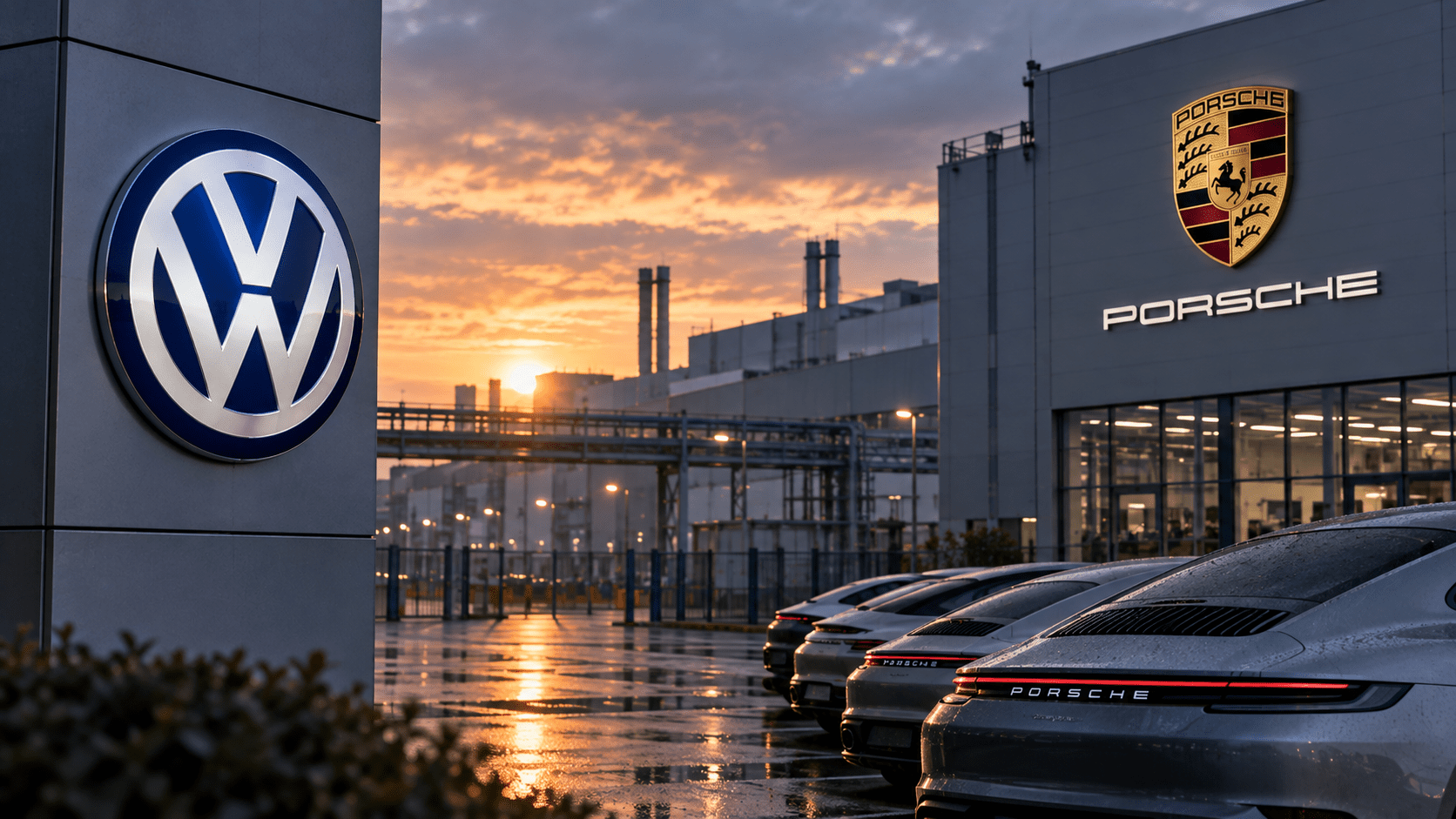
Porsche stock faces another turbulent chapter as Volkswagen reportedly pushes for approximately 4,100 additional job cuts at its struggling luxury sports car subsidiary, deepening a restructuring effort that could eliminate thousands more positions by 2035. The proposal, reported by German business newspaper Handelsblatt on September 19, comes just one day after Volkswagen slashed its full-year 2026 profit margin forecast from 4%–5.5% to no more than 1%, citing a deteriorating business environment, restructuring expenses, and a substantial impairment related to Porsche. The developments have intensified scrutiny of Porsche AG, Volkswagen Group, and Porsche Automobil Holding SE (OTC: POAHY), the Porsche-Piëch family’s investment holding company.
The reported workforce reduction would come on top of approximately 9,000 job cuts already covered by previous agreements at the Stuttgart-based sports car manufacturer. If implemented in full, the additional measures would bring the total number of positions targeted for elimination to approximately 13,100, highlighting the scale of the transformation facing a company once regarded as one of the automotive industry’s most profitable luxury brands. Volkswagen and Porsche have declined to comment on the newly reported proposal, which has not yet been formally approved by Porsche’s management and employee representatives.
For investors, the significance extends beyond the immediate impact of another round of layoffs. Porsche’s difficulties in China, the financial consequences of its electric vehicle strategy, and Volkswagen’s sharply reduced profitability expectations have raised questions about how quickly the German automotive group can stabilize its business. With restructuring costs mounting and competition intensifying across the global luxury vehicle market, the central question is whether another wave of cost reductions can restore Porsche’s financial performance without undermining the capabilities that made the brand successful.
Volkswagen’s Latest Porsche Restructuring Proposal Could Push Job Cuts Beyond 13,000
Volkswagen’s reported proposal calls for the elimination of approximately 4,100 additional positions at Porsche, according to Handelsblatt, which cited documents relating to the parent company’s broader restructuring plans. The proposed reductions are intended to address an estimated €700 million shortfall in overhead costs and would be implemented in addition to measures already negotiated between Porsche management and employee representatives. Although the recommendation reflects mounting financial pressure within Volkswagen Group, the parent company’s supervisory board cannot independently impose the proposed reductions on Porsche, meaning further discussions would be required before any additional workforce measures could take effect.
The latest proposal follows a significant restructuring agreement reached in July, when Porsche management and employee representatives approved a package providing for another 5,000 job reductions by 2035. Those measures were added to approximately 4,000 previously determined cuts, bringing the existing restructuring program to roughly 9,000 positions. The July agreement emphasized socially responsible workforce reductions, with natural attrition, demographic changes, partial retirement, and voluntary severance arrangements expected to account for much of the planned reduction. It also included employment and site protections through 2035, demonstrating the importance of balancing financial restructuring with commitments to employees and manufacturing locations.
Related articles





Adding another 4,100 positions would substantially increase the scope of Porsche’s existing workforce transformation, potentially bringing the cumulative reduction to approximately one-fifth of its workforce over the restructuring period. However, the newly reported proposal remains separate from the measures that have already been agreed upon, and its eventual implementation would depend on negotiations between the relevant parties. For shareholders, this distinction matters because the financial consequences of previously approved restructuring measures can be assessed with greater certainty than those associated with additional proposals whose terms and implementation remain unresolved.
The potential savings also need to be weighed against the costs of achieving them. Workforce reductions may lower recurring operating expenses over time, but severance payments, early retirement arrangements, and other restructuring expenses can create substantial near-term financial burdens. Investors will therefore be watching whether Porsche can establish a credible timetable for translating its restructuring program into sustainable improvements in operating profitability.
Volkswagen’s Profit Warning Reveals How Deep Porsche’s Problems Have Become
The reported additional job cuts follow Volkswagen’s September 18 announcement that it expects its operating return on sales for 2026 to reach no more than 1%, a dramatic reduction from its previous forecast range of 4% to 5.5%. The German automotive group also expects annual revenue of approximately €315 billion, compared with €321.9 billion in 2025, while forecasting roughly €10 billion in special charges affecting operating profit during the current financial year.
A major component of those charges is a substantial impairment related to Porsche, reflecting the deterioration in the luxury carmaker’s financial outlook. Volkswagen has identified difficult conditions in China, additional restructuring expenses, and the reassessment of Porsche’s business prospects as important factors behind its revised guidance. Excluding the approximately €10 billion in special effects, Volkswagen estimates that its operating return on sales would be around 4%, illustrating how heavily the current year’s reported profitability is being affected by extraordinary expenses.
The revised outlook represents a significant financial setback for Volkswagen shareholders because it demonstrates that the group’s ongoing restructuring efforts are creating substantial short-term costs while its underlying businesses continue facing pressure. Although Volkswagen maintained its automotive division net cash flow forecast of €3 billion to €6 billion, the reduction in expected operating profitability highlights the challenges associated with restoring financial performance across a large and complex automotive group.
For Porsche, the warning is particularly significant because the luxury sports car business has historically been an important contributor to Volkswagen’s profitability. When that contribution weakens, the consequences extend beyond Porsche’s own financial statements, affecting the consolidated performance and valuation of its parent company. Investors are therefore examining whether the latest restructuring proposals represent a decisive adjustment to Porsche’s cost structure or indicate that the company’s operating environment remains more difficult than previously anticipated.
China’s Luxury Car Market Has Become a Major Problem for Porsche
One of Porsche’s most pressing challenges is the deterioration of its position in China, a market that has historically played an important role in the company’s global sales and profitability. Chinese consumers have become increasingly selective in their purchasing decisions, while domestic manufacturers have strengthened their competitive position through advanced technology, attractive pricing, and rapidly developing electric vehicle offerings. The result has been a more difficult environment for established international luxury brands, including Porsche, which must compete for customers whose expectations and purchasing preferences are changing.
Volkswagen’s latest financial warning explicitly identifies challenging conditions in China as a factor behind its revised outlook, while Porsche’s declining sales in the country have added pressure to the sports car manufacturer’s recovery efforts. Competition has intensified not only in the electric vehicle market but also across premium automotive categories, where Chinese manufacturers are increasingly offering sophisticated vehicles equipped with advanced digital technology and driver-assistance features. Porsche’s established brand recognition and engineering reputation remain important competitive assets, but the company must demonstrate that these advantages can translate into sustainable demand in a market where domestic alternatives are gaining ground.
The financial consequences extend beyond vehicle deliveries. Lower sales volumes can reduce manufacturing efficiency, increase the relative burden of fixed operating costs, and create pressure on profitability if manufacturers rely on pricing adjustments or additional incentives to maintain demand. These considerations are particularly relevant for a luxury carmaker whose business model depends on preserving brand positioning while generating sufficient sales to support substantial investment in product development and manufacturing.
For Porsche stock, the recovery of Chinese demand will therefore remain an important consideration alongside the proposed workforce reductions. Cost savings may improve the company’s financial position, but restoring sustainable profitability will also require a competitive product portfolio and a commercial strategy capable of addressing the changing preferences of luxury vehicle buyers.
Porsche’s Electric Vehicle Strategy Is Adding to the Financial Pressure
Porsche’s restructuring challenges have also been intensified by the financial consequences of its electric vehicle strategy. The company has invested heavily in electrification while continuing to serve customers who value its traditional combustion-engine sports cars, creating a complex transition that requires substantial development expenditure and careful management of its product portfolio. As the pace of electric vehicle adoption has evolved differently across markets, Porsche has been forced to reassess parts of its strategy, adding costs and uncertainty to an already difficult operating environment.
The company’s recent strategic adjustments have included renewed attention to combustion-engine and hybrid vehicles alongside its electric models, reflecting the need to align future products more closely with customer demand. However, changing development priorities does not eliminate the costs associated with previous investments, and maintaining multiple powertrain technologies can increase engineering and manufacturing complexity. The financial consequences become particularly important when declining sales and weaker margins reduce the resources available to support product development.
These difficulties help explain why Volkswagen’s broader restructuring strategy places considerable emphasis on reducing complexity, improving productivity, and aligning production capacity with market conditions. For Porsche, the objective is not simply to reduce employee numbers but to establish an operating structure capable of supporting future vehicle development while preserving the characteristics that distinguish the brand from competitors.
The challenge is that restructuring savings may take years to materialize, while the company must continue investing in new products and technology throughout the transition. Investors will therefore be looking for evidence that Porsche’s revised strategy can deliver sustainable improvements in profitability rather than relying primarily on temporary reductions in expenditure.
What the Restructuring Means for Porsche Stock and Volkswagen Shareholders
The latest developments have different implications for investors holding shares in Porsche AG, Volkswagen Group, and Porsche Automobil Holding SE. Although the companies are closely connected through their ownership structures, they represent distinct investment exposures that should not be treated as interchangeable.
Porsche AG is the operating company responsible for manufacturing and selling Porsche vehicles, making its financial performance directly dependent on vehicle demand, production costs, product development, and the profitability of its automotive operations. Volkswagen Group holds a controlling interest in Porsche AG, meaning the sports car manufacturer’s financial difficulties affect the parent company’s consolidated performance. Porsche Automobil Holding SE, whose U.S. over-the-counter shares trade under the ticker POAHY, is a separate investment holding company with substantial stakes in Volkswagen and Porsche AG, making its valuation sensitive to developments affecting both businesses.
For Porsche AG shareholders, the central issue is whether the restructuring program can restore margins while the company addresses weaker demand in China and adjusts its product strategy. Volkswagen investors must consider those same challenges alongside the group’s broader restructuring costs, manufacturing operations, and financial performance across its other automotive brands. Porsche SE shareholders face an additional layer of complexity because the holding company’s financial results and valuation are influenced by its investment portfolio and ownership structure rather than Porsche AG’s operating performance alone.
The reported additional job cuts could eventually contribute to lower operating costs, but their financial benefits remain uncertain until the company confirms the measures, establishes implementation terms, and provides further information about expected savings and associated expenses. For investors assessing Porsche stock, the next important developments will therefore involve the outcome of discussions with employee representatives, the implementation of previously approved restructuring measures, and management’s ability to demonstrate progress toward restoring sustainable profitability.
Porsche’s Next Challenge Is Bigger Than Another Round of Layoffs
Porsche’s reported plan for another 4,100 job cuts comes at a defining moment for the German luxury sports car manufacturer. With approximately 9,000 positions already covered by existing workforce reduction agreements, Volkswagen’s profit outlook sharply reduced, and the competitive environment in China continuing to evolve, the company faces a demanding combination of financial and strategic challenges. The proposed additional reductions demonstrate the scale of the cost adjustments under consideration, but they also highlight the distance Porsche must travel before its restructuring efforts can be judged through improved financial results.
The coming months will reveal whether management can reach further agreements on workforce reductions while implementing its existing restructuring program and refining its vehicle strategy. Investors will also be watching developments in Chinese luxury car demand, the profitability of Porsche’s electric and combustion-engine product portfolio, and Volkswagen’s ability to manage the substantial charges associated with its broader transformation.
For Porsche AG, Volkswagen, and Porsche SE shareholders, the central question is no longer simply how many positions the company may eliminate. It is whether a leaner operating structure, a more competitive product strategy, and improved market conditions can restore the profitability that investors have historically associated with the Porsche brand.
The latest restructuring proposal makes the scale of the challenge increasingly clear. What remains uncertain is how quickly the company can turn those difficult decisions into measurable financial improvements.
Disclaimer
This article is for informational purposes only and does not constitute financial or investment advice. Readers should conduct their own research or consult a qualified financial advisor before making investment decisions. This article was researched and drafted with the support of AI; editorial review, fact-checking, and editing must be completed by the editorial team before publication.