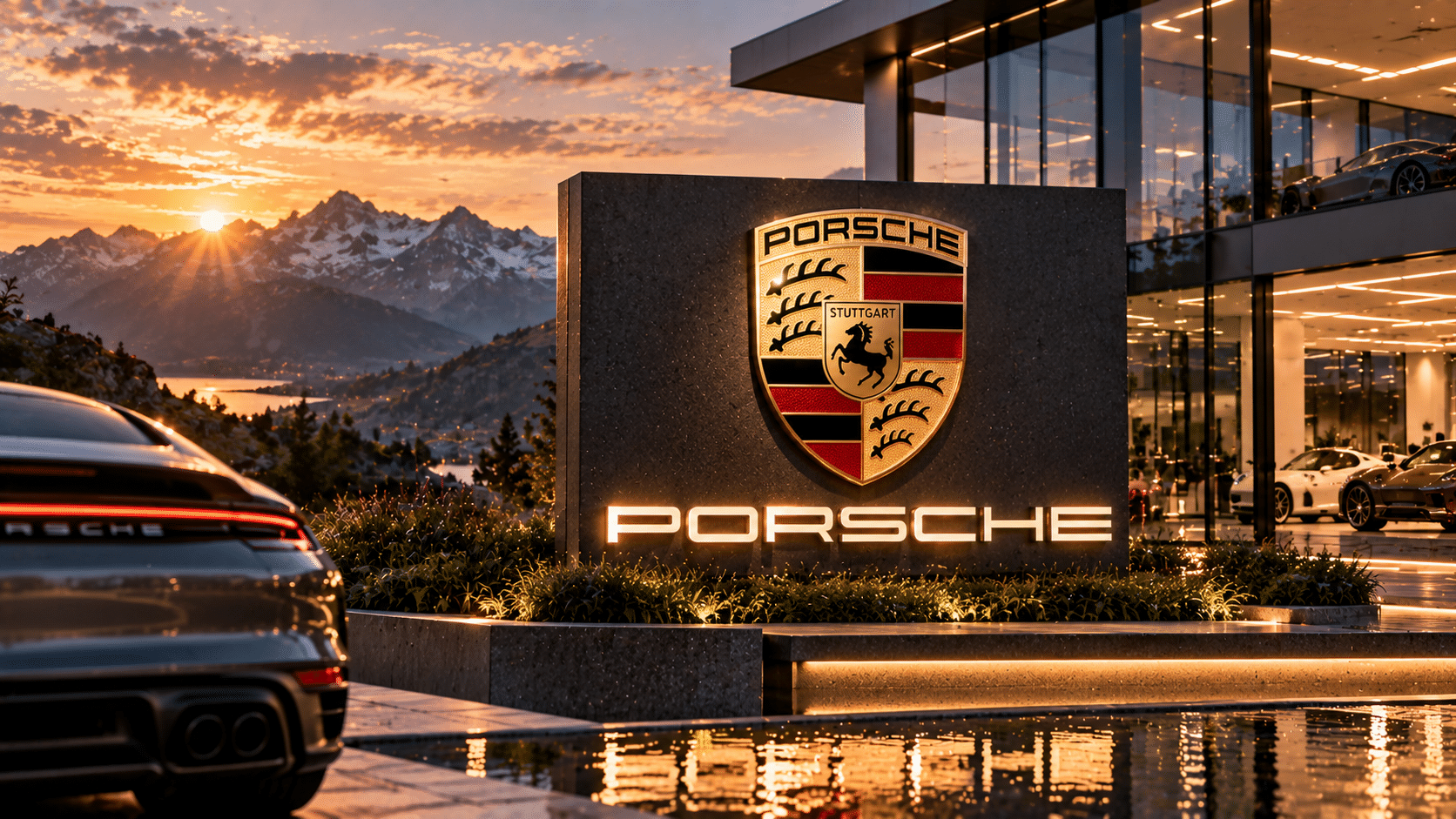
Porsche is preparing to ask some of its wealthiest customers to pay dramatically more for its most desirable cars. The German sports-car maker plans to raise prices on selected top-end models by as much as 20%, according to Bloomberg, as management attempts to restore profitability after one of the most difficult periods since Porsche’s 2022 stock-market listing. The increases are expected to focus on limited-production and highly customized vehicles rather than the entire lineup, turning the Porsche stock forecast 2026 into a fascinating test of one of the company’s most valuable assets: whether the Porsche badge still carries enough pricing power to repair margins without driving even affluent customers away.
The strategy comes at a delicate moment. Porsche has been battling weaker demand in China, U.S. tariff costs, restructuring expenses and the consequences of an electric-vehicle strategy that moved faster than some customers were willing to follow. The company has already lowered ambitions, rebalanced its product roadmap toward combustion-engine and plug-in hybrid vehicles and launched a sweeping cost-reduction effort. Raising prices at the very top of the range now offers another path toward rebuilding profitability—one that could be extraordinarily lucrative if customers accept it, because Porsche’s rarest cars are precisely where exclusivity can matter more than affordability.
But a 20% price increase is not ordinary inflation.
It is Porsche asking customers to prove just how powerful its brand really is.
Porsche Isn’t Raising Every Price by 20%—And That Distinction Matters
The headline number immediately sounds dangerous. Increase prices by 20%, conventional economic logic says, and demand should decline.
Related articles




Porsche’s strategy appears considerably more targeted.
The largest increases are expected to hit high-end, limited-production and heavily customized models, where buyers tend to be less price-sensitive and scarcity itself can increase desirability. Rather than simply charging substantially more for every Macan or Cayenne, Porsche is attempting to extract more value from customers already purchasing vehicles at the most exclusive end of its portfolio.
That distinction is crucial for investors.
Luxury manufacturers don’t necessarily maximize profit by selling the greatest possible number of vehicles. At the highest end of the market, protecting scarcity can be more valuable than maximizing volume. Ferrari has built an extraordinarily profitable business around precisely that principle: control supply, cultivate exclusivity and give customers enough customization opportunities to push the transaction price dramatically above the vehicle’s advertised starting price.
Porsche occupies a different position. Its annual volumes are substantially higher and products such as the Macan and Cayenne compete in broader premium segments. But the 911, limited editions and Porsche’s extensive personalization options give the company an opportunity to push part of its business further toward the economics of ultra-luxury.
The potential reward is obvious.
Higher prices can flow through to profit far faster than selling additional cars—provided buyers don’t walk away.
Porsche Needs Those Extra Euros Because Its Old Margin Machine Has Broken Down
The timing of the price increases makes more sense when viewed against Porsche’s recent profitability.
For years, the company was admired by investors because it combined relatively high automotive volumes with margins closer to those of much more exclusive luxury manufacturers. That profitability helped support Volkswagen’s decision to list a minority stake in Porsche AG in 2022 and fueled expectations that the company could eventually command a valuation more comparable with luxury businesses than conventional automakers.
Reality became much more difficult.
Porsche has been forced to absorb the costs of restructuring its product strategy, weaker Chinese sales, tariffs and a slower-than-expected transition toward electric vehicles. Management has responded with billions of euros of measures intended to reshape the business and lower its cost base.
That has damaged profitability in the short term.
The challenge is particularly uncomfortable because Porsche cannot simply behave like a mass-market manufacturer during a downturn. Heavy discounting might stimulate sales, but it would risk damaging residual values and the exclusivity of the brand—the very characteristics that allow Porsche to charge premium prices in the first place.
That leaves management searching for another route.
Sell fewer low-return cars.
Cut costs.
And make the most desirable cars considerably more expensive.
A 20% Increase Could Be Extremely Powerful for Margins
Consider the basic economics.
A Porsche that already costs €200,000 would cost €240,000 after a 20% increase. If the underlying manufacturing cost doesn’t rise proportionally, a large part of that additional €40,000 can potentially contribute to gross profit.
The effect can become even larger when options are involved.
Porsche customers routinely personalize cars with expensive paint finishes, wheels, interior materials, performance equipment and customization from Porsche Exclusive Manufaktur. On rare models, customers can push transaction prices far beyond the base MSRP.
This makes high-end pricing one of the cleanest levers available to management.
Building significantly more cars requires additional components, factory capacity and working capital. Charging more for cars Porsche is already producing requires considerably less incremental capital.
That does not mean every extra euro becomes profit. Dealer economics, taxes, product mix and higher specification costs matter.
But the direction is unmistakable.
If Porsche can increase transaction prices on its highest-margin cars without materially reducing demand, profitability can improve even if overall unit sales remain relatively subdued.
And Porsche desperately needs that leverage because the volume side of its business is under pressure.
China Is the Problem a More Expensive 911 Cannot Completely Fix
Porsche’s difficulties in China remain one of the biggest obstacles facing the stock.
China was once an extraordinary growth engine for European premium-car manufacturers. Rising wealth, strong demand for German brands and rapidly expanding luxury consumption made the country enormously profitable.
The market has changed.
Chinese electric-vehicle manufacturers have improved at extraordinary speed, offering sophisticated technology, powerful electric drivetrains and advanced digital features at prices European manufacturers have struggled to match. At the same time, China’s property-market problems and weaker consumer confidence have weighed on discretionary luxury spending.
Porsche has deliberately resisted chasing volume through aggressive discounts.
Strategically, that may be the correct choice. Destroying pricing power to protect unit sales can create a short-term revenue benefit while permanently damaging a luxury brand.
Financially, however, fewer cars still mean fewer cars.
Higher pricing on limited-production models can offset some of that weakness, but it cannot fully replace a healthy Chinese business. Porsche needs to stabilize its position in the world’s largest automotive market while protecting the premium image that separates it from mainstream manufacturers.
That makes the 20% strategy both attractive and limited.
It can repair mix.
It cannot single-handedly repair geography.
Porsche’s EV Reversal Shows How Much the Market Changed
Another reason management needs stronger pricing is that Porsche’s product strategy has undergone an expensive reset.
The company once expected electric vehicles to represent more than 80% of new-car sales by 2030, depending on customer demand and infrastructure development. But EV adoption has evolved more slowly and unevenly than many automakers expected, particularly in some of Porsche’s most important markets.
Porsche responded by extending the life of combustion-engine and plug-in hybrid vehicles and reconsidering parts of its future electric-product roadmap.
That reversal is expensive.
Automakers plan vehicles years in advance. Platforms, batteries, factories, software and supplier contracts require enormous upfront commitments. Changing direction doesn’t simply erase the money already spent.
At the same time, maintaining combustion-engine, hybrid and electric architectures simultaneously can increase complexity and development costs.
The problem is particularly visible around Porsche’s most iconic products.
Enthusiasts have demonstrated that they still place enormous value on combustion engines, mechanical character and scarcity. That means Porsche must navigate an unusually delicate transition: investing in the technology required for an electric future without abandoning the attributes customers are willing to pay extraordinary amounts to preserve today.
A higher-priced, more exclusive top end can help finance that transition.
But only if customers continue believing those cars are special enough to deserve the premium.
The 911 May Be Porsche’s Most Powerful Financial Weapon
If there is one product that gives management confidence in aggressive pricing, it is the Porsche 911.
The 911 is not simply another sports car inside Porsche’s lineup. It is the company’s defining product, backed by more than six decades of history and a global enthusiast community that treats certain variants as collectibles.
Scarcity can make the most desirable versions appreciate rather than depreciate.
That changes buyer psychology.
A customer buying an ordinary premium SUV may compare prices across Mercedes-Benz, BMW, Audi, Range Rover and Porsche. A customer who wants a particular 911 GT model often isn’t shopping in the same way.
They want that car.
Porsche can monetize that desire through limited-production derivatives, special editions and increasingly elaborate customization.
That is where a 20% price increase becomes far more plausible than it would appear across the broader automotive market.
The risk is pushing too far.
Part of Porsche’s historical magic has come from existing between conventional premium manufacturers and ultra-exclusive brands such as Ferrari. Its cars are expensive but still attainable enough to create a large global enthusiast base.
Move too far toward scarcity and Porsche could sacrifice part of that ecosystem.
Move too little and it leaves potentially enormous profits on the table.
Management is trying to find the line.
Ferrari Shows Investors Why Porsche Is Tempted to Push Higher
The comparison with Ferrari is impossible to avoid.
Ferrari sells far fewer vehicles than Porsche but generates extraordinary margins and commands a stock-market valuation that conventional automakers can only dream about. Investors don’t treat Ferrari primarily as a car manufacturer. They treat it as a luxury company whose vehicles happen to be the mechanism through which exclusivity is monetized.
Porsche has never fully achieved that valuation status.
The 2022 IPO briefly encouraged investors to imagine that it could.
But weaker margins, China exposure, EV-transition problems and its complicated relationship with Volkswagen gradually weakened the argument.
Aggressive pricing at the top of Porsche’s portfolio therefore has strategic significance beyond the immediate additional revenue.
It represents a move toward emphasizing value per vehicle rather than vehicles sold.
If Porsche can demonstrate that customers will accept significantly higher prices, management gains evidence that the company possesses more luxury-brand economics than recent financial results suggest.
If buyers resist, the opposite conclusion becomes difficult to avoid.
That makes the pricing decision almost a real-world experiment in Porsche’s valuation.
The Risk Is That Even Rich Customers Know When They’re Being Squeezed
Luxury pricing power isn’t infinite.
Customers with enough money to buy a €200,000 car usually have enough money to buy something else.
Ferrari, Lamborghini, Aston Martin, Mercedes-AMG and other manufacturers compete for the same affluent buyers, while the used market offers another alternative. If new-car prices increase too rapidly, lightly used examples can suddenly appear much more attractive.
Porsche must also be careful with its most loyal enthusiasts.
Some customers already complain about complicated allocation systems, expensive options and the difficulty of accessing limited-production vehicles without substantial purchase histories.
A large additional increase in pricing could reinforce the perception that Porsche is prioritizing short-term monetization over accessibility to enthusiasts.
That may not matter for a single quarter.
Brand erosion rarely does.
But luxury businesses are built on relationships lasting decades. Today’s entry-level Cayman buyer can become tomorrow’s 911 Turbo customer and eventually purchase a limited-production model.
Porsche therefore needs to extract more profit from its richest customers without turning aspiration into alienation.
Twenty percent is large enough to test that boundary.
Porsche Stock Needs Margin Recovery More Than It Needs Another Sales Record
For investors, the crucial point is that Porsche doesn’t necessarily need explosive volume growth for the stock to recover.
It needs better economics.
If unit sales stabilize while average selling prices increase, costs decline and product mix improves, earnings can recover faster than headline vehicle deliveries suggest.
That makes the current strategy potentially powerful.
Management is attacking profitability from multiple directions: restructuring operations, reducing costs, recalibrating the EV strategy and now pushing harder on high-end pricing.
The pieces fit together.
Porsche appears increasingly willing to sacrifice some volume to protect exclusivity and rebuild margins.
That is a very different strategy from the volume race dominating much of the global auto industry.
Chinese manufacturers are fighting over market share.
Tesla has repeatedly used pricing as a competitive weapon.
Mainstream European automakers are trying to spread enormous development costs across millions of vehicles.
Porsche can attempt something else.
It can charge more.
The question is whether its brand remains strong enough to get away with it.
The Porsche Stock Forecast 2026 Comes Down to One Word: Exclusivity
The planned price increases won’t solve every problem facing Porsche.
They won’t restore Chinese luxury demand overnight. They won’t eliminate U.S. tariff exposure. They won’t recover money already committed to an EV transition that had to be redesigned. And they won’t instantly return operating margins to the levels investors once associated with the company.
But the strategy attacks the variable Porsche has more control over than almost anything else: what customers pay for exclusivity.
That could matter enormously.
If limited-production and customized models absorb increases approaching 20% without meaningful demand destruction, Porsche gains a powerful new lever for rebuilding profitability. Higher average selling prices can offset weaker volume, help fund the company’s technology transition and move its economics incrementally closer to the luxury model investors once hoped the IPO would deliver.
Failure would send a much less comfortable message.
If even Porsche’s richest and most loyal customers begin resisting higher prices, management may discover that years of weaker demand, EV uncertainty and aggressive monetization have reduced the brand’s pricing power.
That is why investors should watch more than the sticker price.
They should watch order books, waiting lists, customization spending, 911 mix and—above everything else—automotive margins.
A 20% increase sounds spectacular in a headline.
The stock will ultimately care about how much of it reaches the bottom line.
Porsche has spent decades convincing customers that scarcity, engineering and heritage make its best cars worth paying more for.
Now the company is putting a number on that belief—and in some cases, that number could be 20% higher.
Disclaimer
This article is for informational purposes only and does not constitute financial or investment advice. Readers should conduct their own research and, where appropriate, consult a qualified financial advisor before making investment decisions. This article was researched and drafted with the support of AI, then reviewed, fact-checked, and edited by the editorial team before publication.