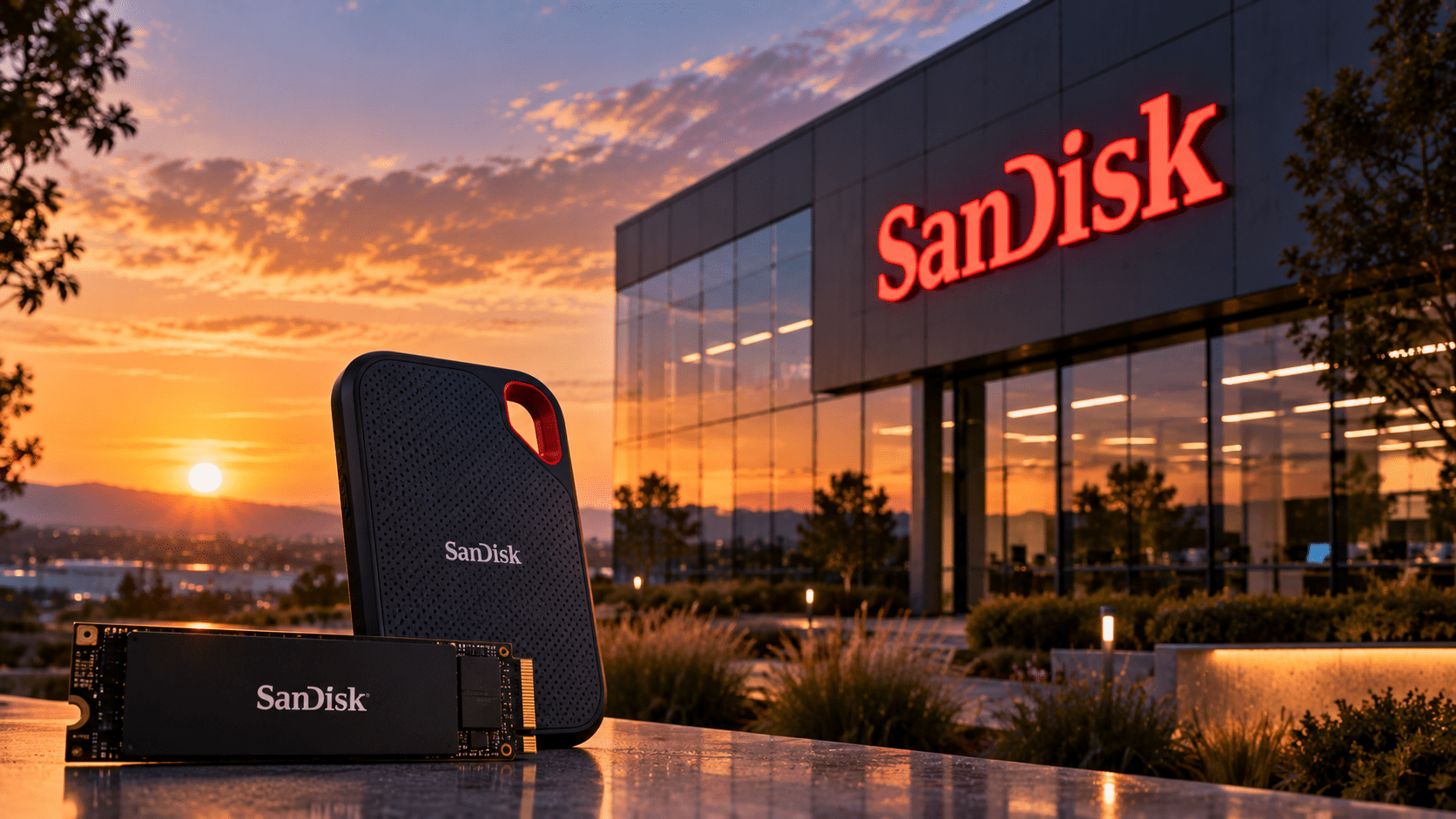
Sandisk stock surged more than 7% in early trading on Tuesday, September 22, 2026, after Rosenblatt Securities initiated coverage of the memory and storage company with a Buy rating and an ambitious $2,400 price target. The new target implies approximately 36% upside from Sandisk’s September 21 closing price of $1,766.64, adding momentum to one of the most extraordinary semiconductor rallies of the year. Rosenblatt analyst Kevin Cassidy argued that artificial intelligence is fundamentally changing the economics of NAND flash memory, creating an opportunity for Sandisk (NASDAQ: SNDK) to benefit from growing demand for high-performance storage infrastructure.
The announcement comes after a remarkable transformation in Sandisk’s financial performance. The company has benefited from rising memory prices, accelerating demand from data-center customers, and a shift toward higher-value storage products as technology companies expand their artificial intelligence infrastructure. With shares having gained more than 600% since the beginning of 2026, investors are increasingly treating Sandisk as a major participant in the AI investment cycle rather than simply a supplier of conventional storage devices.
However, the latest analyst upgrade also raises the stakes for a company whose valuation already reflects substantial expectations for future growth. Sandisk’s recent earnings demonstrate that demand and pricing conditions have improved dramatically, but the semiconductor memory industry has historically experienced significant fluctuations in profitability as manufacturers adjust production and customers change their purchasing patterns.
For shareholders, the central question is whether AI-driven storage demand and Sandisk’s expanding customer relationships can support a more durable period of earnings growth, or whether the extraordinary share-price rally has already incorporated much of the company’s future financial potential.
Rosenblatt’s $2,400 Target Puts Sandisk’s AI Opportunity in the Spotlight
Rosenblatt’s decision to initiate coverage with a $2,400 price target reflects its assessment that Sandisk is undergoing a significant change in its business model. Analyst Kevin Cassidy highlighted the increasing importance of NAND flash memory in artificial intelligence infrastructure, where customers require substantial storage capacity alongside high performance, reliability, and consistent availability. The firm argues that these requirements are making memory technology more strategically important to data-center operators, potentially changing the way customers evaluate storage products and negotiate long-term supply arrangements.
Related articles




The investment bank’s analysis focuses on a shift away from treating NAND flash primarily as a standardized commodity purchased according to price. As artificial intelligence systems become more complex, data-center operators must manage increasingly large datasets, support demanding computing workloads, and maintain reliable access to information. Storage density, endurance, performance, and supply stability can therefore become important considerations alongside the cost of individual memory components.
Sandisk’s advanced manufacturing technology and its long-standing relationship with Japanese semiconductor company Kioxia form another important part of Rosenblatt’s assessment. The two companies have collaborated on NAND flash development and production for decades, allowing Sandisk to participate in advanced memory manufacturing while benefiting from established technological expertise and production infrastructure.
The $2,400 target represents an analyst’s forward-looking assessment rather than a guaranteed future share price. Reaching that valuation would depend on Sandisk’s subsequent financial performance, market conditions, and the earnings multiple investors are willing to assign to the company. Nevertheless, the initiation has brought renewed attention to whether the underlying economics of the NAND market are changing in ways that could support stronger profitability over an extended period.
Sandisk’s $8.97 Billion Quarter Reveals the Financial Power Behind the Rally
The enthusiasm surrounding Sandisk is supported by substantial improvements in its recent financial performance. On August 5, the company reported fiscal fourth-quarter revenue of $8.97 billion, representing a 51% increase from the preceding quarter. GAAP net income reached $6.90 billion, equivalent to diluted earnings of $43.97 per share, while adjusted diluted earnings totaled $39.25 per share. For the full fiscal year, revenue increased 175% to $20.25 billion, demonstrating the scale of the recovery in Sandisk’s storage business.
However, the composition of that growth is particularly important for investors assessing the sustainability of the company’s earnings. Approximately two-thirds of Sandisk’s sequential fourth-quarter revenue increase came from higher selling prices, while roughly one-third resulted from increased shipment volumes. The figures demonstrate how strongly memory manufacturers can benefit when demand exceeds available supply, allowing higher prices to translate into substantial improvements in profitability. They also reveal an important source of uncertainty, because a future reversal in NAND pricing could affect earnings even if demand for storage capacity continues expanding.
Sandisk’s exposure to data-center customers has become another defining feature of its financial transformation. During fiscal 2026, data-center revenue increased 437% year over year, reflecting expanding demand for storage products used in cloud computing and AI infrastructure. That growth has changed the composition of Sandisk’s business, creating additional opportunities in a market where performance and reliability can influence purchasing decisions alongside price.
For investors, the latest financial results provide evidence that Sandisk is already benefiting from the AI infrastructure expansion. The more difficult question is how much additional growth the company can generate as its revenue base becomes considerably larger and competitors respond to favorable market conditions.
AI Data Centers Are Turning NAND Flash Into Essential Computing Infrastructure
Much of the investment surrounding artificial intelligence has concentrated on advanced processors developed by companies such as Nvidia and AMD. However, powerful computing systems also require storage infrastructure capable of managing enormous quantities of information, including training datasets, application files, and data generated during the operation of AI services. As models become larger and workloads more demanding, the efficiency with which computing systems access and manage stored information can influence their overall performance.
NAND flash technology plays an important role in that infrastructure because it enables solid-state drives to provide substantial storage capacity with performance characteristics suited to many demanding applications. The commercial opportunity for Sandisk lies in supplying increasingly advanced products to customers expanding data-center capacity and seeking reliable storage systems.
Rosenblatt’s investment thesis emphasizes that AI infrastructure could change purchasing priorities, potentially creating opportunities for manufacturers offering greater storage density, endurance, and performance. However, the financial benefits will depend on actual customer demand, product pricing, manufacturing costs, and the competitive position of individual suppliers.
A structural increase in demand for data storage would not necessarily eliminate the cyclical characteristics of the memory industry. Manufacturers can still expand production capacity, customers can adjust purchasing schedules, and technological advances can change the economics of individual products. The question for Sandisk is whether its growing exposure to demanding enterprise customers can make its financial performance less dependent on short-term fluctuations in conventional memory markets.
Sandisk’s Kioxia Partnership Could Become a Crucial Competitive Advantage
Sandisk’s relationship with Kioxia has become an important component of its efforts to develop advanced NAND flash technology. Rosenblatt highlighted the companies‘ BiCS8 and BiCS10 memory architectures, which are designed to improve storage density and manufacturing efficiency through advances in three-dimensional NAND technology.
These developments matter because increasing storage capacity does not depend exclusively on manufacturing larger quantities of conventional memory chips. Improvements in semiconductor architecture can allow manufacturers to store more information within a given physical area while addressing the performance and cost requirements of increasingly sophisticated applications.
For Sandisk, continued technological progress could support its ability to compete for higher-value data-center business while managing manufacturing costs. However, its competitive position will also depend on how successfully rival suppliers develop alternative technologies and expand production.
The broader NAND market includes major manufacturers such as Samsung Electronics, SK Hynix, and Micron Technology, all of which have substantial resources and exposure to expanding demand for memory and storage products. Strong growth in AI infrastructure could create opportunities across the industry, but competition over manufacturing efficiency, product performance, and pricing will remain important in determining how much of that opportunity individual companies capture.
Sandisk’s established manufacturing relationship provides access to advanced technology, but maintaining its position will require continued investment and successful execution as customer requirements evolve.
Long-Term Customer Agreements Could Change Sandisk’s Earnings Outlook
One of the most significant developments in Sandisk’s business is its increasing use of longer-term supply agreements with major customers. During its August earnings announcement, the company disclosed that it had signed five additional customer agreements, including three arrangements with new customers and two expansions of previously established agreements. These commitments could provide greater visibility into future demand while helping management plan production and investment more effectively.
The agreements are particularly relevant because the memory industry has historically been exposed to substantial fluctuations in pricing and customer purchasing activity. When manufacturers increase production faster than demand expands, excess supply can place pressure on selling prices and profitability. Longer-term commercial arrangements may help reduce some of that uncertainty, although the financial benefits will depend on contractual terms, customer requirements, and prevailing market conditions.
Sandisk has also expanded its share repurchase authorization, with its board approving an additional $14 billion program and bringing its total remaining authorization to $15.5 billion. The decision provides management with additional flexibility to return capital to shareholders, although the timing and financial impact of future repurchases will depend on execution and the prices paid.
For investors, these developments introduce another consideration beyond the immediate AI storage boom: whether Sandisk can convert its current profitability into more predictable earnings and cash generation over time.
Can Sandisk Stock Justify Its $2,400 Price Target?
Sandisk’s latest financial guidance provides an important benchmark for evaluating Rosenblatt’s assessment. The company expects fiscal first-quarter 2027 revenue between $10.3 billion and $10.8 billion, compared with $8.97 billion in the preceding quarter. Management also forecasts adjusted diluted earnings of $44 to $46 per share, reflecting expectations that favorable storage demand and pricing conditions will continue supporting profitability.
However, Sandisk’s extraordinary share-price appreciation means that substantial growth is already reflected in its market valuation. Even strong financial results may not automatically generate further stock gains if investors have anticipated similar performance or become less willing to pay the same earnings multiple.
The next important developments will involve NAND pricing, data-center demand, production capacity, and the financial contribution from Sandisk’s expanding customer agreements. Investors will also be monitoring competition across the memory industry, where manufacturing decisions can influence the balance between supply and demand.
Rosenblatt’s $2,400 target introduces a new reference point for evaluating Sandisk’s future performance, but the company’s subsequent earnings reports will provide more concrete evidence about whether its recent growth can be sustained.
The market has increasingly recognized the importance of storage infrastructure in the artificial intelligence industry. For Sandisk, the next challenge is demonstrating that its expanding role in that market can support the financial expectations now attached to its shares.
Disclaimer
This article is for informational purposes only and does not constitute financial or investment advice. Readers should conduct their own research or consult a qualified financial advisor before making investment decisions. This article was researched and drafted with the support of AI; editorial review, fact-checking, and editing must be completed before publication.