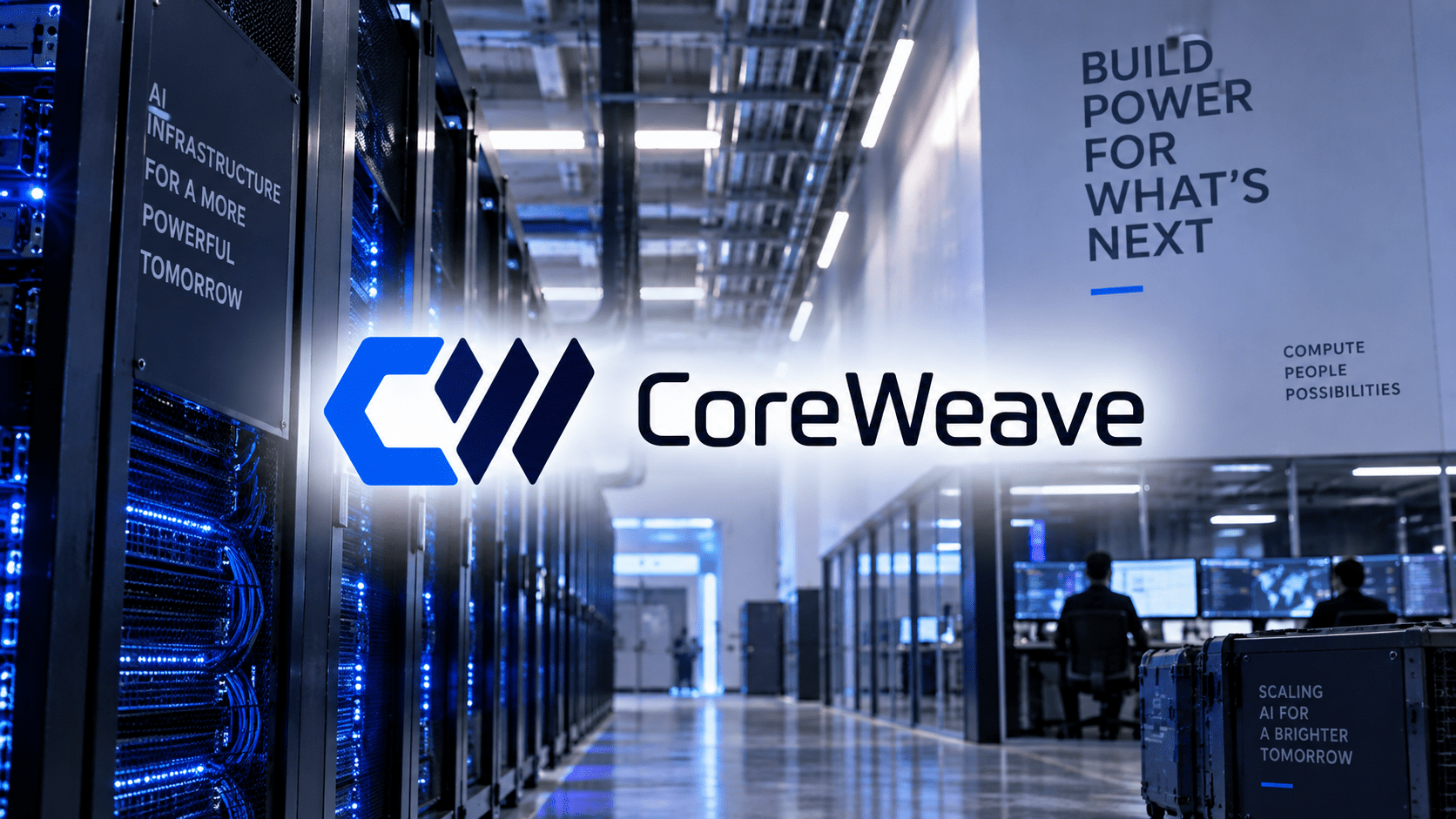
CoreWeave stock has become one of Wall Street’s purest bets on an extraordinary assumption: that artificial intelligence companies will keep demanding more computing power, more data-center capacity and more high-end GPUs at a pace that justifies tens of billions of dollars in infrastructure spending. That assumption is now being challenged. Bernstein Société Générale says CoreWeave is among the companies most exposed if frontier AI model development slows, because so much of its business is tied directly to compute-intensive training workloads that can be placed in large, relatively remote data centers. The concern surfaced after leading AI executives called for a more deliberate pace of model development, triggering a broad selloff in chipmakers, neocloud providers and other companies sitting closest to the AI infrastructure boom.
For CoreWeave, the debate is unusually important because the company has built an enormous financial machine around continued AI demand. Second-quarter revenue more than doubled year over year to $2.58 billion, while revenue backlog reached approximately $104 billion at the end of June and CoreWeave said it added more than $25 billion of additional customer commitments early in the third quarter. Yet that growth is being financed with an equally extraordinary amount of capital. CoreWeave reported $13.6 billion outstanding under delayed-draw term facilities and $16.6 billion in notes at June 30, while its quarterly interest expense alone reached $640 million. The bullish case is that this debt funds infrastructure attached to long-duration customer contracts. The bearish case is much simpler: if the AI compute market ever slows materially, CoreWeave is carrying obligations that do not disappear merely because demand does.
That is why Bernstein’s warning cuts deeper here than it does for many other AI stocks.
Bernstein Is Drawing a Line Between Training and the Next Phase of AI
The crucial distinction in Bernstein’s argument is between AI training and AI inference. Training the largest frontier models requires vast quantities of accelerators running simultaneously for extended periods, which makes enormous data-center campuses in locations with abundant power economically attractive. Latency matters less when thousands of GPUs are spending weeks teaching a model. CoreWeave has been one of the biggest beneficiaries of that buildout because it specializes in high-performance AI infrastructure and can deploy large GPU clusters faster than many traditional cloud providers.
Inference has different economics. Once models have been trained, they must actually serve users, software applications and autonomous agents. Those workloads can become much more sensitive to latency, network connectivity and proximity to population centers. Bernstein argues that if AI development shifts away from relentless construction of ever-larger training clusters and toward inference-heavy agentic applications, metropolitan data-center operators may be relatively better insulated than infrastructure providers heavily exposed to remote training facilities. Existing take-or-pay contracts help protect near-term revenue, but the more vulnerable area would be future power capacity that has been secured or developed without yet being committed to customers.
Related articles





That does not mean CoreWeave suddenly becomes obsolete in an inference-driven world. The company is explicitly building products spanning training, inference, reinforcement learning and AI agents, and in August it highlighted new agentic capabilities alongside benchmark results for both training and inference workloads. CoreWeave also said active power had expanded to 1.5 gigawatts while total contracted power reached approximately 3.7 gigawatts. The problem for investors is therefore not that inference produces zero demand for CoreWeave. It is that the economics and location of the next wave of demand may differ from the conditions that made the first wave so lucrative.
And CoreWeave has made commitments based on the first wave continuing at enormous scale.
The $104 Billion Backlog Is CoreWeave’s Biggest Shield
Anyone building the bearish case has to confront one huge number: approximately $104 billion.
That was CoreWeave’s reported revenue backlog at the end of the second quarter, before including more than $25 billion of net new customer commitments the company said it added during early Q3. Revenue itself reached $2.575 billion during the quarter, compared with $1.212 billion a year earlier. Adjusted EBITDA came in at $1.51 billion, and CoreWeave said customer demand was accelerating as enterprise adoption expanded. Those figures explain why investors have been willing to finance such an aggressive infrastructure buildout. CoreWeave is not constructing data centers purely on speculation; much of its expansion is supported by signed commitments from some of the largest AI customers in the world.
Those contracts matter because they reduce the immediate danger from a short-term slowdown. Bernstein itself noted that take-or-pay arrangements provide some protection to existing backlog. If an AI laboratory decides to train its next model more slowly, it may still owe CoreWeave money under capacity agreements already signed. That makes the bearish thesis very different from saying next quarter’s revenue suddenly collapses.
The risk emerges further out. Infrastructure businesses continually replenish their pipeline. Data-center campuses take time to permit, finance and build, and power must often be secured years before customers actually use it. If the expected demand curve flattens, the value of contracted-but-unsold power and future development projects can deteriorate while the associated financial commitments remain. This is exactly the kind of mismatch that worries investors when an industry moves from shortage conditions to more normal supply.
CoreWeave’s backlog is therefore simultaneously its greatest strength and one reason the company has been able to assume so much leverage.
CoreWeave Stock Carries a Debt Problem That Only Looks Small While Growth Is Huge
CoreWeave’s capital structure is what turns an abstract AI slowdown into a serious stock-market risk.
At June 30, the company reported $5.52 billion of cash and about $15.55 billion of total liquidity, including available borrowing capacity. But it also had $13.6 billion outstanding under delayed-draw term loan facilities and $16.6 billion in aggregate principal amount of notes. During Q2 alone, net interest expense reached $640 million, contributing to a GAAP net loss of $626 million despite $2.58 billion of revenue and $1.51 billion of adjusted EBITDA.
That financing is not automatically reckless. CoreWeave says its delayed-draw facilities are tied to infrastructure supporting customer contracts, with contractual cash flows helping repay the debt over time. The company also had roughly $10 billion available under existing facilities as of June 30. If demand continues rising and those contracts perform as expected, leverage can amplify equity returns by allowing CoreWeave to build far faster than it could using internally generated cash alone.
But leverage also magnifies forecasting mistakes. Data-center leases, server purchases, power commitments and financing costs continue even if a future customer decides it needs less capacity. CoreWeave itself warns in its SEC filings that a material reduction in AI or high-performance-computing spending could hurt results, and that it may be left with excess capacity while still being responsible for infrastructure, data-center leases and financing obligations if customers fail to fulfill commitments.
In a hypergrowth market, investors tend to focus on revenue. In a slowdown, they start reading the liabilities.
Customer Concentration Makes the AI Debate Even More Important
CoreWeave’s second structural risk is concentration.
The company acknowledges that a substantial portion of revenue comes from a limited number of customers, and its filings identify Microsoft and OpenAI among significant clients. It also disclosed a roughly $6 billion commitment from Jane Street announced in April. Those names are impressive, but customer quality and customer diversification are not the same thing. When a relatively small group of buyers accounts for an outsized amount of demand, any change in their capital-spending plans can have enormous consequences for the supplier.
That concentration was easier for investors to ignore when every major AI laboratory appeared locked in a race to build a larger model as quickly as possible. The weekend warnings from Anthropic CEO Dario Amodei and other AI leaders challenged that assumption by introducing the possibility that safety concerns could lead to more deliberate pacing. Sam Altman and Elon Musk also supported greater caution, helping trigger Monday’s sharp decline across semiconductors and AI infrastructure stocks. The PHLX Semiconductor Index fell more than 5%, while CoreWeave and other neocloud companies also came under pressure.
A coordinated halt in AI investment remains far from certain. Governments and corporations have powerful strategic incentives to keep spending, particularly while the United States and China compete for technological leadership. Several market strategists have described Monday’s selloff as an overreaction, and there is currently little hard evidence that hyperscalers have begun cancelling infrastructure projects.
But stocks trade on changes in probability before they trade on confirmed earnings damage. CoreWeave is especially sensitive because the market has valued it as though compute demand remains extraordinary for years.
The Bull Case Says CoreWeave Is Already Moving Beyond Pure Model Training
There is a strong counterargument to Bernstein’s warning: CoreWeave is not standing still.
Its latest product announcements increasingly emphasize inference and agents rather than only giant training clusters. During Q2, the company launched infrastructure designed to connect training, inference, observability and reinforcement learning while enabling AI agents to improve continuously in production. It also announced cross-cloud tools connecting its infrastructure with platforms such as Google Cloud and reported new MLPerf records covering both training and inference on Nvidia’s Grace Blackwell architecture.
That evolution matters. If CoreWeave can remain competitive as spending shifts from building frontier models toward deploying those models at enormous scale, then a change in the composition of AI demand does not necessarily mean a collapse in total demand. Billions of people and potentially billions of software agents continuously querying AI systems could ultimately require extraordinary amounts of compute even if the industry trains fewer giant foundation models.
CoreWeave also benefits from specialization. General-purpose clouds such as Amazon Web Services, Microsoft Azure, Google Cloud and Oracle have far broader businesses, while CoreWeave has designed its platform specifically around accelerated computing. The company argues that this focus lets it deploy new Nvidia architectures quickly and optimize infrastructure for demanding AI customers. Its customers clearly see some value in that proposition, given the backlog.
The problem is that CoreWeave’s competitors also have much stronger balance sheets.
If AI infrastructure transitions from scarcity to competition on price, cost of capital suddenly becomes much more important.
High Interest Rates Could Make the AI Slowdown Risk Even More Painful
CoreWeave’s current challenge is not occurring in a friendly macroeconomic environment.
The U.S. 10-year Treasury yield briefly crossed 5% on Monday as markets worried about inflation, elevated energy prices and the possibility of tighter Federal Reserve policy. Rising benchmark yields make leveraged infrastructure models more difficult because refinancing becomes more expensive and investors demand higher returns from risky growth stocks.
For CoreWeave, that creates a potentially dangerous combination. If AI growth expectations weaken at exactly the same time financing costs remain elevated, both sides of the valuation equation move against the stock. Expected future revenue falls while the discount rate applied to those future earnings rises.
The company has already demonstrated how expensive capital can be. Earlier this year CoreWeave priced $1 billion of senior notes due 2031 at a 9.75% coupon. That may be manageable while revenue is doubling, but it illustrates why continued growth is not merely desirable. It is central to the economics of the model.
This is where CoreWeave differs dramatically from Nvidia. Nvidia can experience weaker demand and still generate enormous cash. CoreWeave has built capacity and borrowed heavily in anticipation of demand that must continue arriving.
CoreWeave Stock Is Now Trading on Whether AI Compute Is Cyclical After All
The central question behind Bernstein’s warning is bigger than Monday’s stock move.
For most of the AI boom, compute has been treated almost like a permanently scarce commodity. Companies raced to secure GPUs, power and data-center capacity because failing to obtain them meant falling behind competitors. CoreWeave built its business around solving that shortage, and the results have been spectacular: quarterly revenue has more than doubled, active power has reached 1.5 GW and backlog has climbed above $100 billion.
But every infrastructure boom eventually encounters the same question: how much capacity is enough?
If frontier labs continue racing toward larger models, CoreWeave could remain one of the biggest winners in the AI economy. Its backlog provides unusually strong visibility, its customers are among the industry’s most important companies and inference may eventually create a market just as large as training.
If model development slows materially, however, CoreWeave could discover that the characteristic which made it attractive on the way up — extreme exposure to AI infrastructure — makes it unusually vulnerable on the way down.
That is the real message from Bernstein. The issue is not whether artificial intelligence disappears. It almost certainly will not. The issue is whether the industry continues requiring new training capacity at the breathtaking pace embedded in CoreWeave’s expansion plans.
Investors spent the last two years asking whether CoreWeave could build fast enough to satisfy demand.
The more uncomfortable question is what happens if, one day, it has built too much.
Disclaimer
This article is for informational purposes only and does not constitute financial or investment advice. Readers should conduct their own research and, where appropriate, consult a qualified financial advisor before making investment decisions. This article was researched and drafted with the support of AI, then reviewed, fact-checked and edited by the editorial team before publication.