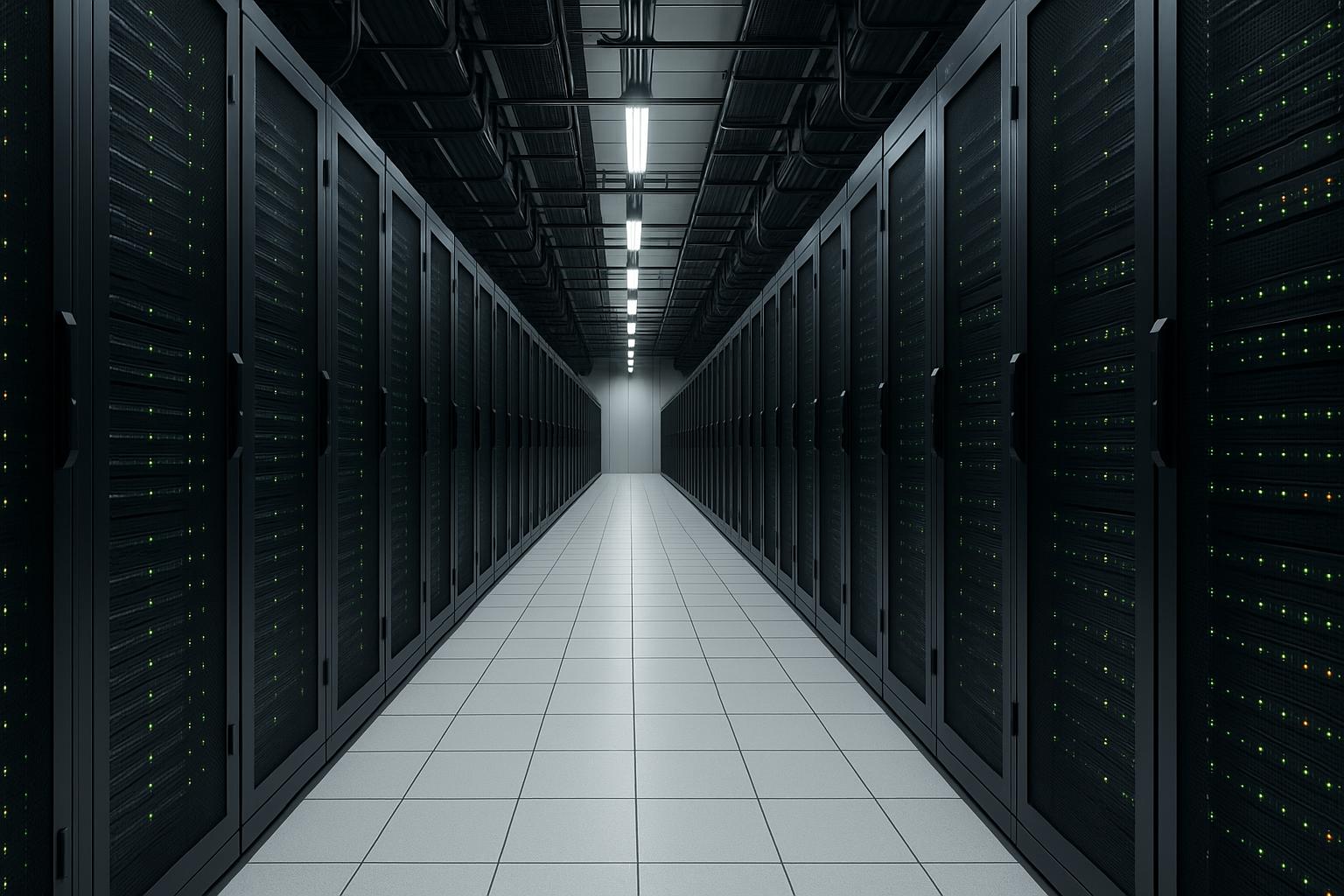
Amazon.com, Inc. is signaling a step-change in investment to capture surging demand for AI infrastructure. Management outlined a plan to deploy roughly $200 billion of capital expenditures with a heavy concentration in its cloud arm, Amazon Web Services (AWS). The aim: secure scarce inputs—power, land, chips—and expand capacity for training and inference at hyperscale. The sticker shock hit the stock near-term, but the strategic logic is clear: lock in capacity now to monetize sustained AI workloads over multiple years.
What’s actually changing
- Scale: The spend envelope materially exceeds prior cycles. It’s a hyperscaler-style land grab for compute, networking, and energy, sized for AI clusters rather than conventional cloud growth.
- Focus: Dollars skew toward data centers, power procurement, high-bandwidth networking, and tighter integration of custom silicon alongside third-party accelerators.
- Time horizon: Management is front-loading outlays to avoid supply bottlenecks later. In practice, that means heavier capex before all revenue shows up, then utilization catches up as customers ramp production AI.
Why now: the AI demand curve
Three forces are converging. First, model sizes and training cadences keep rising, pushing demand for dense compute and ultra-fast interconnects. Second, enterprises are shifting from pilots to production—especially in retrieval-augmented workflows, agentic automation, and vertical fine-tuning—which favors managed platforms with predictable latency and security. Third, AI unit economics improve as workloads transition from experimentation to repeatable inference; at scale, this can offset higher depreciation from new capacity.
Where the money goes
Physical plant: multi-region data-center buildouts with high-density racks, advanced cooling, and fiber-rich topologies.
Power: long-dated power purchase agreements and on-site energy strategies to guarantee multi-gigawatt supply without excessive volatility.
Networking: low-latency clusters designed around training fabrics and memory bandwidth, not just CPU cores.
Silicon: deeper adoption of AWS-designed accelerators to complement leading GPUs, lowering total cost per token and improving control over supply.
Platform software: managed services for model hosting, safety/governance, fine-tuning, vector databases, and guardrails—turning raw compute into higher-margin recurring revenue.
Market reaction and the trade-off
Investors keyed in on free-cash-flow cadence. A spend plan this large can pressure near-term FCF and push out buyback capacity. That said, hyperscaler history shows an S-curve: cash flow dips as capacity is installed, then recovers as utilization rises and depreciation is absorbed by expanding high-margin services. The bet is that AI demand is durable enough—and AWS’s sales motion efficient enough—to compress the lag between capex and monetization.
How to frame AWS economics
- Training vs. inference mix: Training clusters are capex-heavy and cyclical with model refreshes. Inference is steadier and margin-accretive when optimized on custom silicon. Watch the mix.
- Custom silicon penetration: The more workloads move to in-house accelerators, the tighter the flywheel becomes: cost per token falls, performance predictability improves, and switching costs rise.
- Backlog and utilization: High-quality backlog is the bridge from capacity to returns. If committed demand scales with installs, idle time shrinks and ROIC holds up.
Competitive positioning
AWS is choosing leadership on capacity rather than incrementalism. That stance matters in a world where power is the new bottleneck and chips remain constrained. By securing both—and stitching them into a coherent platform from silicon to services—AWS aims to win multi-year enterprise commitments that are difficult to dislodge. The flip side: any execution slip (delayed energizing, supply chain hiccups, local permitting issues) reverberates more loudly when you’ve set expectations at this scale.
Key risks
- Execution: Building, energizing, and staffing new capacity on schedule amid grid constraints and permitting.
- Pricing: Rapid cost curves on accelerators could compress per-unit revenue if price cuts outpace efficiency gains.
- Demand elasticity: If pilots stall before widespread deployment, utilization could lag and returns drift below plan.
- Capital intensity: A multi-year super-cycle raises the bar for consistent cash generation and increases sensitivity to macro slowdowns.
- Regulatory/local constraints: Data residency, energy sourcing, and environmental standards can alter timelines and economics by region.
Leadership’s stance
CEO Andy Jassy has framed the opportunity as unusually large and time-sensitive. The message to investors: new capacity is being monetized faster than in prior build cycles because demand for AI compute is both broader (across industries) and deeper (within each customer). That confidence underpins the willingness to accept near-term FCF volatility in exchange for strategic share gains.
What to watch next
- Committed backlog growth vs. capex run-rate: The cleanest signal that capacity is landing in the right places.
- Silicon adoption: Uptake of AWS custom accelerators in real workloads—not just marketing slides.
- Power wins: New PPAs and regional grid partnerships that derisk energizing timelines.
- Gross margin trajectory: Early pressure is normal; stabilization and lift as inference ramps is the tell that the model is working.
- Customer wins: Anchor commitments from large enterprises and model providers that signal long-duration demand.
Conclusion
Amazon is choosing scale over caution. A $200B capex plan is a bold wager that AI demand is real, durable, and best served by an integrated stack that AWS can deliver at global scale. The near-term trade-off is straightforward: heavier investment and potentially choppier free cash flow as depreciation rises ahead of full utilization. For long-horizon investors who believe AI workloads will compound across training and, more importantly, inference, this strategy could look prescient in hindsight. For those focused on the next four quarters of cash yield, the number may feel too big, too fast. The next checkpoints—backlog, silicon penetration, and power security—will determine whether this spend curve proves visionary or merely expensive.
FAQ
Did Amazon “miss the quarter,” or is this just a capex story?
The quarter itself was solid; the debate is about future free cash flow as capex ramps faster than revenue recognition.
Why spend so much now instead of pacing it?
Because the scarcest inputs—power, land, and chips—must be locked in early. Waiting risks losing high-value AI workloads to rivals with available capacity.
What needs to go right for the thesis to work?
On-time buildouts, rising utilization, growing backlog, and continued migration of workloads to AWS’s custom silicon to defend margins.
How could the plan backfire?
If AI projects fail to scale into production, or if pricing compresses faster than costs, returns slip and cash generation disappoints.
Is this primarily an AWS story?
Yes. Retail and ads matter, but the capex thesis hinges on AWS converting AI demand into sustained, profitable growth off a much larger asset base.
Disclaimer
This article is for informational purposes only and does not constitute investment advice, an offer, or a solicitation to buy or sell any security or digital asset. Investing in equities involves risk, including the potential loss of principal. Evaluate your financial situation, objectives, and risk tolerance, and conduct your own research before making any investment decision.