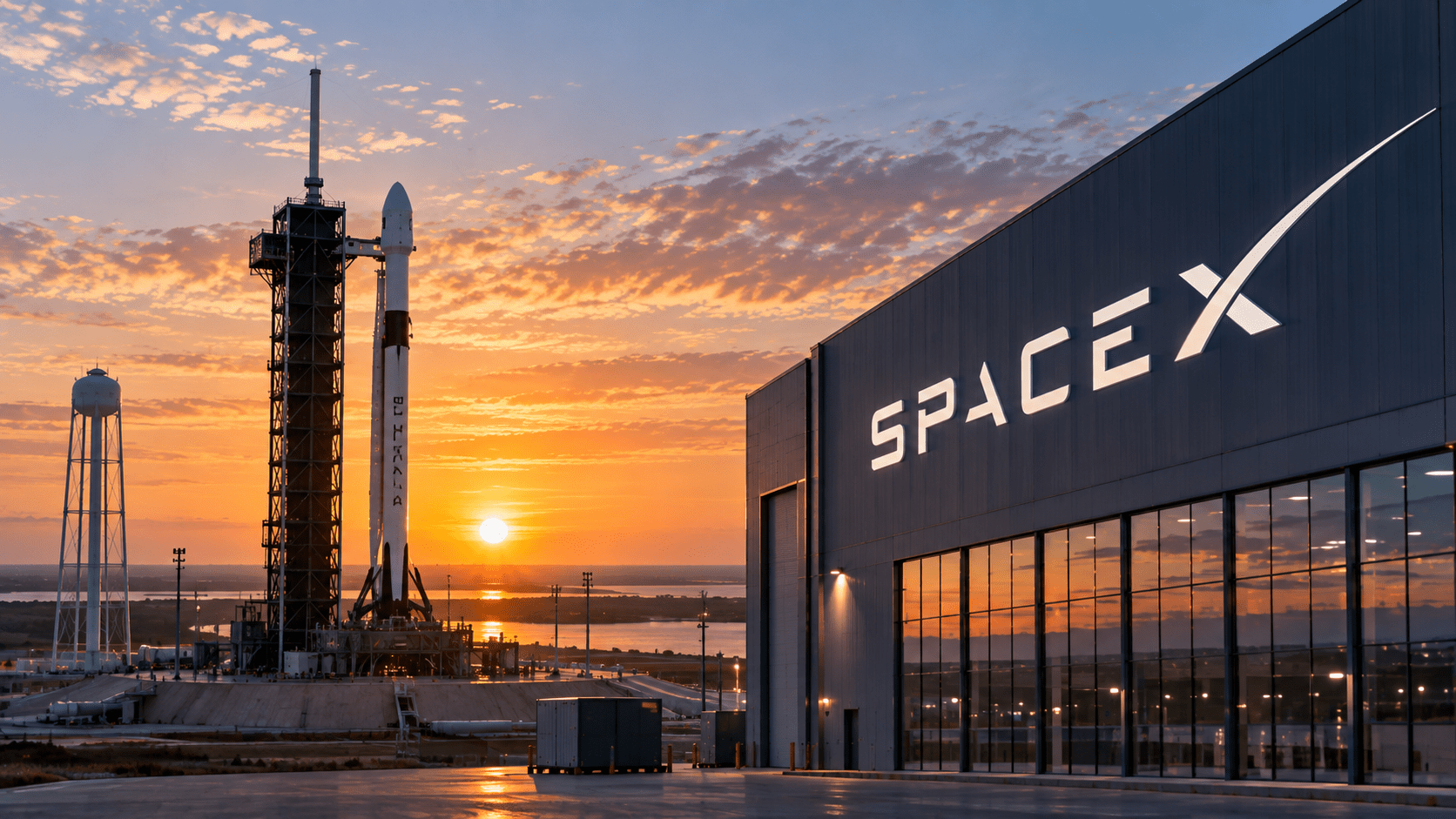
SpaceX stock surged roughly 7% on Friday, putting Elon Musk’s space company back in the spotlight after a rapid series of launch milestones gave investors another reason to reconsider just how valuable its increasingly dominant launch infrastructure could become. The move followed a remarkable stretch that included a successful Crew-13 astronaut mission, a Falcon 9 rideshare flight carrying an experimental Google AI satellite, a Falcon Heavy national-security launch and, only days earlier, SpaceX’s most important Starship flight yet.
The immediate market reaction makes sense. Frequent Falcon launches demonstrate operational scale, government missions reinforce SpaceX’s strategic position, and every successful Starship test moves the company closer to deploying a vehicle designed to carry vastly more cargo at potentially much lower costs. Yet the rally raises a more difficult question for investors watching SpaceX stock: how much future success is already reflected in a company valued at roughly $2 trillion?
That question matters because SpaceX is no longer simply a rocket company. Investors are effectively valuing several enormous opportunities at once—launch services, Starlink broadband, national-security contracts, direct-to-cell communications and eventually the radically larger payload capacity promised by Starship. The latest launches strengthen the argument that SpaceX possesses infrastructure few competitors can match, but after its blockbuster 2026 public debut, operational success must increasingly translate into financial results capable of supporting one of the largest valuations in the stock market.
SpaceX Just Put Its Launch Machine on Full Display
The latest rally came after a stretch that demonstrated the sheer breadth of SpaceX’s operations. On October 1, a Falcon 9 launched Crew-13, sending four astronauts toward the International Space Station aboard a Crew Dragon capsule. The reusable Falcon booster subsequently returned safely to Earth while Dragon continued toward the orbiting laboratory, reinforcing a capability that would have seemed extraordinary only a decade ago but has increasingly become routine for SpaceX.
That routine reliability is financially important. SpaceX began flying astronauts for NASA in 2020 and has since established itself as a critical provider of U.S. crew transportation. Each successful mission strengthens a record that matters not only for NASA contracts but also for future commercial human-spaceflight opportunities and government relationships.
Related articles





Hours after the Crew-13 launch, another Falcon 9 lifted off from California on the Transporter-18 rideshare mission, carrying 130 payloads into low Earth orbit. Among them was a prototype satellite connected to Google’s Project Suncatcher, which is testing whether AI computing hardware can function effectively in the harsh conditions of space. The Falcon 9 first stage used for that mission was flying for the 25th time, an extraordinary example of how deeply rocket reusability has become embedded in SpaceX’s operating model.
SpaceX then added a Falcon Heavy national-security mission, NROL-97, on October 2. The combination of human spaceflight, commercial payloads and classified government work within such a compressed period illustrates why launch cadence has become one of SpaceX’s biggest competitive advantages.
But even those launches were overshadowed by what happened several days earlier.
Starship Flight 14 May Be the Milestone That Matters Most
On September 28, SpaceX launched Starship Flight 14, and the mission achieved something previous full-scale Starship tests had failed to accomplish: the spacecraft successfully entered proper orbit and deployed 26 next-generation Starlink V3 satellites.
The flight was not perfect. SpaceX originally planned a substantially longer orbital mission, but engineers shortened it following early engine issues, and Starship eventually reentered before splashing down in the Pacific. Yet for investors, perfection was arguably less important than proving that the massive vehicle could reach orbit and deploy useful payloads.
That changes the conversation around Starship.
Previous tests primarily demonstrated engineering progress. Flight 14 moved the program closer to becoming an operational system capable of carrying revenue-generating payloads. If SpaceX can eventually make Starship rapidly and reliably reusable, the economics of putting mass into orbit could change dramatically.
That possibility explains why analysts are paying so much attention to each test. Citi has argued that Starship could become central to an enormously larger long-term valuation for SpaceX, because increased payload capacity and lower launch costs would not merely strengthen the existing launch business—they could make entirely new businesses economically viable.
For SpaceX stock, that distinction is enormous.
The Real Starship Opportunity Is Bigger Than Selling Rocket Launches
It is tempting to think of Starship simply as a larger Falcon 9, but that dramatically understates what SpaceX is attempting to build.
Falcon 9 has already changed launch economics through reusable boosters and extraordinarily high flight frequency. Starship is designed to push that model much further by creating a fully reusable system capable of carrying far larger payloads. If SpaceX succeeds, the company could deploy satellites at a scale that competitors would struggle to match while simultaneously reducing its own internal cost of expanding Starlink.
That vertical integration is one of SpaceX’s most unusual advantages.
Traditional satellite companies generally have to purchase launch capacity from another provider. SpaceX effectively owns both sides of the equation: it operates the rocket network and owns the satellite constellation that represents one of its largest customers. Lower launch costs can therefore benefit SpaceX twice—first by making its launch service more competitive and then by reducing the cost of expanding Starlink.
The 26 Starlink V3 satellites deployed by Starship Flight 14 offer an early glimpse of that model. A mature Starship could eventually place much larger batches of advanced satellites into orbit, accelerating the expansion and replacement of the Starlink constellation while potentially increasing network capacity.
And that is where the investment story moves beyond rockets.
Starlink May Ultimately Matter More Than Falcon 9
SpaceX’s rockets attract spectacular footage and enormous public attention, but Starlink increasingly sits at the center of the company’s financial story. The satellite network gives SpaceX something launch providers rarely possess: a large recurring-revenue business built on top of the infrastructure they use to reach orbit.
Starlink serves residential users, businesses, aircraft, maritime customers and governments. The network also creates opportunities in direct-to-cell connectivity, potentially extending SpaceX’s reach from specialized satellite internet hardware toward ordinary smartphones.
This matters because recurring connectivity revenue can produce a fundamentally different financial profile from individual rocket launches. A launch provider earns revenue when it flies a mission. A satellite communications network can potentially earn monthly revenue from millions of users over long periods, creating the kind of repeatable cash flow investors generally reward with higher valuations.
Starship could amplify that advantage by making it cheaper and faster for SpaceX to expand network capacity.
The flywheel is straightforward: more capable rockets can deploy more satellites; more satellites can support more Starlink capacity; greater capacity can support more customers; and more customers can generate additional cash that SpaceX can reinvest into launches, satellites and new infrastructure.
That potential feedback loop is one reason investors are willing to assign SpaceX stock a valuation far beyond that of a conventional aerospace manufacturer.
The question is how quickly that theoretical flywheel can become measurable earnings.
SpaceX’s $2 Trillion Valuation Raises the Stakes
SpaceX entered public markets in June through one of the largest IPOs ever, raising roughly $86 billion and reaching a valuation above $2 trillion during its debut. The scale of that listing immediately transformed the company from a difficult-to-access private investment into one of the stock market’s largest technology and aerospace bets.
That valuation changes how investors should interpret successful launches.
Before the IPO, another Falcon 9 mission or successful Starship test primarily increased the potential value of a private company whose shares were accessible to relatively few investors. At a roughly $2 trillion public valuation, every milestone now has to be viewed against extremely ambitious expectations for future revenue and profits.
SpaceX does not merely need to dominate commercial launches. It needs to turn that dominance into businesses large enough to justify a valuation already comparable with the world’s largest technology companies.
This is where the bullish and cautious interpretations of Friday’s 7% rally begin to diverge.
Bulls can point to a company executing at a pace that remains difficult for competitors to replicate. SpaceX can launch astronauts, government payloads, commercial satellites and its own Starlink constellation while simultaneously developing the largest rocket ever flown. Each additional successful mission strengthens its technological lead and increases the infrastructure competitors would need to reproduce.
The counterargument is simpler: a great company can still become an expensive stock.
Rocket Lab and Other Space Stocks Show How Powerful the Theme Has Become
The enthusiasm surrounding SpaceX has also spilled into the broader publicly traded space sector. After the recent Falcon 9 rideshare mission, Rocket Lab stock jumped roughly 7%, while other space-related names also moved higher. The Procure Space ETF rose more modestly, suggesting investors were particularly focused on companies with direct exposure to launch infrastructure.
Rocket Lab remains one of the most obvious publicly traded comparisons because it operates its Electron launch vehicle while developing the larger Neutron rocket. But the difference in scale remains substantial. SpaceX’s Falcon infrastructure is mature, Dragon regularly transports crews, Starlink already operates at global scale and Starship is moving toward operational deployment.
That does not mean SpaceX will capture every opportunity. Governments increasingly view independent launch and satellite capabilities as strategically important, which could encourage funding for competitors rather than allowing a single company to dominate critical infrastructure. The European push to reduce dependence on Starlink, for example, has helped focus attention on alternative satellite networks such as Eutelsat’s OneWeb.
SpaceX’s success may therefore expand the overall space economy while simultaneously encouraging governments and competitors to invest more aggressively against it.
AI in Space Could Become the Next Huge Narrative
One of the most intriguing payloads aboard Transporter-18 had relatively little to do with traditional satellite communications.
Google’s Project Suncatcher prototype is designed to test AI computing hardware in space, including how tensor processing units perform under radiation exposure and whether heat can be managed effectively. Another payload on the same mission tested power-beaming technology, a concept that could eventually become relevant to orbital computing infrastructure.
The idea of placing large AI computing systems in orbit remains highly experimental, and investors should be cautious about assigning enormous financial value to a market that barely exists today. But the concept demonstrates why cheaper launch capacity could create opportunities that are difficult to model using the existing aerospace industry.
If launch costs fall sufficiently, businesses previously dismissed as economically unrealistic can become more plausible. Orbital data centers, larger commercial space stations, manufacturing in microgravity and substantially expanded lunar infrastructure all become easier to contemplate when the cost of moving equipment into space declines.
SpaceX does not necessarily need to operate every one of those businesses itself.
It only needs to own enough of the infrastructure required to reach them.
What Could Stop the SpaceX Stock Rally?
The biggest risk may be that expectations have moved faster than financial reality.
Starship remains under development despite the major Flight 14 milestone, and the latest mission still experienced engine issues that forced SpaceX to shorten the planned flight. Achieving orbit is not the same as demonstrating rapid, fully reusable commercial operations. SpaceX still needs to prove that Starship can fly frequently, recover reliably and deliver the economics its long-term business model assumes.
Capital intensity is another concern. Rockets, launch facilities, satellites, ground infrastructure and next-generation AI projects require enormous investment. Even with Starlink generating substantial revenue, maintaining SpaceX’s aggressive expansion requires continuous spending.
The valuation magnifies those risks. At roughly $2 trillion, investors are not paying only for Falcon 9 and today’s Starlink network. They are paying for a future in which SpaceX dramatically expands connectivity, Starship becomes operational at scale, launch demand continues growing and entirely new space-based businesses emerge.
Any major delay can therefore challenge assumptions already embedded in the share price.
What the 7% Jump Really Means for SpaceX Stock
Friday’s rally was not simply a reaction to another rocket launch. It reflected growing evidence that several parts of SpaceX’s strategy are beginning to reinforce each other.
Falcon 9 continues demonstrating extraordinary launch frequency and reusability. Dragon has made astronaut transportation increasingly routine. Government missions deepen SpaceX’s strategic importance. Starlink provides a recurring-revenue business that can benefit directly from lower launch costs. And Starship has finally crossed an important threshold by reaching orbit and deploying operational satellites.
That combination makes SpaceX one of the most unusual companies available to public-market investors. It is simultaneously an aerospace manufacturer, launch provider, satellite operator, telecommunications network and increasingly a platform for businesses that may not yet exist at commercial scale.
But the same breadth that makes the story compelling makes valuation difficult.
Investors watching SpaceX stock should therefore focus less on whether another Falcon launch succeeds and more on whether the company can convert its extraordinary operational capabilities into sustainable financial returns. Starship flight frequency, Starlink subscriber economics, capital expenditures, government contract growth and progress toward full rocket reusability will provide more meaningful signals than any single daily stock move.
The 7% rally shows that Wall Street remains willing to reward SpaceX for technological progress. The recent milestones provide plenty of evidence that the company’s launch machine is accelerating.
The much bigger question is whether SpaceX can accelerate its profits fast enough to keep up with a valuation that already assumes an extraordinary future.
The rockets are increasingly proving they can reach orbit. Now SpaceX has to prove its earnings can eventually reach the same altitude.
Disclaimer
This article is for informational purposes only and does not constitute financial or investment advice. Readers should conduct their own research or consult a qualified financial advisor before making investment decisions. This article was researched and drafted with the support of AI, but was reviewed, fact-checked, and edited by the editorial team before publication.