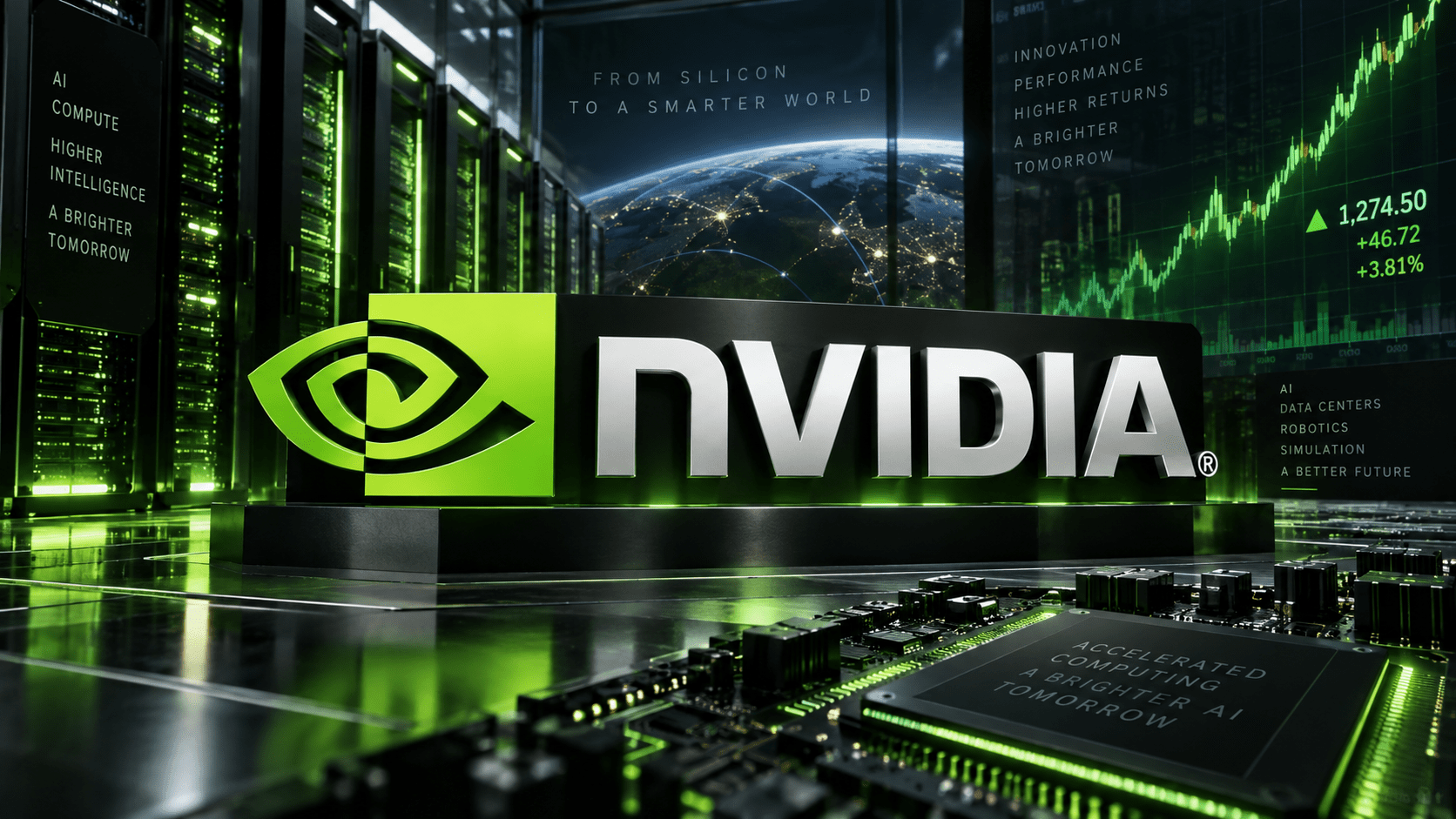
Nvidia stock just received one of the most aggressive demand signals Jensen Huang has delivered all year. Speaking to reporters in Scotland on September 17, Nvidia’s chief executive said he expects the company to sell roughly twice as many chips next year as this year, arguing that artificial intelligence is spreading across industries fast enough to support another enormous increase in semiconductor shipments. The statement comes only weeks after Nvidia reported $96.2 billion of quarterly revenue and told investors that supply — not demand — could remain the company’s biggest constraint well into fiscal 2028.
That combination is difficult for investors to ignore. Nvidia is already operating at a scale that would have looked almost impossible several years ago. Its Data Center division produced $89 billion of revenue in the latest quarter, up 117% from a year earlier, while Blackwell Ultra systems drove another major acceleration in hyperscaler and AI-cloud spending. Yet Huang is effectively saying the unit-volume expansion is still nowhere near finished.
The headline sounds spectacular for Nvidia stock.
But doubling chip shipments does not automatically mean doubling revenue or profits. The real question is whether Nvidia can manufacture enough Rubin and Blackwell systems, preserve its extraordinary margins and keep hyperscalers spending at the pace needed to absorb all that capacity.
That is where the story gets much more interesting.
Related articles





Huang Is Talking About Volume at a Scale
Huang’s comment is particularly important because Nvidia is no longer starting from a small base.
The company reported $96.2 billion of revenue in its fiscal second quarter, up 106% year over year. Data Center revenue alone reached $89 billion, increasing 117%. Hyperscale revenue more than doubled from the previous year, while demand from AI-native companies, enterprises, sovereign customers and cloud providers also accelerated sharply.
Nvidia is therefore trying to double unit shipments after already scaling production to levels without precedent in the company’s history.
Management has been preparing for exactly that problem.
Nvidia disclosed that its supply and capacity commitments jumped from $119 billion in the previous quarter to $279 billion as of July 26. Those commitments cover data-center infrastructure, memory and manufacturing capacity needed for both existing and future architectures.
That number may be the clearest evidence that Huang’s forecast is more than promotional enthusiasm.
Nvidia is committing enormous sums upstream because it expects enormous demand downstream.
The company also said it continues to face supply constraints and warned that the complexity and scale of producing its data-center systems can create manufacturing delays, yield problems and higher component costs.
In other words, the biggest obstacle to selling twice as many chips may not be finding customers.
It may be physically producing them.
Blackwell Is Still Booming
Nvidia’s current growth engine is Blackwell.
In its latest quarter, Blackwell remained the vast majority of Nvidia’s product mix, with Blackwell Ultra helping drive the extraordinary jump in Data Center revenue. But Nvidia has already begun shipping its next architecture, Vera Rubin, and management expects Rubin to account for around 20% of Data Center revenue in the current quarter.
That transition matters because doubling unit volumes next year will likely depend heavily on Rubin.
Nvidia unveiled the Rubin platform earlier this year as the successor to Blackwell, claiming that it can reduce inference token costs by as much as tenfold compared with Blackwell systems. Major cloud customers including Amazon Web Services, Google Cloud, Microsoft Azure and Oracle Cloud Infrastructure are expected to deploy Rubin-based infrastructure.
The opportunity is shifting as well.
Early AI spending was dominated by training enormous foundation models. Nvidia is increasingly emphasizing inference — the process of actually running those models for users, software agents and enterprise workloads.
At GTC in March, Nvidia said the revenue opportunity for AI computing infrastructure could reach at least $1 trillion through 2027 as inference demand expands.
That distinction helps explain why Huang believes chip volumes can keep climbing even after several years of extraordinary data-center investment.
Training produces massive but concentrated hardware purchases.
Inference can spread across almost every industry and application.
If AI assistants, autonomous agents, robotics, cybersecurity tools, enterprise software and industrial systems all begin generating continuous inference workloads, demand for computing could become much broader than the hyperscaler buildout that launched Nvidia’s first explosive growth phase.
Nvidia Is Already Guiding to 70% Growth
The most remarkable part of the current Nvidia story may be management’s preliminary fiscal 2028 outlook.
Nvidia said on its August earnings call that it currently expects revenue to grow approximately 70% year over year in fiscal 2028. Management also said supply could remain a bottleneck through at least the end of that fiscal year.
That is an unusual combination.
Most companies eventually face a demand problem as they grow.
Nvidia is telling investors its problem may remain producing enough hardware to satisfy customers.
Its current fiscal third-quarter guidance calls for roughly $108 billion of revenue, plus or minus 2%, representing another large sequential increase. Management expects growth to be driven primarily by accelerated computing and AI infrastructure, with hyperscaler spending expected to reaccelerate further into fiscal 2028 as Rubin supply expands.
Huang’s doubling comment therefore fits directly into Nvidia’s formal financial outlook rather than contradicting it.
The company is already preparing Wall Street for another year of extreme growth.
But investors should not assume twice the chips automatically means twice the earnings.
Memory Costs Could Become the Stock’s Next Problem
Nvidia’s biggest near-term financial risk is hiding inside its gross margin.
The company reported a 75% gross margin in the latest quarter — a level most semiconductor companies could only dream about. But Nvidia warned that memory prices are becoming increasingly expensive and could pressure profitability as it scales next-generation systems.
AI servers consume enormous quantities of high-bandwidth memory.
As Nvidia doubles chip volume, it also needs vastly more memory, advanced packaging, networking components, wafers and manufacturing capacity. That can strengthen suppliers’ pricing power.
Investors got a taste of this concern after Nvidia’s August earnings. The company initially surged following its enormous revenue forecast, but shares later came under pressure as traders focused on the possibility that rising component costs could compress margins even while sales continue exploding.
This is why unit growth alone is not the number Nvidia shareholders should watch.
The more important question is how much profit Nvidia earns from each additional dollar of revenue.
A company can double shipments and still disappoint investors if pricing declines sharply or manufacturing costs rise faster than expected.
So far, Nvidia has demonstrated extraordinary pricing power.
Maintaining it during a dramatic expansion in volume will be harder.
The Hyperscalers Still Have to Keep Writing Enormous Checks
There is also a demand concentration problem.
Microsoft, Amazon, Alphabet, Meta, Oracle and large AI laboratories have spent hundreds of billions of dollars building computing infrastructure. Industry-wide AI infrastructure investment is expected to approach $795 billion this year and could exceed $1 trillion in 2027, according to estimates cited by Reuters.
That spending supports Nvidia’s remarkable forecast.
It also creates one of the market’s biggest vulnerabilities.
If hyperscalers conclude they have overbuilt capacity, if AI monetization disappoints or if regulators force the industry to slow model development, semiconductor demand could change extremely quickly.
That concern exploded into view this week when calls from several AI leaders for slower development triggered a sharp selloff in chip stocks. The Philadelphia Semiconductor Index fell 5.9% on September 14 as investors questioned whether safety concerns could disrupt the investment cycle. Nvidia and other AI-linked companies were hit particularly hard.
Huang has pushed strongly against that narrative.
He argues that industries are only beginning to adopt AI and that economic benefits will encourage continued investment rather than retreat. His latest prediction of doubled chip volumes is effectively a direct rebuttal to investors worried that the AI infrastructure boom is nearing saturation.
Now Nvidia has to prove him right.
China Is Becoming a Smaller Part of Growth Equation
One surprising detail in Nvidia’s latest numbers is how little current growth depends on China.
Data Center Hopper shipments into China represented less than 1% of Data Center revenue during Nvidia’s fiscal second quarter, and the company excluded China Data Center compute revenue from its forward guidance because of continuing geopolitical uncertainty.
That reduces one historical risk.
Export restrictions have severely limited Nvidia’s ability to sell its most powerful AI processors into China, while Huawei is rapidly developing domestic alternatives. Huawei said this week that demand for its own AI computing products is already exceeding supply, and it plans to accelerate additional chip launches in 2027.
China remains strategically important, but Nvidia no longer needs a major rebound there to support management’s current growth forecast.
The doubling thesis instead rests primarily on global hyperscalers, AI labs, sovereign infrastructure and enterprise adoption.
That diversification could make Nvidia’s growth story more resilient.
Nvidia Stock Now Has to Outrun Enormous Expectations
The problem for shareholders is that Nvidia’s success is not exactly a secret.
The stock has already created trillions of dollars in market value as investors priced in years of AI dominance. That means spectacular growth is no longer enough.
Nvidia must deliver spectacular growth without slipping.
Revenue misses matter more. Margin compression matters more. Supply delays matter more. Any hint that cloud companies are moderating capex could create violent moves because current expectations are so high.
The bullish side of that equation remains formidable.
Nvidia doubled quarterly revenue year over year. Data Center revenue rose 117%. Management expects fiscal 2028 revenue growth around 70%. Supply commitments have reached $279 billion, and Huang now says unit volumes could double next year.
Those are not normal growth-company numbers.
They suggest Nvidia may still be operating in a market where demand is expanding faster than even one of the world’s most aggressive semiconductor supply chains can respond.
Nvidia Stock’s Next Phase Comes Down to One Question: Can Supply Catch Demand?
Jensen Huang’s latest statement changes the Nvidia debate in a subtle but important way.
Investors have spent much of 2026 wondering whether AI spending might finally slow.
Nvidia is preparing for the opposite.
The company has committed $279 billion to future supply capacity, launched Rubin into production, guided toward roughly 70% fiscal 2028 revenue growth and now expects to sell roughly twice as many chips next year. Its latest financial results show that demand from hyperscalers, AI companies, enterprises and sovereign customers remains extraordinarily strong.
The main threat may therefore be execution rather than demand.
Can Nvidia secure enough advanced manufacturing? Can memory suppliers keep pace? Can Rubin scale without costly delays? And can the company maintain margins near current levels while dramatically increasing unit volumes?
If the answers are yes, doubling shipments could turn Nvidia’s already astonishing revenue numbers into something even Wall Street’s most aggressive forecasts may struggle to capture.
If costs rise or customers begin pulling back, the same enormous supply commitments that demonstrate confidence today could become a liability.
That is why Huang’s prediction is more consequential than another bullish comment about AI.
Nvidia is no longer merely saying demand is strong.
It is building the supply chain for a world in which next year requires twice as many chips.
Now investors get to find out whether the AI economy is actually big enough to absorb them.
Disclaimer
This article is for informational purposes only and does not constitute financial or investment advice. Readers should conduct their own research and, where appropriate, consult a qualified financial advisor before making investment decisions. This article was researched and drafted with the support of AI, then reviewed, fact-checked and edited by the editorial team before publication.