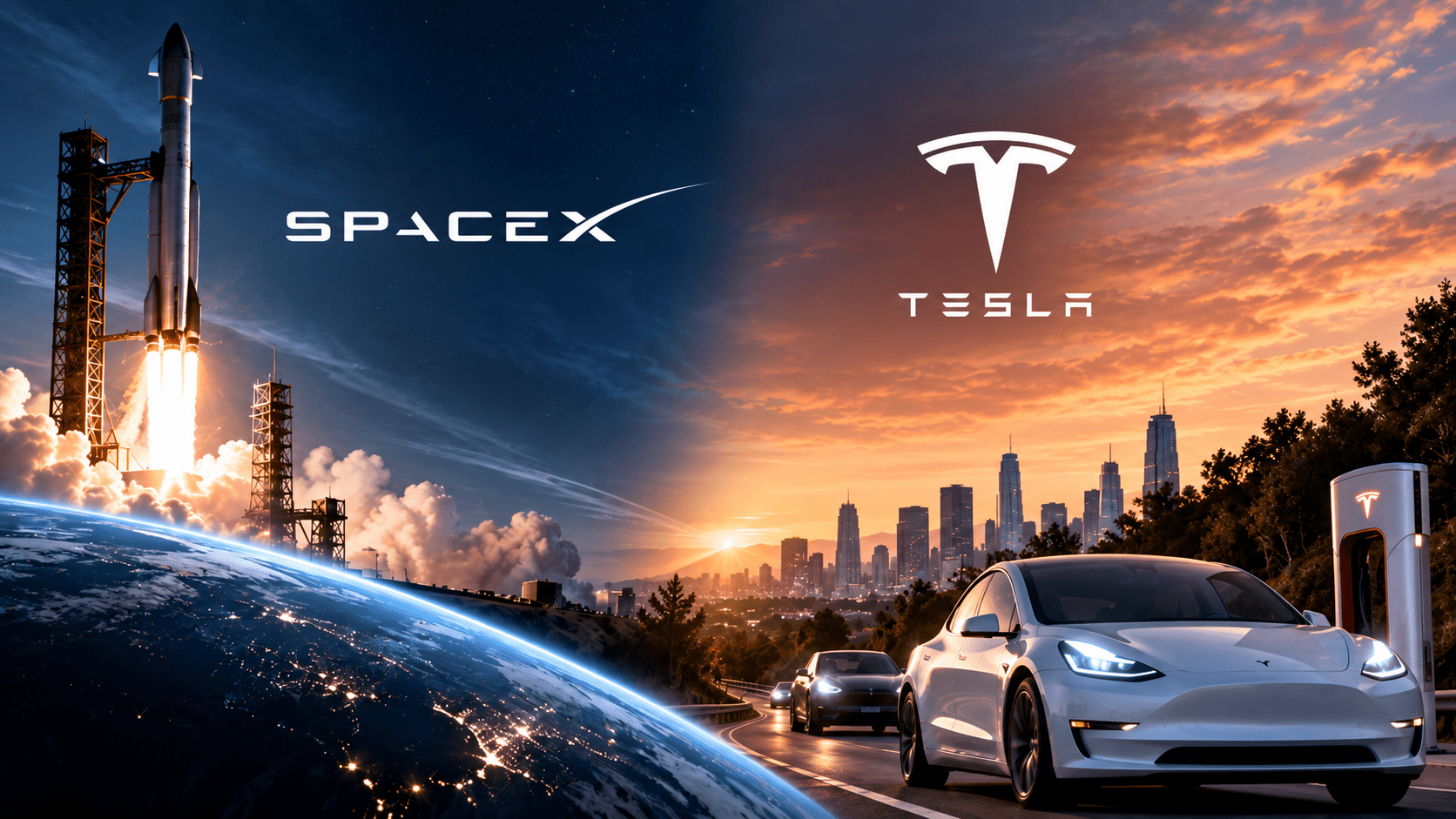
Tesla stock has a new catalyst that has almost nothing to do with electric vehicles. Elon Musk has once again refused to shut down speculation that Tesla and SpaceX could eventually combine, telling an audience at the All-In Summit that the two companies are collaborating so closely across chips, artificial intelligence, manufacturing, energy and computing that it is increasingly fair to ask why they remain separate. Asked directly about the logic of keeping them apart, Musk called it a “great question” and pointed to the growing overlap between the businesses without confirming that any transaction is being prepared. Tesla shares edged higher on Tuesday as investors revived a question that has followed Musk for months: could Tesla shareholders eventually gain direct exposure to SpaceX through one enormous corporate combination?
For now, the answer remains speculative. There is no announced merger agreement, no disclosed exchange ratio and no regulatory filing showing that Tesla or SpaceX has formally begun a transaction. Musk’s comments nevertheless matter because they are becoming increasingly consistent. During Tesla’s July earnings call, he said there was “more and more overlap” between Tesla and SpaceX and added that any discussion of combining the companies would have to take place through the appropriate formal process rather than casually on an earnings call. At the latest summit, he again chose not to dismiss the idea.
That keeps the possibility alive at a particularly interesting moment. SpaceX is now publicly traded following its record-setting June IPO, while Tesla is spending aggressively on AI, robotaxis, humanoid robots and its own chip infrastructure. A combination that once sounded like little more than an Elon Musk fan theory now has enough operational overlap that major Wall Street firms are discussing whether it could actually make strategic sense.
The Tesla-SpaceX Merger Idea Is Becoming Harder to Dismiss
The strongest argument for a combination is no longer simply that Musk controls both companies. Tesla and SpaceX are increasingly building pieces of the same technology stack.
Tesla contributes batteries, energy storage, high-volume manufacturing, autonomous-driving software, robotics and AI systems. SpaceX contributes launch capability, Starlink connectivity, satellite infrastructure, large-scale engineering expertise and an expanding computing operation. Their cooperation is becoming particularly visible around Terafab, the planned semiconductor manufacturing project in Austin that is expected to produce AI chips for both companies. Those chips could eventually support Tesla’s autonomous vehicles and Optimus robots while also serving SpaceX data centers and other AI workloads.
Related articles





SpaceX President Gwynne Shotwell reinforced that theme at the All-In Summit, saying teams across Musk’s businesses were integrating more quickly than she had expected, even though the companies were not yet fully integrated. She pointed to collaboration in AI, compute, solar manufacturing and other areas. Musk has also discussed ways Starlink connectivity could support Tesla vehicles and robotaxis, creating another potential link between SpaceX infrastructure and Tesla products.
That is why JPMorgan reportedly described a merger as strategically coherent on paper, citing potential overlap across AI, robotics, transportation, energy and space. Jefferies has also modeled how a combination could work and estimated that Musk could retain majority voting control under a deal without requiring an additional merger premium. Those exercises do not mean a transaction is imminent, but they show the idea has moved from online speculation into serious institutional analysis.
The real question for Tesla stock investors is whether that strategic logic would translate into economic value.
SpaceX Would Give Tesla Shareholders Exposure to a Completely Different Growth Engine
SpaceX is no longer a private asset hidden behind Musk’s personal holdings. Its June IPO raised $75 billion, the largest U.S. public offering on record, at a $135 share price that valued the company at roughly $1.77 trillion. Musk retained overwhelming voting control following the offering.
That valuation reflects far more than rockets.
Starlink has become a major global communications business, with more than 12 million users and growing ambitions in direct-to-device mobile connectivity. Reuters Breakingviews reported that SpaceX generated approximately $12.5 billion of revenue during the first half of 2026, with Starlink’s mobile and connectivity operations becoming a major contributor. The company has also expanded into AI infrastructure after absorbing xAI earlier this year, meaning SpaceX increasingly combines rockets, satellites, telecommunications and artificial intelligence under one corporate umbrella.
For Tesla investors, direct exposure to that business could diversify a company still heavily influenced by vehicle deliveries and automotive margins. Tesla delivered a record 480,126 vehicles during the second quarter of 2026, up roughly 25% from the prior year, but the company’s valuation increasingly rests on businesses that do not yet resemble traditional automaking. Robotaxis, autonomous driving, Optimus and AI infrastructure now play a much larger role in the long-term Tesla narrative than incremental vehicle deliveries alone.
Adding SpaceX would take that transformation much further. Tesla would effectively become one part of a massive Musk-controlled technology conglomerate spanning electric transportation, robotics, satellite communications, space launch, energy storage, semiconductor manufacturing and AI.
That sounds compelling. It would also create one of the most complicated valuation exercises Wall Street has ever seen.
A Merger Could Solve One Problem While Creating Another
Tesla’s biggest strategic challenge is becoming increasingly capital-intensive.
The company plans to spend more than $25 billion on capital expenditures in 2026, roughly triple its 2025 level, as it invests in factories, AI compute, robotaxis, battery infrastructure and robotics. Analysts surveyed by Tesla before its second-quarter results expected the company to generate negative free cash flow for the year because capex was rising faster than operating cash flow.
SpaceX is also spending heavily. Building Starship, expanding Starlink, constructing AI data centers and developing new semiconductor and communications infrastructure requires enormous amounts of capital. Both companies therefore face the same broad challenge: they are pursuing opportunities that could be enormous, but those opportunities require cash today for profits that may arrive years later.
Combining the businesses could theoretically improve capital allocation. Instead of Tesla and SpaceX independently financing chips, data centers, batteries, AI infrastructure and manufacturing systems, a merged entity could coordinate spending across a single balance sheet and potentially avoid duplicating some investments.
That is the optimistic interpretation.
The bearish interpretation is that Tesla shareholders could inherit even more capital intensity. Space launch, satellite constellations and AI infrastructure are not cheap businesses. A merger might diversify Tesla’s revenue, but it could also make its cash-flow profile even harder to predict.
That trade-off would depend heavily on valuation.
The Exchange Ratio Could Matter
Any Tesla-SpaceX combination would immediately produce one contentious question: who gets what percentage of the merged company?
SpaceX was valued at roughly $1.77 trillion at its IPO, while Tesla remains one of the largest publicly traded companies in the world. Because Musk owns significant stakes and voting power in both businesses, minority shareholders would scrutinize any transaction closely to make sure the exchange ratio did not unfairly transfer value from one group to another.
This is why the headline “Tesla merges with SpaceX” would not automatically be bullish for Tesla stock.
If Tesla paid too high a price for SpaceX, existing TSLA shareholders could face substantial dilution. If SpaceX shareholders received an unusually favorable exchange ratio, Tesla investors might effectively be financing the transaction on unattractive terms. Conversely, if Tesla shareholders received meaningful SpaceX exposure without an excessive premium, a deal could unlock access to a business many investors have wanted for years.
Jefferies’ modeling is notable because it suggests Musk might retain majority voting control even without a merger premium, potentially creating room for a structure that does not require Tesla shareholders to surrender as much value as skeptics might fear. But until actual terms exist, this remains theoretical.
That uncertainty explains why Tesla’s market reaction to Musk’s latest comments has been relatively restrained.
Investors like the idea.
They do not yet know the price.
Musk’s Real Goal
The deeper logic behind a merger becomes clearer when Tesla and SpaceX are viewed through the lens of artificial intelligence rather than automobiles and rockets.
Tesla needs huge amounts of compute for autonomous driving, robotaxis and Optimus. SpaceX needs AI for Starlink, autonomous systems, data-center services and its expanding xAI operations. Both companies need semiconductors, electricity, batteries, networking equipment and enormous physical infrastructure. Their joint work on Terafab directly addresses one of Musk’s recurring concerns: dependence on Asian semiconductor manufacturing, particularly Taiwan.
A combined company could theoretically control more of that stack internally. Tesla’s energy-storage products could power data centers. SpaceX satellites could provide connectivity to Tesla vehicles and robots. Shared AI chips could run across both terrestrial and orbital computing systems. Tesla’s manufacturing techniques could support satellite or hardware production, while SpaceX engineering could feed back into Tesla projects.
Even the long-delayed Roadster illustrates the cross-pollination. Tesla has teased SpaceX-inspired technology for the vehicle, and the company’s October 1 Roadster unveiling is being marketed with aerospace-themed language. That collaboration is more symbolic than financially important today, but it highlights how blurred the boundaries between Musk’s businesses have become.
A merger would turn that informal ecosystem into one company.
For investors, however, bigger does not automatically mean better.
Tesla Stock Would Inherit SpaceX’s Opportunities
SpaceX offers extraordinary assets, but it also introduces risks Tesla shareholders currently do not own directly.
The company depends partly on government and defense contracts, exposing it to political and procurement cycles. Its Starship program carries enormous technical and capital requirements. Starlink competes against deeply established telecommunications providers. Its AI expansion requires continued data-center investment, and its current valuation assumes that several businesses still in development will eventually become highly profitable.
Tesla itself already asks investors to underwrite ambitious future businesses alongside its current automotive operation. Adding SpaceX would create an even more complicated conglomerate in which cash generated by mature businesses could be redirected toward projects with distant or uncertain returns.
Governance would become another issue. Musk already holds enormous influence over both companies, and a combination would concentrate even more technology assets under one corporate structure and one controlling shareholder. Some investors might value that alignment because Musk could allocate people and capital more freely. Others could see it as increasing key-person and governance risk.
Those debates would become especially intense if shareholders were asked to vote on an actual transaction.
For now, they are still hypothetical.
The Next Biggest Stock Catalyst
The market has now heard Musk flirt with the merger idea several times. In July, he pointed to growing overlap while saying a formal process would be required. In September, he again emphasized extensive collaboration and declined to explain why the companies necessarily need to remain separate.
The next meaningful development therefore cannot simply be another cryptic comment.
Investors should watch for evidence of a formal board process, financial advisers being retained, an SEC filing, a special committee or explicit management confirmation that a transaction is under consideration. Until one of those things appears, the Tesla-SpaceX merger remains an increasingly plausible strategic idea rather than an announced deal.
That distinction matters for anyone buying Tesla stock because of the speculation.
Tesla can still rise on enthusiasm around the possibility, particularly because SpaceX offers exposure to Starlink, AI infrastructure and space businesses that TSLA shareholders otherwise do not own. But the valuation effect could reverse quickly if investors conclude Musk was merely discussing collaboration rather than preparing a transaction.
Tesla Stock Could Be Transformed
The companies share a chief executive, increasingly share technology, collaborate on AI and chip infrastructure, and operate businesses that could eventually fit inside a broader vertically integrated technology platform. SpaceX’s public listing has also removed one of the biggest practical obstacles: both companies now have observable public-market valuations and tradable stock.
But strategic logic is only the first step.
A deal would need acceptable valuation terms, board approvals, regulatory scrutiny and a structure that protects minority shareholders on both sides. Tesla investors would need to decide whether gaining exposure to Starlink, rockets and SpaceX’s AI ambitions is worth the dilution and added capital intensity that could come with them.
That is why Musk’s latest hint is interesting without yet being decisive.
If nothing formal follows, the merger speculation may once again fade into the background while Tesla trades on deliveries, margins, robotaxis and Optimus.
If Musk eventually turns those hints into an actual proposal, however, Tesla stock would stop being merely an EV-and-AI investment.
It could become the publicly traded core of an Elon Musk technology empire stretching from roads on Earth to satellites in orbit.
And at that point, the most important question will not be whether Tesla and SpaceX belong together.
It will be what Tesla shareholders have to pay to make it happen.
Disclaimer
This article is for informational purposes only and does not constitute financial or investment advice. Readers should conduct their own research and, where appropriate, consult a qualified financial advisor before making investment decisions. This article was researched and drafted with the support of AI, then reviewed, fact-checked and edited by the editorial team before publication.