
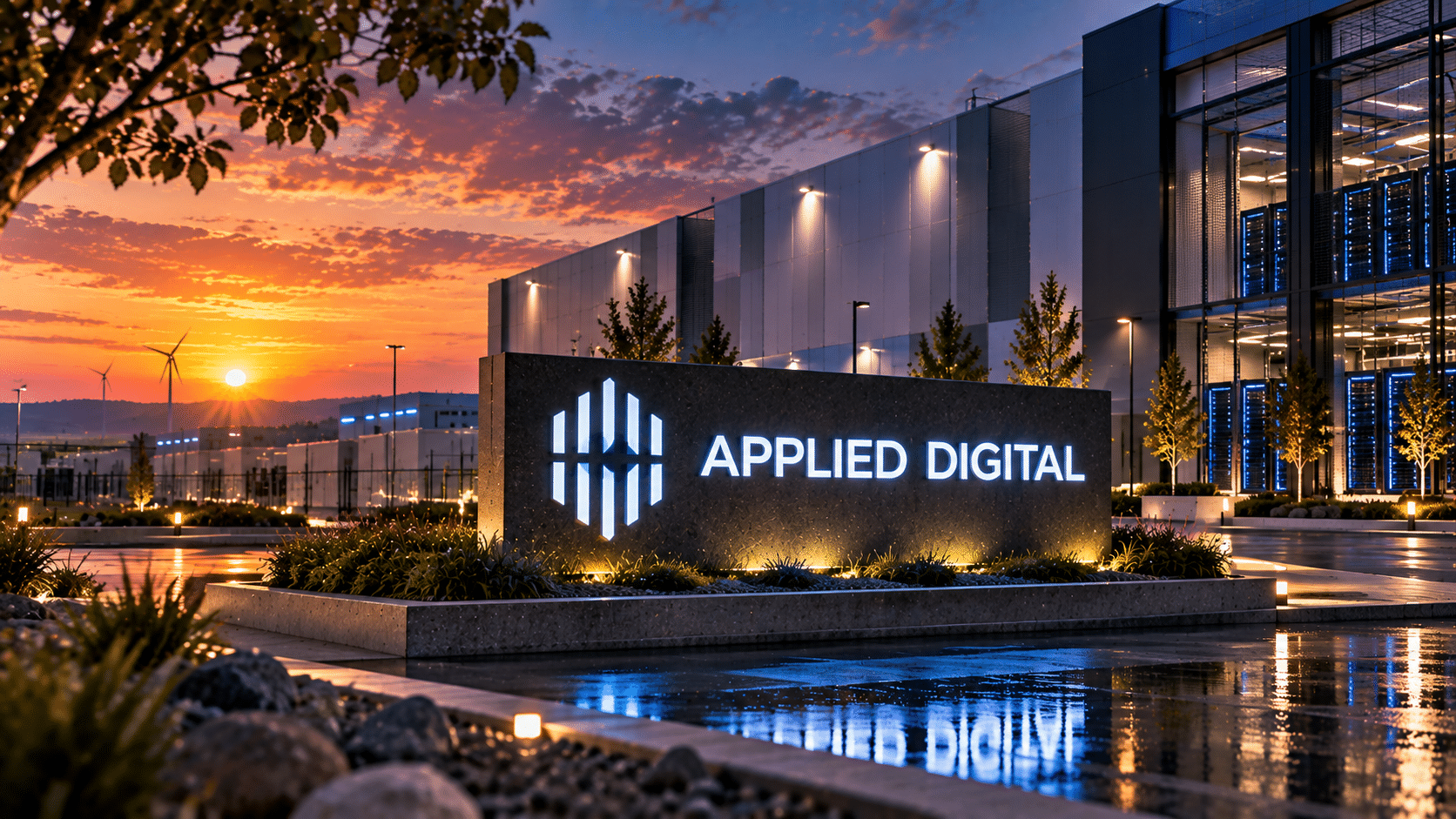
Applied Digital has delivered the kind of revenue growth that would normally send an artificial intelligence stock soaring. On October 7, 2026, the company reported $341.9 million in fiscal first-quarter 2027 revenue, an increase of approximately 322% from a year earlier, as its AI data center business expanded rapidly. Adjusted losses were also considerably smaller than analysts had expected. Yet the stock failed to produce a sustained rally, slipping approximately 1.5% during Thursday’s trading even as several Wall Street analysts maintained a constructive view of the company’s long-term prospects. The conflicting reaction reveals a growing tension in the AI infrastructure market: investors are increasingly demanding proof that enormous spending on data centers will eventually generate sustainable profits.
For investors following the Applied Digital stock forecast 2026, the latest earnings represent an important milestone. Applied Digital is transitioning from a company associated with cryptocurrency infrastructure into a major developer and operator of high-performance computing facilities designed for artificial intelligence workloads. Its expanding campuses, long-term customer relationships and ambitious construction pipeline provide exposure to one of the technology industry’s fastest-growing investment categories. But the same expansion requires billions of dollars in financing, creates substantial execution risks and leaves the company vulnerable to rising borrowing costs.
The question is no longer whether AI companies need more computing infrastructure. Demand is clearly substantial. The harder question is whether Applied Digital can convert that demand into enough recurring cash flow to justify the capital required to build its facilities.
A $341.9 Million Quarter Shows Applied Digital’s AI Strategy Is Becoming Real
Applied Digital’s latest financial results demonstrate how quickly its business model is changing. Revenue climbed to $341.9 million from approximately $80.9 million in the prior-year quarter, an increase of 322.5%. The company also reported an adjusted loss of approximately $0.01 per share, substantially better than the roughly $0.29 loss analysts had anticipated. These results exceeded Wall Street’s expectations and provided tangible evidence that the company’s investment in AI infrastructure is beginning to translate into recognized revenue.
However, the headline figures require closer examination. Applied Digital reported a net loss of approximately $221 million, underscoring the difference between rapid revenue growth and bottom-line profitability. The company is spending aggressively to develop data centers, finance construction and prepare additional capacity for large customers, meaning its financial statements reflect both the benefits of expanding operations and the considerable costs required to support them.
Related articles





This distinction matters because infrastructure businesses behave differently from traditional software companies. A software provider may be able to serve additional customers with relatively limited incremental investment, while a data center developer must secure land, electricity, cooling systems, buildings and specialized equipment before earning revenue from new capacity. Applied Digital’s growth is impressive, but investors must evaluate the cash required to produce it rather than focusing exclusively on the percentage increase in quarterly sales.
The Most Important Number Isn’t Revenue—It’s $65.8 Million in Base Rent
One of the most revealing figures in Applied Digital’s earnings report was the increase in base rental revenue from its high-performance computing hosting operations. The company generated $65.8 million in base rent, up from $44.1 million in the previous quarter, demonstrating that additional AI data center capacity is becoming operational and beginning to produce recurring income.
That development is significant because Applied Digital’s quarterly revenue also includes substantial amounts associated with tenant fit-out services, which involve preparing facilities to meet customers‘ technical requirements. During the quarter, the HPC Hosting business generated $262.6 million in revenue, consisting of $65.8 million in base rent, $183.5 million in tenant fit-out services and $13.3 million in tenant recoveries.
The composition of that revenue is crucial for investors. Tenant fit-out activity can produce substantial reported sales as facilities are constructed and prepared, but it does not necessarily represent the same recurring economics as long-term rental income. Base rent is therefore an important indicator of whether completed facilities are transitioning into operating assets capable of generating more predictable revenue over time.
Applied Digital’s latest results suggest that transition is progressing, although the company still needs to demonstrate that recurring rental income can eventually support its financing obligations and generate attractive returns for shareholders.
Polaris Forge Is Becoming the Centerpiece of Applied Digital’s Growth Story
The expansion of Applied Digital’s Polaris Forge campus provides some of the clearest evidence that the company is executing its AI infrastructure strategy. The first 100-megawatt building at Polaris Forge 1 became operational in October 2025, followed by the first 75-megawatt phase of a second building in July 2026. Another 75-megawatt phase came online on October 1, bringing operational capacity at the campus to 250 megawatts shortly after the fiscal quarter ended.
The company is also developing a third 150-megawatt building at Polaris Forge 1, while additional projects including Polaris Forge 2, Polaris Forge 3, Delta Forge 1 and Delta Forge 2 remain in various stages of construction. This growing network of facilities is intended to serve customers requiring large amounts of computing capacity for AI training, inference and other high-performance workloads.
The scale of the expansion illustrates both the opportunity and the challenge. AI customers increasingly need infrastructure capable of supporting power-intensive computing systems, advanced cooling technology and reliable long-term operations. Applied Digital is positioning itself as a specialist in developing that infrastructure rather than competing directly with the companies designing AI chips or building foundation models.
But each new campus also creates another set of construction deadlines, financing requirements and operational risks. Investors will therefore judge the company not simply by how much capacity it announces, but by how reliably that capacity becomes operational and begins generating revenue.
A $36 Billion Contract Backlog Changes the Long-Term Investment Case
Perhaps the most important number in Applied Digital’s latest filing is not quarterly revenue at all. As of August 31, the company had leases covering approximately 1.41 gigawatts of critical IT load across five campuses, representing roughly $36 billion in contracted revenue over their initial lease terms. If all renewal options were exercised, the potential total would reach approximately $86 billion. Those figures illustrate why analysts remain interested despite the company’s current losses: Applied Digital has already secured substantial long-term customer commitments for infrastructure that is still being developed. <Cite ref=“turn396604view0″/>
However, contracted revenue is not the same as cash already received, and the $86 billion figure depends on optional renewals that may never occur. Applied Digital must finish construction, meet delivery obligations and operate its facilities successfully to realize the economics of its agreements. The contracts nevertheless provide a degree of visibility that purely speculative AI infrastructure projects lack. The company is not simply building campuses and hoping customers eventually arrive; it has secured significant commitments from major computing customers, including CoreWeave and other hyperscalers. <Cite ref=“turn396604view0″/>
The opportunity becomes especially interesting when considered alongside Applied Digital’s newest developments. Its Delta Forge 2 campus includes a 210-megawatt, 15-year lease representing approximately $5.2 billion in contracted base-term revenue. If the company can repeatedly convert signed agreements into operating facilities, recurring rental income could increase substantially over the coming years. The challenge is ensuring that the economics remain attractive after construction costs, financing expenses and ongoing maintenance are considered.
Microsoft, Nvidia and Finland Show How Far Applied Digital Wants to Expand
Applied Digital’s ambitions extend beyond its existing North Dakota campuses. Its majority-owned subsidiary ChronoScale has announced plans involving Microsoft for a 50-megawatt AI computing deployment in North America using Nvidia GB300 NVL72 systems and advanced liquid cooling. Applied Digital owns approximately 96% of ChronoScale, although the subsidiary’s financial results are excluded from certain non-GAAP measures that management uses to evaluate its core data center operations. <Cite ref=“turn396604view0″/>
The company has also secured an agreement for up to approximately 1 gigawatt of potential power capacity in Finland, marking its first international development initiative. Management sees the Nordic region as attractive because of its cooler climate, access to electricity and potential suitability for large-scale computing infrastructure. The agreement does not mean a fully operational gigawatt-scale campus already exists, but it provides an option for future expansion if customer demand, permitting and financing conditions support development. <Cite ref=“turn976077search1″/>
These developments demonstrate how Applied Digital is attempting to establish itself as an infrastructure provider to the wider AI economy. Rather than betting on one particular AI model or semiconductor architecture, the company is seeking to supply the buildings, power and cooling systems required by increasingly sophisticated computing workloads. That positioning could prove valuable if hyperscaler investment remains elevated, but it also exposes shareholders to the possibility that infrastructure demand eventually grows more slowly than expected.
The $6.4 Billion Debt Burden Is the Risk Investors Cannot Ignore
The bullish case becomes more complicated when Applied Digital’s balance sheet enters the discussion. At the end of August, the company reported approximately $3.7 billion in cash, cash equivalents and restricted cash, alongside roughly $6.4 billion in debt. Its quarterly interest expense increased to $77.4 million from just $8 million a year earlier, reflecting the substantial borrowing required to support its construction program. <Cite ref=“turn396604view0″/>
The company also completed a $1.59 billion offering of senior secured notes carrying a 7% interest rate, with proceeds intended to finance additional infrastructure and repay an existing bridge facility. Such financing can be appropriate for long-lived assets supported by contractual rental income, but it creates fixed obligations that must be serviced regardless of short-term market conditions. If construction is delayed, customer payments begin later than expected or financing becomes more expensive, the pressure on cash flow can increase quickly.
This is particularly relevant because Treasury yields have risen sharply, creating a more difficult environment for companies dependent on external capital. Applied Digital’s long-term contracts may support access to financing, but the cost and availability of that financing will remain central to the stock’s valuation. The company must demonstrate that the returns generated by its facilities comfortably exceed the cost of building and funding them.
Why Wall Street Remains Interested Even After the Stock’s Disappointing Reaction
The muted stock-market response to Applied Digital’s earnings reflects a change in how investors are evaluating AI infrastructure companies. Rapid revenue growth once attracted attention almost automatically, particularly when businesses could connect their expansion plans to rising demand from major technology companies. Today, investors are increasingly examining the quality of revenue, capital intensity, financing structures and the timing of future cash generation.
Applied Digital’s results contain evidence supporting both optimism and caution. Revenue increased 322%, adjusted EBITDA reached $64.4 million, and additional data center capacity is beginning to generate recurring rental income. At the same time, the company reported a $221 million net loss, substantial interest expenses and a balance sheet carrying billions of dollars in debt. <Cite refs={[„turn976077news21″,“turn396604view0“]}/>
That explains why analysts can remain constructive about the company’s growth prospects even when the shares fail to rally. The business may be progressing operationally while investors reassess how much of that progress is already reflected in the valuation. Applied Digital’s long-term opportunity is considerable, but shareholders still need evidence that its expansion will create attractive returns after accounting for financing costs and potential dilution.
The next several quarters will therefore be judged less by spectacular percentage growth and more by the quality of the financial results supporting it.
The Applied Digital Stock Forecast 2026 Depends on Turning Construction Into Cash Flow
Applied Digital’s latest earnings confirm that its AI infrastructure strategy is advancing rapidly. The company has reported $341.9 million in quarterly revenue, brought additional computing capacity online, secured substantial long-term lease commitments and expanded its development pipeline beyond the United States. Those achievements provide tangible evidence that demand for large-scale AI data centers is translating into commercial opportunities rather than remaining confined to industry forecasts.
However, the company’s financial transformation is far from complete. Its quarterly results still include substantial nonrecurring construction-related revenue, its balance sheet carries significant debt, and its reported net losses demonstrate that growth has not yet translated into consistent profitability. The distinction between signed contracts, completed facilities and recurring cash generation will become increasingly important as the company scales.
Investors should focus on the pace at which new campuses become operational, the growth of base rental revenue, financing costs and the conversion of contracted capacity into sustainable operating income. Management’s expectation that delivered critical IT load across its North Dakota campuses could reach 300 megawatts by the end of 2026 provides one near-term milestone against which execution can be measured. <Cite ref=“turn396604view0″/>
The most compelling part of the investment case is the approximately $36 billion in initial-term contracted revenue associated with Applied Digital’s existing HPC leases. That backlog offers a potential foundation for years of growth, but realizing its value will require substantial additional investment and disciplined execution. The company must prove that it can deliver facilities on schedule, control construction costs and generate sufficient cash flow to support its obligations.
Applied Digital’s 322% revenue growth proves that the AI data center boom is already transforming its business. What it does not yet prove is how much of that growth will ultimately become profit for shareholders.
That is the tension behind Wall Street’s cautious optimism. Applied Digital has secured a position in one of the technology industry’s most important infrastructure expansions, but the next stage of its investment story will be determined by whether billions in contracted revenue can become billions in economically attractive, recurring cash flow.
Disclaimer
This article is for informational purposes only and does not constitute financial or investment advice. Readers should conduct their own research or consult a qualified financial advisor before making investment decisions. This article was researched and drafted with AI assistance and should undergo independent editorial review and fact-checking before publication.