What is currently happening?
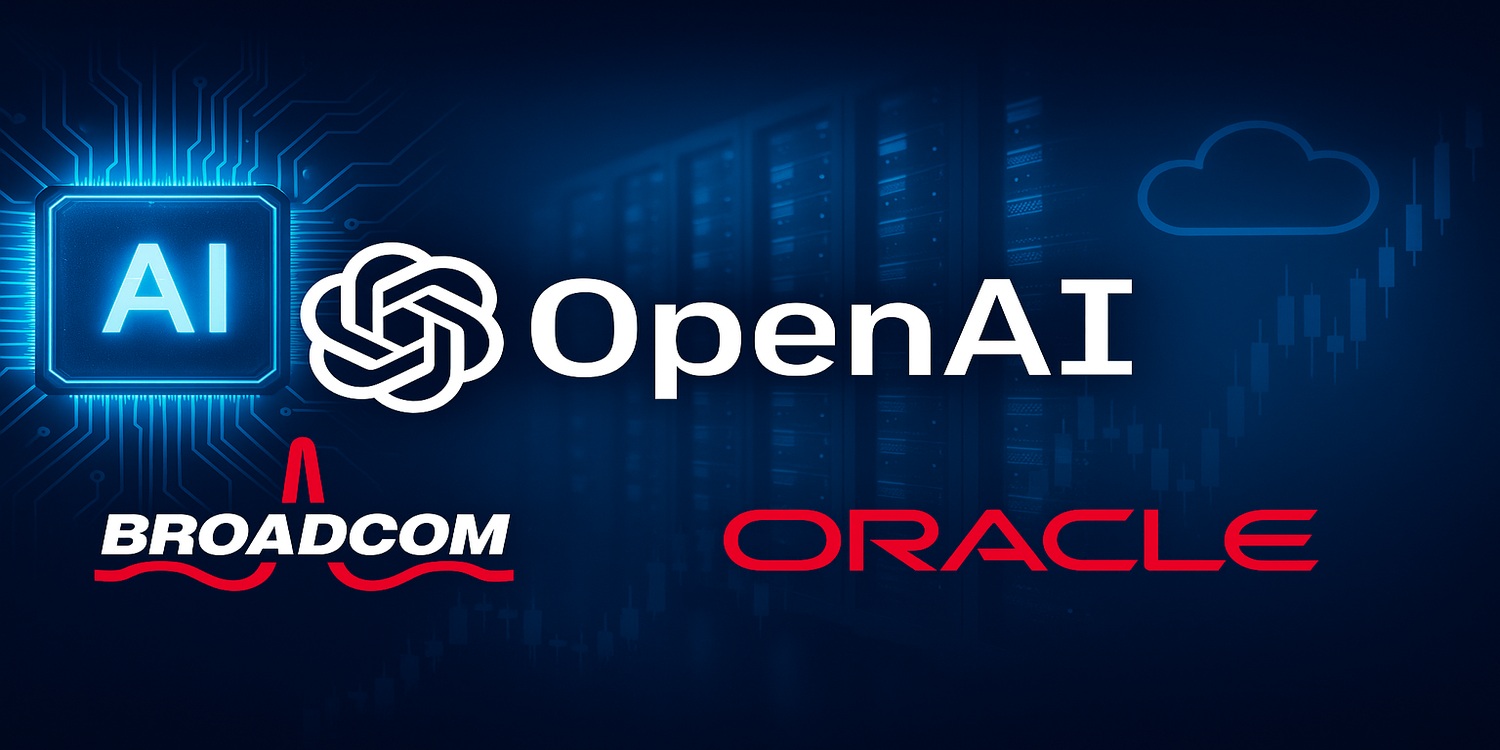
- Oracle: Multi-year cloud commitment around $60B per year over five years starting 2027 positions Oracle as a flagship AI landlord.
- Broadcom: Custom OpenAI accelerators and networking slated to begin deploying in 2H 2026, scaling through 2029 toward ~10 GW of capacity.
- Market impact: Diversifies OpenAI’s compute supply, pressures unit costs, and nudges the ecosystem toward a multi-vendor future—without displacing Nvidia near term.
The Oracle Agreement: Capacity, Visibility, Scale
OpenAI’s proposed five-year commitment—totaling roughly $300 billion—would be one of the largest compute purchases ever. For Oracle, this provides:
- Bookings visibility: Clear line of sight into multi-year AI demand.
- Utilization uplift: Better absorption of new data-center builds.
- Ecosystem pull-through: A marquee AI tenant that can attract partners, ISVs, and enterprise migrations.
Execution watchpoints: power procurement, construction timelines, GPU/accelerator supply, and the pace of OpenAI’s workload ramp to avoid under-utilized capacity.
The Broadcom Partnership: Owning the Cost Curve
OpenAI’s collaboration with Broadcom centers on custom AI accelerators and the networking fabric to tie clusters together. The rationale is straightforward:
- Performance per dollar: Encode model insights directly into silicon to bring $ / token down at scale.
- Supply assurance: Reduce reliance on a single vendor and broaden hardware pathways for both training and inference.
- Network strategy: Lean on Broadcom’s Ethernet-centric approach where it makes sense as an alternative to proprietary interconnects.
Timeline:
- 2025–H1 2026: Design, tape-outs, and site/power/network planning.
- H2 2026: Initial deployments of Broadcom-enabled systems.
- 2027–2029: Scale-out toward ~10 GW across multiple sites.
What It Means for the AI Value Chain
For OpenAI
- Cost & control: Custom silicon + reserved cloud capacity aim to compress unit costs as usage explodes.
- Resilience: Multi-sourcing mitigates hardware bottlenecks and price shocks.
For Oracle
- Anchor tenant status: A signature AI workload can redefine Oracle’s cloud growth narrative.
- Bottlenecks to solve: Power, cooling, supply chains, and delivery sequencing.
For Broadcom
- Beyond merchant silicon: A seat at the table co-designing full AI systems, with attached demand in switching and optics.
- Upside optionality: Long-dated visibility if deployments hit yield and performance targets.
For Nvidia (and AMD)
- Still central—for now: Software stack, ecosystem, and cadence keep Nvidia in the pole position.
- Pricing & mix pressure: Custom chips add negotiating leverage and alternative lanes, especially for targeted inference and specialized training.
How Enterprises Should Read This
- Don’t assume a single-vendor future. Expect multi-cloud, multi-silicon designs to proliferate.
- Watch the KPIs that matter: cluster utilization, training-to-inference mix, effective cost per 1M tokens, and model release cadence.
- Negotiate flexibly: Longer contracts can trade price for committed usage; short-term flexibility may cost more but reduces lock-in risk.
Risks & Open Questions
- Monetization vs. capex: Can AI product revenues and enterprise seat growth fund the capacity ramp without margin strain?
- Power & permitting: Sourcing gigawatt-scale power with grid upgrades and sustainability requirements is non-trivial.
- Software readiness: Compilers, runtimes, and frameworks must mature quickly for new accelerators to reach target performance.
- Ecosystem politics: How these deals intersect with existing supplier agreements and hyperscaler partnerships.
Bottom Line
OpenAI’s two-pronged strategy—locking in massive cloud capacity with Oracle and co-developing custom accelerators with Broadcom—is a bid to own its cost curve and de-risk supply as AI demand surges. It doesn’t dethrone Nvidia today, but it reshapes the playing field for 2026–2029. The swing factor is utilization: if clusters run hot with profitable workloads, these moves could reset AI infrastructure economics for the next cycle.
Related articles




FAQ
When does the Oracle commitment begin?
The five-year drawdown is scheduled to start in 2027, with spend phased to match demand and build-outs.
When will Broadcom’s custom accelerators show up?
Initial deployments are targeted for 2H 2026, followed by a multi-year scale-out through 2029.
Does this threaten Nvidia now?
Not immediately. It adds alternatives and bargaining power, but Nvidia’s platform lead persists in the near term.
What’s the biggest execution risk?
Power and supply chain: aligning energy, cooling, fabs, and networking at multi-gigawatt scale while achieving performance targets.
Disclaimer
This article is for information purposes only and does not constitute investment advice or an offer to buy or sell any security**. Investing involves risk, including loss of principal. Conduct your own research and consider consulting a licensed financial adviser. All figures, dates, and views reflect information available as of October 13, 2025 (Europe/Berlin) and may change without notice.