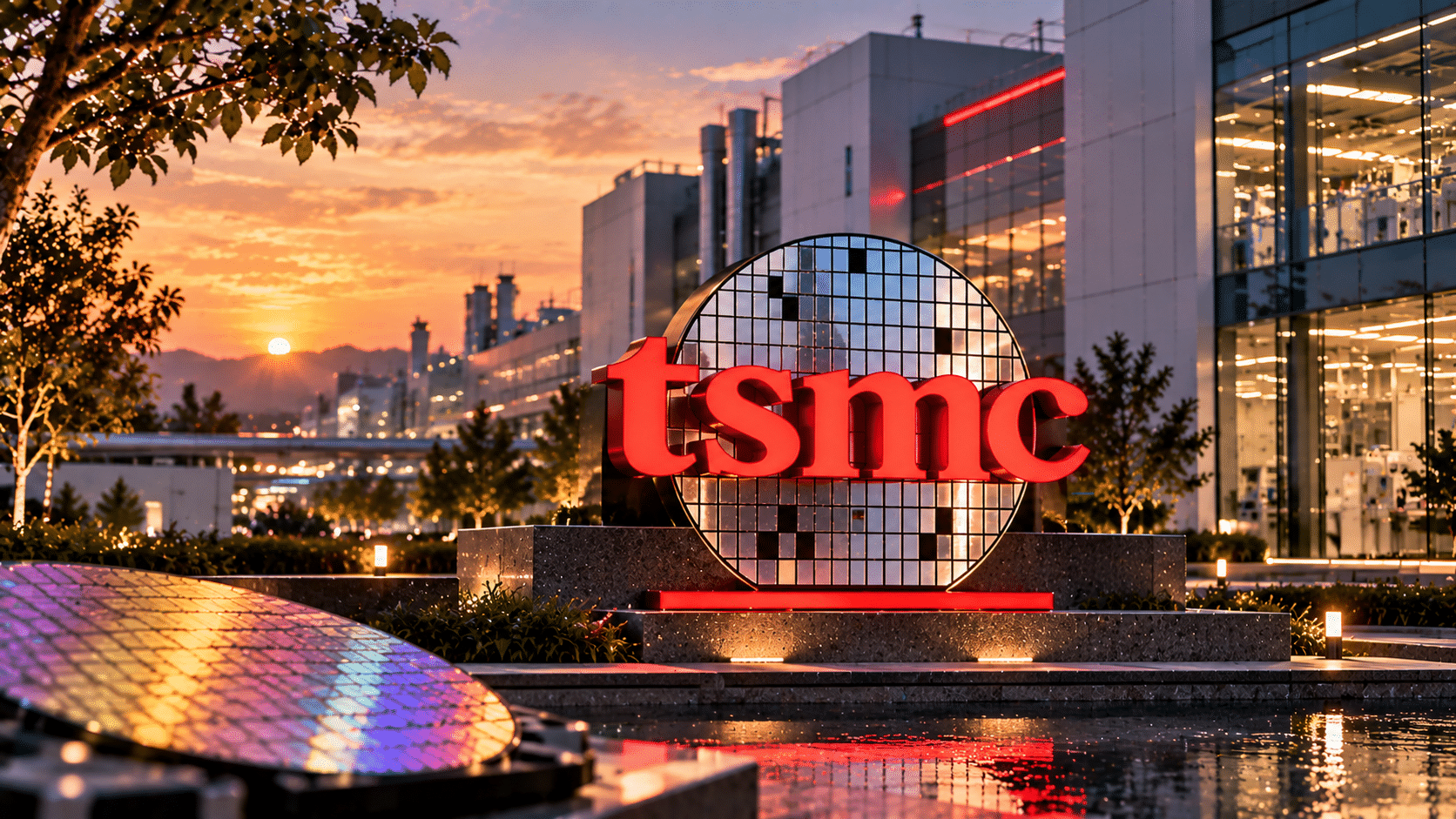
Taiwan Semiconductor Manufacturing Co. is making a staggering bet on how long the artificial-intelligence boom can last. The world’s dominant contract chipmaker has expanded its planned investment in Arizona to $265 billion, including another $100 billion announced in July for additional 2-nanometer-and-below factories and advanced packaging capacity. Now TSMC is reportedly evaluating an additional multibillion-dollar manufacturing campus in Texas as Nvidia, AMD and other AI customers scramble for more leading-edge chips. The scale transforms the TSMC stock forecast 2026 into something bigger than another semiconductor growth story: TSMC is effectively betting that AI demand will remain powerful enough to justify recreating a substantial portion of its world-leading manufacturing ecosystem on American soil.
The timing is remarkable because TSMC isn’t expanding into weak demand. Second-quarter dollar revenue surged 33.7% year over year to $40.2 billion, while net income jumped 77.4% and gross margin reached an extraordinary 67.7%. The company expects third-quarter revenue of $44.6 billion to $45.8 billion as leading-edge demand remains exceptionally strong. July revenue subsequently increased 44.7% from a year earlier and August revenue jumped another 53.3%, suggesting the AI infrastructure boom has yet to show meaningful signs of exhaustion.
But there is a catch buried inside those spectacular numbers. TSMC has warned that overseas manufacturing will be more expensive than producing chips in Taiwan, potentially diluting gross margin by 2 to 3 percentage points initially and 3 to 4 points later as international factories scale.
That means $265 billion isn’t simply a vote of confidence in AI.
It is a test of whether TSMC can export the economics that made it one of the world’s most profitable manufacturers.
Related articles




TSMC Is Building Something Much Bigger Than a Few American Chip Fabs
The numbers surrounding TSMC’s Arizona project have become so large that it is easy to lose perspective. The company’s latest $100 billion expansion brings its total planned investment in Arizona to $265 billion, covering 10 fabs, two advanced packaging facilities and a research-and-development center, according to Arizona officials. The additional fabs will focus on 2-nanometer and more advanced manufacturing technologies—the chips expected to power future generations of AI accelerators and high-performance computing.
TSMC’s first Arizona fab has already been producing N4 chips since late 2024, with yields the company says are comparable to its facilities in Taiwan. Construction of the second fab, which will use 3-nanometer technology, is complete and volume production is expected to begin in 2027. When the broader buildout is finished, Arizona is expected to account for roughly 30% of TSMC’s 2-nanometer-and-more-advanced manufacturing capacity.
That is a dramatic strategic shift.
For decades, TSMC’s manufacturing concentration in Taiwan created enormous efficiencies. Engineers, suppliers, equipment companies and factories existed inside an extraordinarily dense semiconductor ecosystem that competitors have struggled to replicate.
Now TSMC is deliberately creating a second advanced-manufacturing cluster thousands of miles away.
The reason is increasingly obvious: its largest customers want it.
Nvidia and AMD Need More Chips—and TSMC Sits at the Center of the AI Arms Race
One of the most unusual characteristics of the AI boom is that many of the companies competing most aggressively against each other depend on the same manufacturer.
Nvidia relies on TSMC to produce its advanced AI processors. AMD uses TSMC for its expanding Instinct accelerator and EPYC CPU portfolio. Apple remains a major customer. Numerous custom AI accelerators developed by hyperscalers also depend on leading-edge foundry capacity and advanced packaging.
That makes TSMC less like another participant in the AI race and more like the tollbooth through which much of the industry must pass.
AMD CEO Lisa Su highlighted the supply pressure this week when she said AMD plans to substantially increase chip supply during 2027. Su is meeting TSMC as AMD works to secure more advanced wafer capacity for CPUs and GPUs and said the company is planning its supply requirements three to five years ahead.
TSMC is seeing the same signals across its customer base. CEO C.C. Wei said the additional Arizona investment is being driven by strong multiyear demand from leading U.S. customers, while CFO Wendell Huang has described customer demand as structural rather than temporary.
This is what makes the $265 billion figure so striking.
TSMC doesn’t appear to be building speculative factories and hoping customers eventually arrive. Its biggest customers are effectively telling the company they expect to need far more computing capacity years from now.
And TSMC is responding with concrete.
TSMC’s 67.7% Gross Margin Shows Just How Powerful the Business Has Become
The strongest argument supporting the expansion can be found in TSMC’s current profitability.
Second-quarter revenue reached NT$1.27 trillion, or approximately $40.2 billion, rising 36% in Taiwan-dollar terms from a year earlier. Gross margin expanded to 67.7% from 58.6% a year earlier, while operating margin surged to 60.3%. Net income increased 77.4% to NT$706.6 billion, and diluted earnings per ADR reached $4.31.
Those are extraordinary margins for a manufacturing company investing tens of billions of dollars every year in some of the most complicated factories ever constructed.
Leading-edge technology is driving the economics. Three-nanometer products represented 30% of second-quarter wafer revenue, while 5-nanometer accounted for another 33%. Including 7-nanometer, advanced technologies represented 77% of total wafer revenue. Even 2-nanometer, still early in its production ramp, already contributed 3%.
The next wave is arriving quickly.
TSMC expects its steep 2-nanometer ramp to temporarily reduce gross margin by around three to four percentage points during the second half of 2026, but strong demand and productivity improvements should offset part of that pressure.
That margin pressure is largely the cost of preparing for future growth.
The more difficult issue comes from where those future chips are manufactured.
America Could Become TSMC’s Biggest Opportunity—and Its Biggest Margin Headache
TSMC’s Taiwan factories benefit from an ecosystem built over decades. Suppliers are nearby. Engineers are plentiful. Construction expertise is deeply established. Manufacturing infrastructure has been optimized repeatedly across multiple technology generations.
Arizona does not yet possess that same density.
TSMC has already encountered challenges including a shortage of skilled construction workers, while building and operating U.S. semiconductor facilities remains more expensive than doing so in Taiwan.
Management has been unusually transparent about the consequences. TSMC expects overseas factories to dilute consolidated gross margin by approximately 2 to 3 percentage points during the early stages of the expansion, eventually widening to roughly 3 to 4 percentage points as the overseas footprint becomes larger.
For a less profitable semiconductor manufacturer, that might be devastating.
For TSMC, the starting point is a 67.7% gross margin.
That gives the company an enormous financial cushion, but investors shouldn’t dismiss the issue. If American production becomes a substantially larger percentage of TSMC’s advanced manufacturing base, small differences in factory economics can translate into billions of dollars.
The crucial question is whether customers will effectively help pay for geographic diversification through pricing.
Leading U.S. technology companies have powerful reasons to want more domestic production. A geographically diversified supply chain reduces dependence on Taiwan, offers protection against geopolitical disruption and places advanced semiconductor capacity closer to America’s largest AI companies.
Those benefits have economic value.
TSMC will want to capture it.
The Texas Rumor Suggests $265 Billion May Not Be the Final Number
Just when $265 billion began sounding like the ceiling, another possibility emerged.
TSMC is evaluating a potential second U.S. manufacturing hub in Texas, according to Reuters and Bloomberg, which could involve multiple fabs and tens of billions of dollars in additional investment. No final decision has been made.
The fact that TSMC is even studying another giant American campus before completing its Arizona buildout says something about the industry’s expectations.
AI customers aren’t asking TSMC to think about the next twelve months.
They are asking it to prepare for the next decade.
A Texas expansion could also carry strategic benefits. It would give TSMC another U.S. manufacturing location, reducing concentration risk inside America itself. It could deepen the company’s access to skilled engineering talent and semiconductor suppliers while positioning additional capacity near customers and the rapidly expanding U.S. data-center industry.
But every new site also magnifies the execution risk.
TSMC must recruit workers, build supplier networks, install extraordinarily complex equipment and reproduce the manufacturing discipline of its Taiwanese operations.
The company can afford to build factories.
The harder challenge is making them operate like TSMC factories.
Intel and Samsung Now Face a Competitor Bringing Its Best Technology to America
TSMC’s U.S. expansion also changes the competitive landscape for Intel.
Intel has spent years arguing that American technology companies need a domestic alternative to Asian semiconductor manufacturing. Its foundry turnaround is built partly around the idea that geopolitical concerns and supply-chain diversification will push customers toward U.S.-based manufacturing.
TSMC is now weakening that argument by bringing leading-edge manufacturing directly to Arizona.
The first Arizona fab is already producing N4 chips with yields comparable to Taiwan. The second will move to 3 nanometers. Future facilities will manufacture at 2 nanometers and below.
That means customers seeking U.S.-based manufacturing may eventually have a choice between Intel Foundry and TSMC rather than between Intel in America and TSMC in Taiwan.
Intel can still compete on technology, packaging, pricing and strategic relationships. Its 14A process remains a critical opportunity to attract external customers. Samsung also continues investing aggressively in advanced foundry manufacturing.
But TSMC possesses something neither rival can easily manufacture: customer trust built over decades of executing successfully at scale.
Even Japan’s government-backed Rapidus project illustrates that problem. Potential customers are reportedly interested in diversifying supply chains, but some remain hesitant to move away from TSMC because advanced semiconductor manufacturing requires much more than promising process specifications.
TSMC’s $265 billion American expansion brings that reputation directly into Intel’s backyard.
The TSMC Stock Forecast 2026 Depends on Whether AI Demand Can Outrun the Spending
The risk to TSMC stock isn’t difficult to identify.
Semiconductor factories are among the most capital-intensive assets in the world, and TSMC expects 2026 capital spending to reach approximately $60 billion to $64 billion. A meaningful slowdown in AI investment after years of aggressive capacity expansion could leave the company carrying underutilized factories just as depreciation costs accelerate.
There are also signs that expectations throughout the AI ecosystem have become extraordinary. Goldman Sachs estimates U.S. hyperscalers could invest as much as $1.1 trillion by 2027, illustrating just how much capital is now chasing AI infrastructure.
No investment cycle grows at that speed indefinitely.
But TSMC currently has something many AI infrastructure companies do not: enormous profits today.
Its $40.2 billion second quarter wasn’t built on distant projections. Gross margin was already 67.7%, net profit margin reached 55.6%, and third-quarter revenue is expected to climb again toward $45 billion.
The company’s monthly numbers strengthen the argument. Through August, 2026 revenue had increased 39.3% year over year, with July growing 44.7% and August accelerating 53.3%.
TSMC therefore isn’t borrowing against an uncertain AI future to build capacity.
It is using the extraordinary profitability of today’s AI boom to prepare for what its customers say is coming next.
That distinction matters.
$265 Billion Is Really a Bet That the AI Boom Is Becoming Permanent Infrastructure
The most important number in the TSMC stock forecast 2026 may no longer be next quarter’s revenue or even the company’s gross margin.
It may be $265 billion.
Companies don’t commit that amount of capital because they expect a two-year product cycle. TSMC is preparing physical infrastructure that will operate across multiple semiconductor generations, from today’s advanced nodes through 2 nanometers and eventually technologies beyond them.
Arizona is expected to house roughly 30% of TSMC’s 2-nanometer-and-more-advanced capacity when the announced buildout is complete. A possible Texas campus could push America’s share higher still.
For investors, that creates a fascinating trade-off.
TSMC is becoming geographically safer but potentially more expensive to operate. It is moving closer to Nvidia, AMD and other U.S. customers but farther from the concentrated Taiwanese manufacturing ecosystem that helped produce its extraordinary margins. It is reducing geopolitical concentration while dramatically increasing capital commitments.
And it is doing all of this because customers are asking for more chips.
So far, the financial evidence supports the gamble. Revenue is surging, margins remain exceptional, advanced nodes dominate the product mix and AMD is publicly discussing the need for significantly more capacity.
The next test will be whether Arizona can reproduce Taiwan’s manufacturing economics closely enough to prevent geographic diversification from becoming a permanent drag on shareholder returns.
If TSMC can do that, its American expansion could strengthen the company’s competitive moat while reducing one of the biggest geopolitical discounts attached to the stock.
If it cannot, investors may discover that moving the world’s most sophisticated semiconductor manufacturing ecosystem halfway around the planet carries a much larger price than expected.
For now, however, TSMC is sending the market an unmistakable message.
The company manufacturing the chips behind the AI revolution isn’t preparing for demand to cool down. It is spending $265 billion preparing for the possibility that this is only the beginning.
Disclaimer
This article is for informational purposes only and does not constitute financial or investment advice. Readers should conduct their own research and, where appropriate, consult a qualified financial advisor before making investment decisions. This article was researched and drafted with the support of AI, then reviewed, fact-checked, and edited by the editorial team before publication.