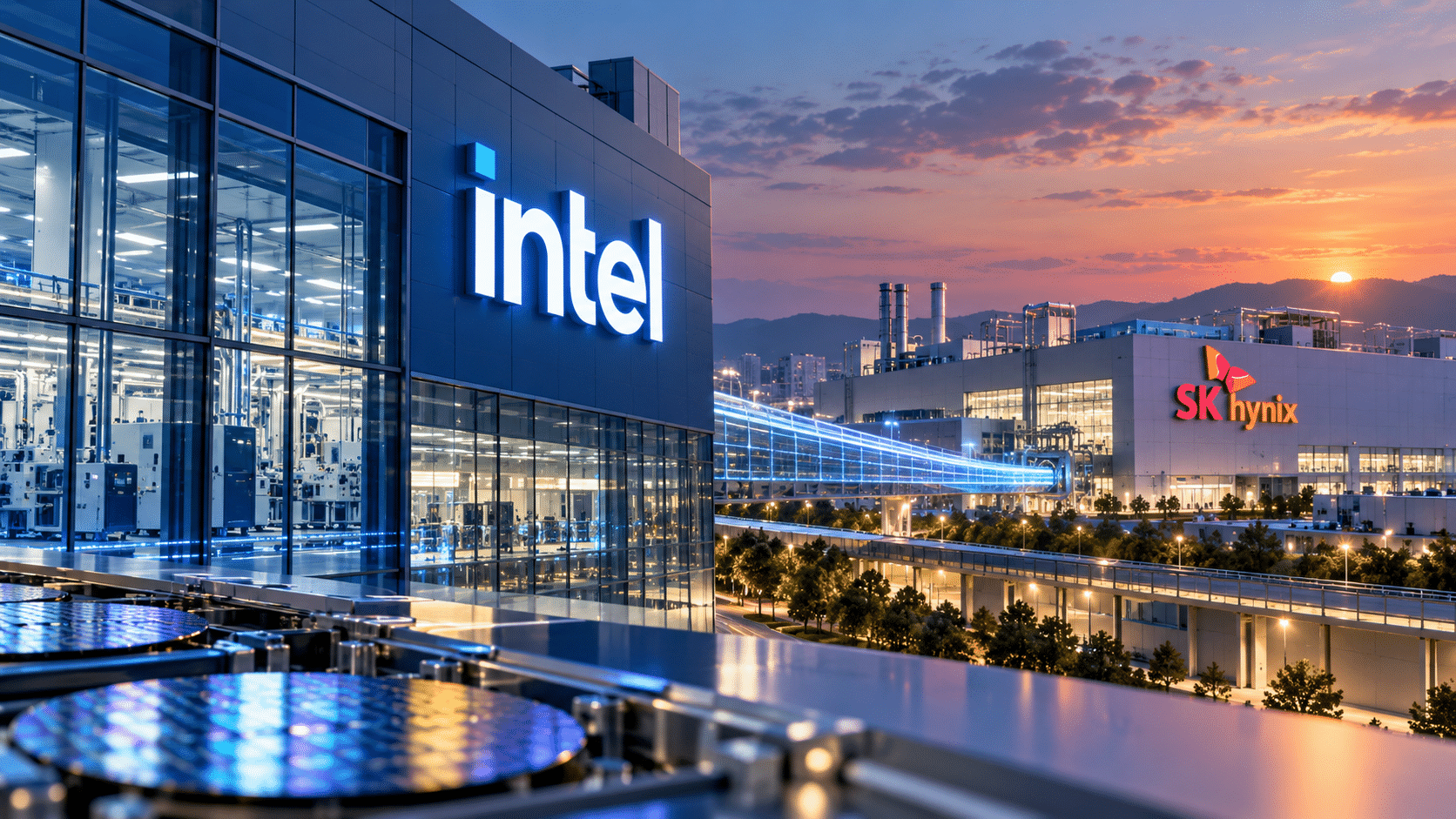
Intel investors received an important message from CEO Lip-Bu Tan on Wednesday: Elon Musk’s Terafab project has not walked away from Intel. Tan told Bloomberg that Intel will continue working with Musk on the enormous semiconductor-manufacturing initiative, easing fears that Taiwan Semiconductor Manufacturing Co. could displace Intel after Musk confirmed discussions with the world’s dominant contract chipmaker. Yet the reassurance doesn’t completely remove the threat. Instead, it turns Terafab into an unusually public test of the Intel stock forecast 2026 and the company’s multiyear effort to prove that its advanced manufacturing technology can compete with TSMC for the world’s most demanding customers.
Intel joined Terafab in April alongside Musk’s Tesla, SpaceX and xAI, bringing its semiconductor manufacturing, advanced packaging and process-development expertise to a project whose ambitions border on extraordinary. Musk has previously discussed using Intel’s next-generation 14A manufacturing process, while Terafab ultimately aims to build enormous quantities of computing hardware for his expanding AI, automotive and space businesses. The relationship quickly became symbolic of Intel’s foundry comeback because landing Musk as an advanced-process partner would provide exactly the kind of external validation Wall Street has been waiting for.
Then TSMC entered the conversation.
Musk confirmed over the weekend that discussions with TSMC were taking place, although he emphasized they were only discussions and said something could eventually come from them. Intel shares fell as investors immediately questioned whether the Taiwanese giant might replace Intel, split the project or take the most valuable manufacturing work for itself. Tan’s latest comments make clear Intel remains involved—but they don’t answer the question that matters most.
What exactly will Intel manufacture, and will Musk ultimately trust 14A with enough production to prove Intel Foundry has arrived?
Related articles



Intel Is Still Inside Terafab—but TSMC Changed the Meaning of the Deal
Before the TSMC discussions surfaced, Terafab looked like an unusually clean victory for Intel’s foundry strategy. Intel had joined the project in April, and Musk had specifically discussed Intel 14A as part of the manufacturing plan. For a company trying to persuade outside customers that its factories can once again produce the world’s most advanced semiconductors, few endorsements could have generated more attention.
TSMC’s potential involvement complicates that story.
The Taiwanese company isn’t simply another semiconductor manufacturer. It is the dominant global pure-play foundry, producing advanced chips for customers including Nvidia, AMD and Apple. Its manufacturing record gives customers something Intel’s emerging external-foundry business still lacks: decades of proof that leading-edge products can be manufactured reliably at massive scale.
Reports around the Terafab discussions have suggested several possible structures, including a scenario in which TSMC could own and operate a new factory while SpaceX or the broader Terafab venture provides capital, production commitments or both. No final agreement has been announced, and Musk has characterized the talks as preliminary.
There is also no requirement that the project use only one semiconductor manufacturer. Given Terafab’s extraordinary scale, Intel and TSMC could ultimately participate simultaneously. Dual sourcing would hardly be unusual in an industry where customers increasingly want geographic and supplier diversification.
That possibility explains why Tan’s confirmation matters.
Intel has not been pushed out.
But the presence of TSMC means Intel may now have to earn every wafer.
Terafab Matters More to Intel’s Reputation Than Its Revenue—At Least for Now
Investors should be careful not to treat Terafab as though billions of dollars of guaranteed Intel revenue have suddenly appeared on the income statement. Specific financial terms have not been publicly disclosed, and SpaceX’s earlier filings described Terafab as a framework under which individual projects would still require separate agreements. Neither Intel nor Tesla was guaranteed to remain involved indefinitely.
That makes the project’s immediate importance primarily strategic.
Intel’s foundry business desperately needs major outside customers.
During the second quarter of 2026, Intel Foundry generated approximately $5.8 billion of revenue, up from $4.4 billion a year earlier. But most of that activity remained internal. External foundry revenue totaled just $293 million, although that was a substantial increase from $22 million in the prior-year quarter. Intel’s filing also shows that much of the increase reflected Altera becoming an external customer following its deconsolidation.
Meanwhile, the segment still reported an operating loss of roughly $2.09 billion during the quarter.
Those numbers reveal why Musk matters.
Intel doesn’t simply need factories running Intel-designed products. It needs sophisticated outside customers willing to entrust their most valuable chips to Intel manufacturing, because only then can investors begin treating Intel Foundry as a genuine alternative to TSMC rather than an expensive internal manufacturing network carrying a new name.
Terafab could provide precisely that validation.
And 14A is the technology that could determine whether it happens.
Intel 14A Has Become the Real Story Behind the Musk Headlines
Intel’s current 18A process represented a crucial step in restoring the company’s manufacturing credibility, but 14A is arguably even more important to the external-foundry strategy. It is being developed with outside customers in mind and represents Intel’s opportunity to win substantial leading-edge business after years in which TSMC steadily expanded its technological and commercial dominance.
CEO Lip-Bu Tan has said customers are expected to make important 14A supplier decisions during the second half of 2026 and into 2027. Volume production is expected later, making today’s customer commitments critical because advanced chips are designed years before mass production begins.
That makes Terafab an unusually valuable potential reference customer.
Musk’s businesses consume enormous amounts of silicon. Tesla needs chips for autonomous driving, vehicles and robotics. SpaceX requires specialized semiconductors for satellites and communications. xAI is building increasingly powerful artificial-intelligence infrastructure. If Terafab develops custom silicon spanning those businesses and Intel becomes a meaningful manufacturing partner, 14A could receive one of the highest-profile endorsements imaginable.
Other prospective customers would notice.
But the opposite is equally true.
If Terafab ultimately chooses TSMC for its most advanced products while Intel receives a smaller manufacturing or packaging role, investors may interpret the decision as evidence that 14A still has work to do.
That is why the TSMC talks hit Intel shares even though no Intel contract was actually canceled.
Wall Street understood the symbolism immediately.
Intel’s Foundry Is Losing Billions—So Marquee Customers Are No Longer Optional
Intel’s manufacturing transformation has consumed extraordinary amounts of capital, and shareholders have spent years waiting for the payoff. The company is expanding semiconductor manufacturing in the United States while simultaneously trying to improve yields, reduce costs and convince external customers that Intel can manufacture their products reliably.
The losses show how difficult that transition remains.
Intel Foundry’s second-quarter operating loss of $2.09 billion was better than the $3.17 billion loss recorded a year earlier, but it remains enormous. For the first six months of 2026, the segment lost approximately $4.53 billion on $11.19 billion of revenue.
There is progress underneath those numbers. Intel said foundry revenue increased partly because higher volumes moved through Intel 18A, Intel 3 and Intel 4, while manufacturing execution improved. External revenue is also beginning to increase from an extremely small base.
Yet investors eventually need evidence that Intel can transform factories from a financial burden into a competitive commercial business.
That requires scale.
A company such as Musk’s Terafab operation could help provide it.
The crucial distinction, however, is whether Intel merely contributes technology and expertise to Terafab or whether Intel Foundry actually receives substantial paid manufacturing volume at Intel-owned facilities. Those outcomes may sound similar in a headline, but financially they are very different.
Intel needs wafers.
The Rest of Intel’s Business Is Finally Giving Tan More Time to Fix the Foundry
The good news for shareholders is that Intel’s entire investment thesis no longer rests exclusively on manufacturing.
Second-quarter revenue increased 25% year over year to $16.1 billion, representing the company’s strongest revenue growth in more than 15 years. Non-GAAP earnings reached $0.42 per share, while Intel forecast third-quarter revenue between $15.8 billion and $16.8 billion and adjusted earnings of approximately $0.38 per share.
AI is helping drive the turnaround.
Demand for server CPUs has strengthened dramatically as the growth of agentic AI creates greater need for general-purpose processing alongside GPUs. Intel’s Data Center and AI business generated approximately $6.26 billion of quarterly revenue, while the company has also been working to expand advanced packaging and custom-silicon opportunities.
That recovery matters enormously for Intel Foundry because manufacturing turnarounds take time and money. A healthier CPU franchise gives Tan more financial breathing room to improve process technology, raise yields and secure customers without depending on immediate foundry profitability.
It also means investors shouldn’t evaluate Intel exclusively through the Terafab headlines.
Losing the entire Musk opportunity would damage confidence in 14A, but it would not erase the improving CPU business.
Keeping Terafab, meanwhile, would not automatically fix the foundry.
The scale of Intel’s challenge is much larger than one customer.
TSMC May Actually Force Intel to Prove Something Investors Need to Know
There is an uncomfortable but potentially healthy interpretation of the TSMC news: competition could make the Terafab project a more meaningful test of Intel than it was before.
If Musk had simply committed to Intel because of strategic considerations around U.S. manufacturing, investors might always wonder whether 14A won the business on technological and economic merit.
Now there may be another benchmark.
TSMC has spent decades perfecting the foundry model. Customers design chips; TSMC manufactures them at extraordinary scale. Intel is trying to prove it can offer customers a credible alternative while simultaneously continuing to design and sell its own processors.
If Terafab evaluates both companies and Intel still wins meaningful advanced-node production, the endorsement becomes more powerful.
It would suggest Intel can compete for business even when customers have access to the industry’s established leader.
There are strategic reasons Musk might want multiple partners regardless of which technology is superior. His companies‘ projected chip requirements are enormous, and concentrating all production with one manufacturer creates supply-chain risk. U.S.-based production also carries geopolitical value as tensions surrounding Taiwan remain a long-term concern for semiconductor customers.
That could leave room for both Intel and TSMC.
But room isn’t the same thing as revenue.
Investors need to see exactly where Intel fits.
Intel Stock Is Already Pricing in a Foundry Comeback That Hasn’t Fully Happened Yet
The valuation creates another complication for the Intel stock forecast 2026.
Intel shares have rallied dramatically as investors price in stronger AI-related CPU demand, improving execution and growing confidence that the company can finally stabilize its manufacturing business. Even after falling when Musk confirmed the TSMC talks, Intel traded around $116-$117, with shares having more than doubled from levels seen before the April Terafab announcement.
That rally raises the standard Intel must now meet.
At roughly 57 times estimated 2027 earnings in one recent calculation, Intel trades at a dramatically higher forward earnings multiple than TSMC, reflecting expectations for a powerful earnings recovery rather than today’s established profitability.
That does not automatically make Intel overvalued. Turnaround companies can justify elevated forward multiples when earnings are emerging from depressed levels.
But it means investors are increasingly paying for things that still need to happen.
14A needs to attract major customers. Foundry losses need to continue narrowing. CPU growth needs to remain strong. Manufacturing yields need to improve. And massive capital expenditures eventually need to produce adequate returns.
Terafab could help prove several parts of that thesis.
It could also expose the weakest ones.
The Intel Stock Forecast 2026 Now Has a Very Simple Terafab Test
Lip-Bu Tan’s message should eliminate one of the market’s biggest immediate fears: Intel is still working with Musk on Terafab despite the TSMC discussions.
That is unquestionably better for Intel than being replaced.
But shareholders should resist turning the announcement into proof that Intel has already secured a transformative foundry victory. The financial structure remains unclear, manufacturing allocations have not been fully disclosed and TSMC is now openly part of the conversation.
The next developments therefore matter much more than today’s reassurance.
Investors should watch for a firm 14A production commitment, details about which Terafab chips Intel would manufacture, whether production takes place inside Intel’s own fabs and how much wafer volume the project could eventually represent. Those answers will determine whether Terafab becomes a meaningful revenue source or primarily a prestigious technology partnership.
Meanwhile, Intel’s broader turnaround continues. Second-quarter revenue growth reached a 15-year high, AI is revitalizing server CPU demand and foundry losses are improving even though they remain enormous.
That leaves investors with an unusually clean test.
Musk doesn’t need Intel simply because Intel needs Musk. He can talk to TSMC, the world’s dominant foundry, and potentially use more than one manufacturing partner.
Intel therefore has to prove it deserves the business.
If 14A wins meaningful Terafab production while competing directly with TSMC, Intel could gain something more valuable than the immediate revenue: evidence that its foundry comeback is finally credible to one of the world’s most demanding technology customers.
If TSMC captures the critical advanced-node work and Intel is left with a secondary role, Wall Street will have to ask whether the foundry recovery embedded in INTC’s rally has moved ahead of reality.
Intel survived the first Terafab scare. Now comes the test that matters: whether it can keep Musk because 14A is good enough—not simply because Intel was there first.
Disclaimer
This article is for informational purposes only and does not constitute financial or investment advice. Readers should conduct their own research and, where appropriate, consult a qualified financial advisor before making investment decisions. This article was researched and drafted with the support of AI, then reviewed, fact-checked, and edited by the editorial team before publication.