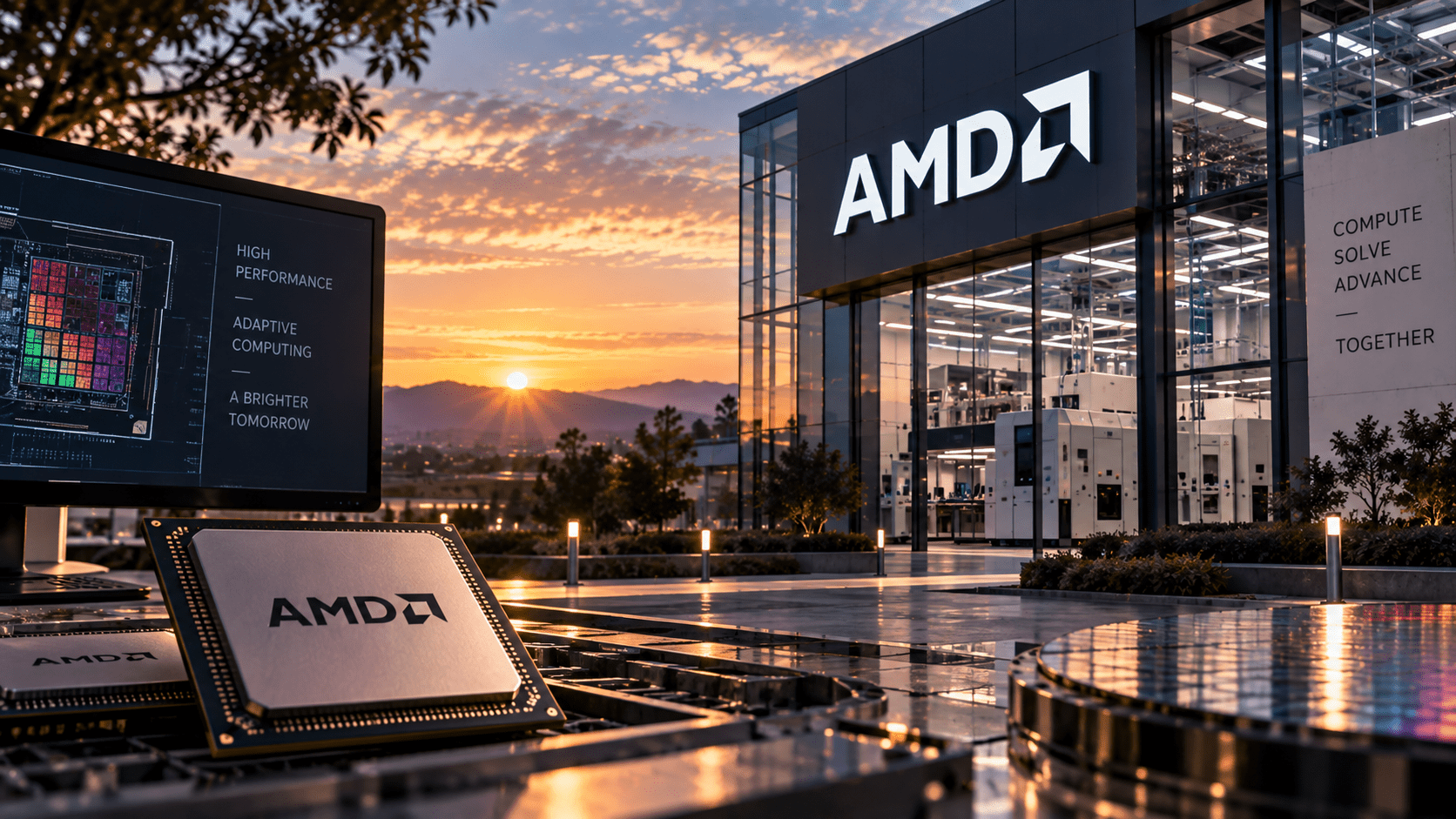
Advanced Micro Devices has spent years convincing Wall Street that it can challenge Nvidia in artificial-intelligence accelerators, but Citi now sees another potentially enormous opportunity hiding in plain sight: the humble CPU. Analyst Atif Malik raised his AMD price target to $800 from $575 on October 6, arguing that the explosion of agentic AI could transform the global CPU market from roughly $29 billion in 2025 to $300 billion by 2030. AMD shares rose about 2% following the call, extending a remarkable run that has pushed the chipmaker above a $1 trillion market value and turned the AMD stock forecast 2026 into a debate over just how much AI growth investors should be willing to price in.
The eye-catching $800 target implies roughly 25% upside from AMD’s recent price around $640, but the number behind Citi’s forecast is arguably more important. A $300 billion CPU market would be more than ten times its estimated 2025 size, representing approximately 60% compound annual growth, according to Malik. The catalyst isn’t simply bigger cloud data centers or another generation of faster PCs. Citi believes increasingly autonomous AI agents—systems capable of continuously performing tasks rather than waiting for a human to type the next question—could require orders of magnitude more computing resources than conventional chatbots. AMD, already gaining momentum with its EPYC server processors, could become the biggest CPU beneficiary of that shift, while Intel would participate as a secondary winner.
That is a dramatically different AMD thesis from the one investors have spent the past two years debating. If Citi is right, AMD doesn’t have to beat Nvidia at its own game to justify substantially higher earnings. It could win another AI battle entirely.
Meta’s Muse May Have Just Changed Wall Street’s CPU Math
The catalyst behind Citi’s new forecast is Meta’s personal AI agent, Muse, which Malik believes offers an early glimpse of how dramatically computing requirements could change when AI moves beyond traditional chatbots. A chatbot is largely reactive: a user asks a question, the model processes the request and produces an answer. An autonomous or semi-autonomous AI agent can behave very differently, remaining active in the background, monitoring information, interacting with applications and carrying out multi-step tasks without waiting for a constant stream of human prompts.
That difference sounds subtle until it is multiplied across hundreds of millions—or eventually billions—of users. Instead of compute resources being activated periodically when someone asks a chatbot for help, agentic systems could continuously consume CPU cycles, memory, networking capacity and accelerator resources. Citi describes that change as potentially producing orders-of-magnitude greater compute demand, which is why Malik dramatically increased his CPU-market estimate after examining the early adoption of Muse.
Related articles




Mizuho reached a similarly bullish conclusion, although with more conservative assumptions. The firm raised its AMD price target to $705 from $580 and estimates agentic AI could account for approximately 30% of server CPU units by 2030. Mizuho sees the agentic CPU opportunity reaching roughly $80 billion and the total server CPU market approaching $209 billion, compared with AMD’s own projection of more than $220 billion. The exact forecasts differ substantially, but the direction is the same: Wall Street increasingly believes AI could revive CPU growth just as investors were becoming accustomed to treating GPUs as the only chips that mattered.
And AMD may be unusually well positioned to capture that revival.
AMD’s EPYC Business Is Already Showing What a CPU Renaissance Could Look Like
Citi’s argument would be far less compelling if AMD were still trying to prove itself in server CPUs, but the company has already spent years taking share from Intel with its EPYC processor family. That momentum accelerated sharply in 2026 as cloud and enterprise customers expanded AI infrastructure and required increasingly powerful host CPUs alongside GPUs.
AMD’s second-quarter revenue reached a record $11.5 billion, up 50% year over year, while non-GAAP earnings came in at $1.66 per share. The Data Center segment was the standout performer, with revenue more than doubling to approximately $6.7 billion on strong demand for EPYC processors and Instinct AI accelerators. AMD expects second-half 2026 server CPU revenue to grow approximately 80% from a year earlier, followed by roughly 70% growth in 2027.
Those numbers matter because they show the CPU thesis isn’t merely based on a theoretical 2030 market forecast. AMD is already experiencing substantial server growth today, and agentic AI could potentially extend that growth by increasing both the number of servers required and the computing intensity inside each system. If autonomous agents become mainstream across consumer and enterprise applications, the server CPU could become an increasingly important component of AI infrastructure rather than an accessory sitting beside the GPU.
That is exactly why Citi identifies AMD as the primary beneficiary rather than simply declaring that a rising CPU tide will lift every semiconductor company equally. Meta is believed to be one of AMD’s largest server customers, giving the company direct exposure to the kind of hyperscale AI deployment Citi thinks could reshape the market.
But AMD isn’t betting on CPUs alone.
Helios Could Turn AMD From a Chip Supplier Into an AI-System Challenger
The bigger strategic transformation underway at AMD is its move from selling individual processors toward offering complete AI infrastructure. The company’s next-generation Instinct MI450 GPUs and sixth-generation EPYC “Venice” CPUs are designed to power Helios, AMD’s rack-scale AI platform combining accelerators, CPUs, networking and software into an integrated system.
That strategy matters because Nvidia’s greatest advantage isn’t simply that it produces powerful GPUs. Nvidia has built an entire computing ecosystem around those processors, combining accelerators, networking, rack-scale architecture and CUDA software into systems that hyperscalers can deploy at enormous scale. AMD increasingly wants to compete at that same system level rather than asking customers to assemble disparate AMD components themselves.
Recent analyst calls suggest Wall Street is becoming more optimistic about that strategy. Stifel raised its AMD target to $700, while BNP Paribas lifted its target to $960, specifically highlighting Helios as a credible alternative to Nvidia’s AI infrastructure offerings.
If Helios succeeds, AMD could benefit twice from the AI buildout. Its Instinct accelerators would compete for GPU spending, while EPYC processors would capture the CPU demand required to manage increasingly complex AI workloads. Networking and system-level components could add further revenue.
That makes the $300 billion CPU forecast especially powerful. AMD doesn’t need the forecast to replace its GPU opportunity; it can sit alongside it.
The problem is that producing enough chips to satisfy those ambitions is becoming a challenge of its own.
Lisa Su Is Already Preparing for a 2027 Supply Crunch
On the same day Citi raised its AMD price target, CEO Lisa Su was in Taiwan discussing something considerably more tangible than analyst forecasts: how to manufacture enough processors to meet demand.
Su said AMD plans to substantially increase chip supply in 2027, with the company seeing significant demand across both CPUs and GPUs. She met Foxconn executives and planned discussions with Taiwan Semiconductor Manufacturing Co. as AMD works to secure additional manufacturing capacity. Su is also expected to visit South Korea, where Samsung Electronics and SK Hynix are critical suppliers of the advanced memory required for AI systems.
The message is significant because semiconductor companies normally worry about excess inventory when demand forecasts become overly optimistic. AMD currently appears to be worried about the opposite problem: not having enough supply to capture the opportunity.
Su said the company is planning three to five years ahead because additional advanced wafer capacity will be necessary if AI demand continues growing as expected. AMD’s Data Center revenue is projected to more than double in 2027, while AI GPU revenue is expected to increase well over 100%.
That creates an unusual situation. Citi is raising its long-term CPU-market assumptions at the same time AMD is actively trying to expand physical production capacity, suggesting the bullish argument is moving beyond spreadsheet projections and into real supply-chain decisions.
Yet that urgency creates risks too. Semiconductor capacity is expensive, and today’s shortages can become tomorrow’s oversupply if demand assumptions prove too aggressive.
A $300 Billion CPU Market Would Lift Intel Too—But Citi Still Prefers AMD
AMD isn’t the only company capable of benefiting if Citi’s forecast proves remotely accurate. Intel remains one of the world’s dominant server CPU manufacturers and would almost certainly participate in a market expanding from $29 billion toward hundreds of billions of dollars. Citi explicitly describes Intel as a secondary beneficiary of the CPU renaissance, while Mizuho raised its Intel price target to $114 from $92.
The distinction is important. A rapidly expanding market can sometimes be more valuable than market-share gains because competitors no longer have to steal every dollar of growth from each other. If agentic AI genuinely creates enough demand to multiply the size of the server CPU opportunity, AMD and Intel could both increase revenue even while fighting fiercely over share.
AMD nevertheless enters that fight with momentum. EPYC has steadily established credibility among hyperscalers and enterprise customers, while Meta’s importance as an AMD server customer gives the company direct exposure to one of the earliest large-scale experiments in personal AI agents. Citi therefore sees AMD as the company most likely to capture disproportionate value from the expansion.
There is also a less obvious winner: memory.
Citi noted that CPUs carry substantial memory requirements, and Micron has indicated that rising CPU demand is contributing to constraints in DRAM. Agentic AI could therefore create a cascading hardware effect in which more autonomous agents require more CPUs, those CPUs require more memory, and the overall infrastructure needs additional networking and storage.
The AI trade may be broadening far beyond GPUs.
For AMD shareholders, however, broader opportunity doesn’t automatically mean the stock is cheap.
AMD Stock Above $600 Leaves Almost No Room for an Ordinary Outcome
The biggest challenge facing the AMD stock forecast 2026 is valuation. Shares have risen approximately 195% year to date, recently traded around $640 and pushed AMD’s market capitalization beyond $1 trillion. That extraordinary rally means investors are no longer buying a misunderstood challenger with modest expectations. They are buying a company already priced for substantial AI success.
Citi’s $800 target still implies meaningful upside, while BNP Paribas‘ $960 target represents an even more aggressive bull case. But the higher AMD climbs, the more demanding the assumptions required to support those targets become. Mizuho’s new $705 target is based on approximately 41 times fiscal 2027 estimated earnings, up from roughly 34 times previously, illustrating how investors are increasingly paying not only for earnings growth but for the expectation that growth will remain exceptional.
That leaves AMD exposed to several risks. Agentic AI adoption could progress more slowly than Citi expects. Hyperscalers could develop more custom silicon. Intel could regain competitiveness. Nvidia could extend its dominance beyond GPUs into more of the AI-system architecture. Manufacturing or memory constraints could prevent AMD from shipping enough products even if customer demand remains strong.
There is also the broader AI-spending question. Reuters recently reported increasing investor concern that U.S. corporate profit growth could slow in 2027 as the pace of AI capital-expenditure growth moderates from this year’s extraordinary levels. A slowdown does not mean AI investment disappears, but stocks carrying enormous growth expectations can react violently when growth merely becomes less spectacular.
AMD therefore doesn’t simply need AI to grow.
At its current valuation, it needs AI infrastructure demand to remain extraordinary.
The AMD Stock Forecast 2026 Now Depends on a Bet Much Bigger Than GPUs
Citi’s new $800 target changes the way investors should think about AMD because the most important number in the report isn’t actually $800. It is $300 billion.
If the CPU market really expands from roughly $29 billion in 2025 to $300 billion by 2030, the implications for AMD would extend far beyond another successful generation of EPYC processors. It would suggest that agentic AI is creating an entirely new layer of computing demand in which autonomous software continuously consumes CPU, GPU, memory, networking and storage resources. AMD could participate across several of those layers simultaneously, while its Helios architecture attempts to package them into a coherent AI platform.
The evidence is beginning to line up. Data Center revenue has already more than doubled. AMD expects server CPU growth to remain extraordinary into 2027. Lisa Su is actively working with suppliers to expand production capacity. Citi, Mizuho, Stifel and BNP Paribas have all recently lifted their expectations, even if their assumptions and targets differ.
But after a roughly 195% year-to-date rally and a trillion-dollar valuation, the market is no longer giving AMD much credit for merely executing well. Investors are increasingly paying for a future in which AI fundamentally expands the total amount of computing the world consumes.
That is what makes Citi’s call both exciting and dangerous.
If personal AI agents evolve from an intriguing product category into software that continuously works for hundreds of millions of people, today’s CPU market forecasts could prove far too conservative. AMD could find itself selling into one of the fastest-expanding semiconductor markets the industry has ever seen.
If agentic AI fails to generate that explosion in compute, the valuation suddenly becomes much harder to defend.
For years, the question surrounding AMD was whether it could take enough CPU share from Intel and enough AI accelerator share from Nvidia.
Citi’s latest forecast poses a much bigger question.
What if AMD doesn’t need to steal the whole pie because AI is about to make the pie ten times larger?
Disclaimer
This article is for informational purposes only and does not constitute financial or investment advice. Readers should conduct their own research and, where appropriate, consult a qualified financial advisor before making investment decisions. This article was researched and drafted with the support of AI, then reviewed, fact-checked, and edited by the editorial team before publication.