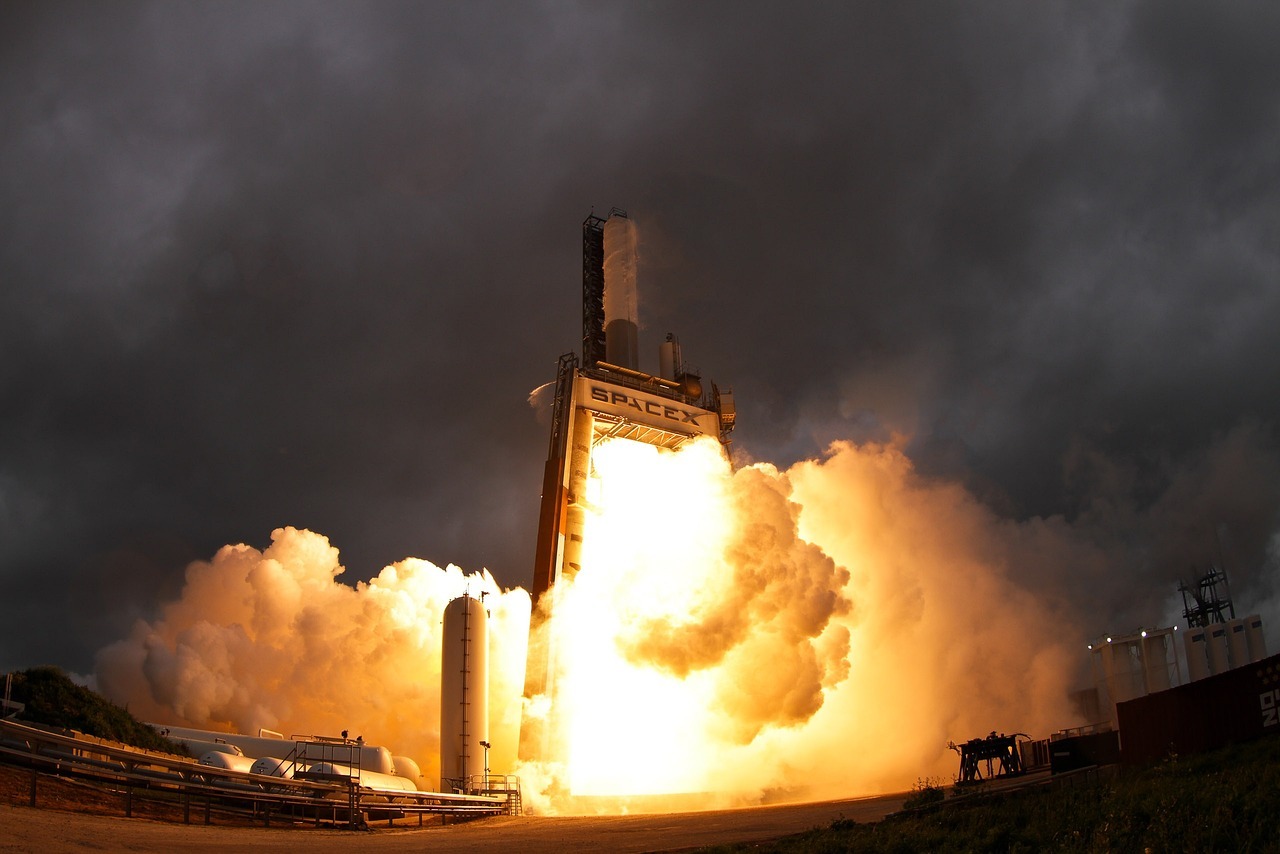
SpaceX has priced its blockbuster initial public offering at $135 per share, raising roughly $75 billion in what is set to become the largest IPO in history. The deal values Elon Musk’s rocket, satellite internet and AI-linked infrastructure company at about $1.77 trillion, or nearly $1.8 trillion.
The scale is extraordinary. The offering easily surpasses Saudi Aramco’s 2019 IPO, which raised $29.4 billion, and immediately places SpaceX among the world’s most valuable public companies. For investors, however, the key question is not whether the SpaceX IPO is historic. It is whether SPCX stock can justify a valuation that already prices in enormous future growth from Starlink, launch services, Starship, defense contracts and AI computing.
SpaceX’s IPO Rewrites the Market Record Book
SpaceX is expected to trade on the Nasdaq under the ticker SPCX, with the IPO raising about $75 billion through the sale of new shares. Reuters previously reported that SpaceX aimed to price shares at $135 and target a valuation of about $1.75 trillion, while Axios noted that the projected market capitalization is nearly equal to the combined inflation-adjusted value of the 29 largest U.S. IPOs since 2000.
That makes the SpaceX IPO more than a company-specific event. It is a stress test for the entire IPO market, which has been searching for a major reopening after years of uneven listing activity. A strong debut could encourage other private technology and AI companies to accelerate public-market plans. A weak debut, by contrast, could reinforce concerns that late-stage private valuations remain too aggressive.
The deal is also unusual in structure. Reuters reported that SpaceX upended traditional IPO conventions by setting its price early and giving retail investors a larger role than is typical in mega-cap listings. That retail-access angle may increase trading interest, but it could also amplify volatility if early demand fades after the first few sessions.
Related articles



Why Investors Are Paying Nearly $1.8 Trillion
The bullish case for SpaceX rests on several businesses that investors see as unusually powerful when combined.
The first is Starlink, the company’s satellite internet network. Reuters reported that SpaceX generated $18.67 billion in revenue last year, up 33%, with Starlink playing a major role and reaching 10.3 million users. Recurring internet revenue gives SpaceX a different profile from traditional aerospace companies, where revenue can be more dependent on large contracts and launch schedules.
The second is SpaceX’s launch dominance. The company’s reusable Falcon 9 rockets have helped it reach a launch cadence of more than two launches per week, according to Reuters. That scale gives SpaceX a cost and reliability advantage that few competitors can match.
The third is Starship, the heavy-lift rocket that remains central to SpaceX’s long-term ambitions. If Starship becomes commercially reliable, it could reduce launch costs, increase satellite deployment capacity and support future markets such as lunar infrastructure, deep-space missions and potentially space-based data centers.
The fourth is AI. Investors are increasingly treating SpaceX as more than a space company after its combination with Musk’s xAI business. That has expanded the narrative from rockets and satellites to AI infrastructure, compute capacity and vertically integrated technology platforms.
Oppenheimer Starts With a Bullish View
Wall Street coverage is already beginning. Reuters reported that Oppenheimer initiated SpaceX with an outperform rating and a $190 price target, implying about 41% upside from the $135 IPO price. Analyst Timothy Horan framed SpaceX as a vertically integrated AI company with strength across data, hardware, manufacturing and engineering.
That bullish view highlights why the IPO is attracting so much attention. If investors believe SpaceX can combine Starlink connectivity, launch dominance, AI infrastructure and xAI into one platform, then the company may be valued less like an aerospace business and more like a mega-cap technology ecosystem.
However, not everyone agrees. Reuters also reported that Morningstar has a much more conservative valuation estimate of about $780 billion, while other analysts have questioned how much future AI growth is already embedded in the IPO price.
The Bear Case: Valuation, Losses and Retail Risk
The main concern is valuation. Reuters reported that SpaceX’s $1.75 trillion valuation implies a trailing price-to-sales multiple of about 94, far above most large technology companies. The company also reported a $4.94 billion net loss last year despite strong revenue growth.
That combination is risky. A company can be strategically important and still be expensive at the wrong price. At nearly $1.8 trillion, SpaceX must deliver extraordinary growth for years to support the IPO valuation.
Retail participation is another concern. Reuters Breakingviews warned that retail investors are receiving a larger allocation than usual, with individual investors expected to get about 30% of shares rather than the roughly 10% typical in many IPOs. The same analysis noted that large tech IPOs have often suffered sharp declines within a year, according to historical data reviewed by Truist Advisory Services.
The risk is that individual investors buy SPCX stock because of the brand, Elon Musk’s profile or first-day excitement rather than valuation discipline. IPO investing can be profitable, but it can also be unforgiving when expectations are extreme.
Index Inclusion Could Create Powerful Flows
Another reason the SpaceX IPO matters is index demand. A company this large could become relevant to index funds and ETFs quickly, depending on eligibility rules. Earlier Reuters reporting said MSCI had confirmed early inclusion rules for large IPOs, creating the possibility of fast benchmark inclusion after listing. That would force some passive funds to buy shares if SpaceX becomes eligible.
That dynamic can support early demand, but it can also create distortions. If funds need to buy SpaceX, they may sell other holdings to make room. That could affect technology, aerospace, communication services and growth-stock positioning across portfolios.
For investors using a stock trading platform, the first days of SPCX trading may be especially volatile because of retail demand, institutional allocations, potential index-flow expectations and limited price history.
What Investors Should Watch After the Debut
The first key issue is the opening trade. If SPCX stock opens far above $135, valuation concerns will intensify quickly. A large first-day pop may reward early buyers, but it also raises the bar for future returns.
The second issue is trading volume and allocation. Heavy retail interest could drive volatility if investors who did not receive IPO shares rush into the open market.
The third issue is management guidance. Investors will want clearer detail on Starlink revenue growth, xAI investment needs, launch margins, Starship timelines and capital spending.
The fourth issue is profitability. SpaceX’s revenue growth is impressive, but public-market investors will need a credible path from massive scale to durable earnings and free cash flow.
The fifth issue is competition and regulation. Satellite internet, AI infrastructure, defense contracting and space launch are all politically sensitive markets. Government contracts, spectrum policy, export controls and international competition could all affect the long-term investment case.
Bottom Line: A Historic IPO With Historic Expectations
The SpaceX IPO is a landmark moment for global markets. At $135 per share, a $75 billion raise and a valuation near $1.8 trillion, SpaceX is not merely entering the public market. It is redefining what investors are willing to pay for a private technology platform with aerospace, satellite broadband and AI ambitions.
The bull case is powerful: Starlink scale, reusable rockets, Starship optionality, defense relevance and AI infrastructure. The bear case is just as clear: extreme valuation, heavy losses, execution risk and a retail-fueled trading environment that could become unstable.
For long-term investors, SpaceX may become one of the most important public companies of the next decade. For short-term traders, SPCX stock could become one of the most volatile mega-cap debuts in market history.
The IPO has shattered records. Now SpaceX has to prove the valuation can survive public-market scrutiny.
FAQ
What price did SpaceX set for its IPO?
SpaceX priced its IPO at $135 per share, raising roughly $75 billion in the largest IPO ever.
What valuation does the IPO imply?
The IPO values SpaceX at about $1.77 trillion, or nearly $1.8 trillion.
What will SpaceX’s stock ticker be?
SpaceX is expected to trade on the Nasdaq under the ticker SPCX.
Is SpaceX profitable?
SpaceX reported $18.67 billion in revenue last year but also posted a $4.94 billion net loss, according to Reuters.
What are the biggest risks for the stock?
The biggest risks are valuation, profitability, Starship execution, AI-investment costs, retail-driven volatility, insider selling concerns and the possibility that future growth fails to justify the IPO price.
Disclaimer: This article is for informational purposes only and does not constitute financial advice. Always conduct your own research before making any investment decisions.