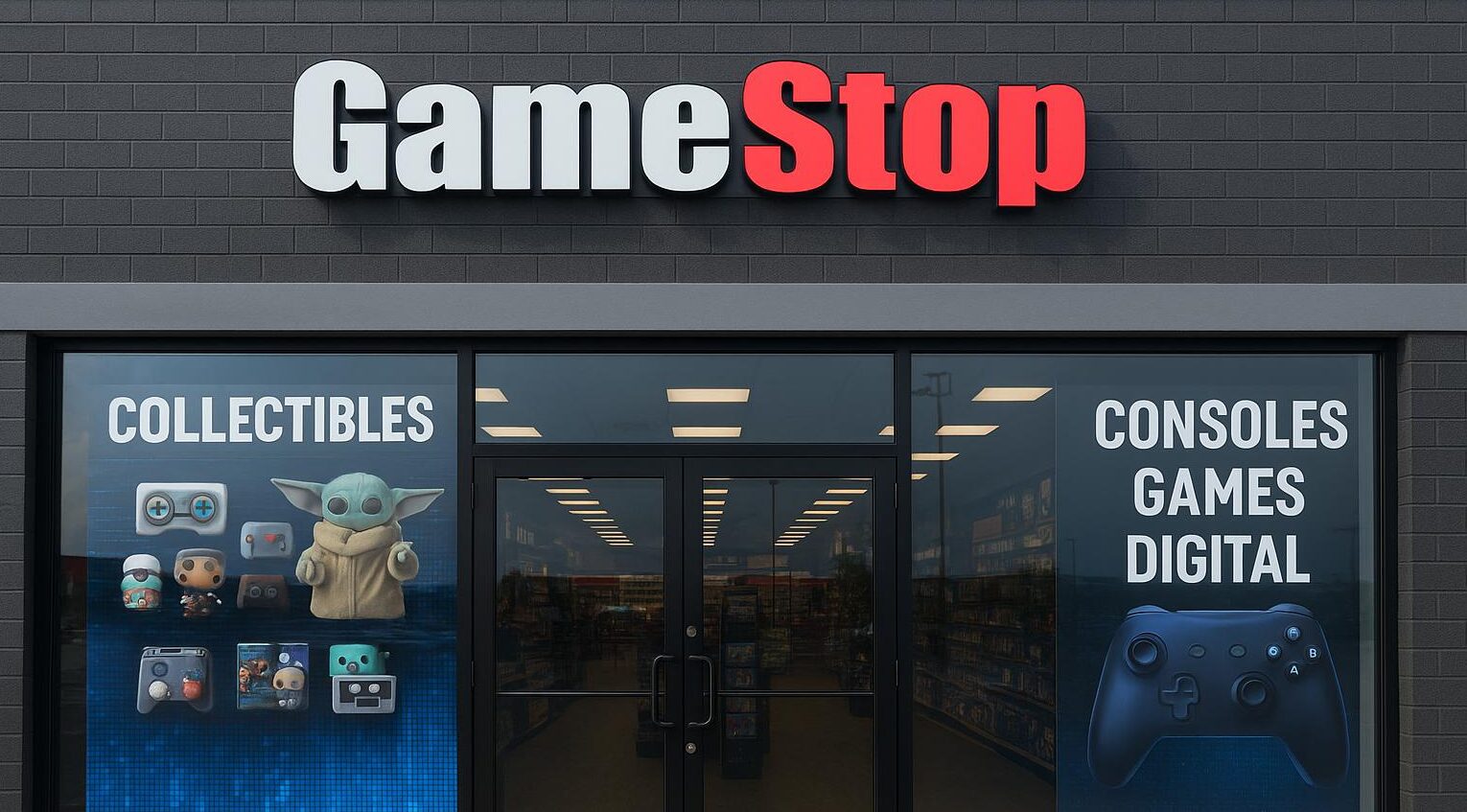
Introduction: From Meme to Corporate Maneuver
GameStop (NYSE: GME) has long been the symbol of speculative mania — the poster child of the 2021 “meme-stock” saga. In 2025, however, the company is working hard to rewrite its story. It is restructuring its retail operations, launching capital-raising initiatives, experimenting with cryptocurrency holdings, and strengthening its collectibles and hardware divisions.
While the stock remains volatile, behind the headlines lies a complex story of reinvention, dilution risk, and digital ambition — a company trying to evolve from meme legend to modern enterprise.
Current Price Action & Key Metrics
As of early October 2025, GameStop stock trades around $24.50 per share, reflecting a mixed year marked by high volatility.
- Intraday range: roughly $24.15 – $25.00
- YTD performance: broadly stable, but prone to sharp intraday swings
- Trading corridor: generally between $20 and $30
This pattern shows a stock still highly sensitive to corporate announcements, investor sentiment, and speculative flows — more than to traditional fundamentals. GameStop’s daily volume remains elevated, underscoring its enduring status as a retail-investor favorite.
Q2 Results: A Surprising Profit Amid Retail Pressures
In a surprising development, GameStop posted a quarterly profit in 2025 after years of recurring losses. The company reported stronger hardware and collectibles sales and managed to reduce operating costs significantly.
Key financial highlights included:
- Revenue: approximately $972 million
- Gross profit: around $283 million
- Operating income: roughly $66 million (compared with a loss in the prior year)
- Net income: near $169 million, or about $0.38 per share
These results marked an encouraging shift toward operational discipline. GameStop’s cost-cutting, leaner inventory management, and better product mix helped push the company into positive territory.
Still, challenges remain. Interest expenses remain elevated, margins are under pressure, and the company continues to carry the costs of its multi-year restructuring. Profitability is fragile, but the quarter signaled that GameStop can still deliver when it focuses on efficiency and strong product categories.
Strategic Moves: Warrant Dividend and Capital Raising
GameStop’s management has taken bold steps to strengthen its financial position. The company announced a warrant dividend, issuing one warrant for every ten shares owned. Each warrant allows investors to purchase new shares at a fixed strike price of $32 through late 2026. If fully exercised, the program could generate roughly $1.9 billion in new capital.
In addition, the company plans to raise further funds through convertible debt offerings totaling approximately $1.75 billion, giving it the flexibility to invest in new ventures and potentially expand its digital and crypto strategy.
These actions aim to improve liquidity and long-term flexibility, but they come at a cost. Warrant issuances and convertible bonds can dilute existing shareholders, especially if the stock fails to rise above the strike price. For GameStop, the trade-off is clear: strengthen the balance sheet now, even if it risks near-term pressure on earnings per share.
The success of these initiatives will largely determine how well GameStop can finance its transition into a more diversified digital-commerce business.
Core Business: From Retail Retreat to Digital Reinvention
GameStop continues to shrink its traditional retail footprint as it transitions toward a digital-first model. Hundreds of stores have been closed across the U.S., with more expected through 2025. The company has also reduced its international exposure, focusing instead on a few profitable flagship markets.
Despite this contraction, GameStop is leaning heavily on growth opportunities in digital commerce, hardware, and collectibles.
- Hardware and accessories remain a vital source of revenue, supported by console upgrades and gaming-related product launches.
- Collectibles and gaming merchandise have evolved into a high-margin segment, appealing to enthusiasts and investors alike.
- Online storefronts and digital trading platforms are being integrated into its retail network, bridging physical and virtual sales channels.
At the same time, GameStop has incorporated digital assets into its treasury, holding cryptocurrencies and exploring potential blockchain-based product lines. While this adds diversification, it also introduces new volatility risks linked to crypto markets.
The company’s challenge is clear: convert these experiments into stable, recurring earnings while keeping its brand relevant in a digital age.
Key Risks and Pitfalls
Despite progress, GameStop stock remains a high-risk investment. Several key challenges could threaten its turnaround:
- Dilution Risk:
The warrant and convertible debt programs could erode shareholder value if uptake is low or the stock fails to rise above key price levels. - Retail Decline:
The continued shift toward digital game distribution undermines GameStop’s traditional retail base and reduces foot traffic. - Crypto Volatility:
Incorporating Bitcoin and other digital assets into the balance sheet exposes GameStop to market swings unrelated to its core business. - Execution Challenges:
Managing store closures, inventory, and logistics while pivoting toward digital commerce requires flawless execution. - Speculative Investor Base:
GameStop’s shareholder mix remains dominated by retail traders, making the stock more volatile and sensitive to sentiment shifts than to fundamentals.
Opportunities and Bullish Scenarios
Despite these headwinds, GameStop also has meaningful upside potential.
- Capital Strength:
Successful warrant conversion and debt placement could leave GameStop with one of the strongest balance sheets in the specialty-retail sector. - Brand Leverage:
GameStop remains a globally recognized name, and its nostalgia factor continues to attract loyal customers and investors. - Digital Growth:
Expansion into e-commerce, collectibles, and online marketplaces could produce steady revenue streams. - New Partnerships:
Licensing agreements and collaborations with gaming and entertainment companies could open scalable, high-margin opportunities. - Crypto Optionality:
If digital assets appreciate in value, GameStop could benefit financially, adding speculative upside.
These factors combine to give GameStop a unique risk-reward profile: speculative but with genuine strategic possibilities.
Outlook and Scenarios for GameStop Stock
The next 12 to 18 months will likely define GameStop’s trajectory. Investors currently see three broad scenarios:
- Base Case:
The stock continues to trade between $20 and $30, reacting to earnings and capital-structure updates but without major trend shifts. - Bear Case:
Dilution, weak execution, and declining sales could drag the stock below $15, especially if the company fails to convert its capital raise into growth. - Bull Case:
If warrant exercises succeed, profitability stabilizes, and digital revenues accelerate, the stock could rally toward $40 or higher.
Given the speculative nature of GameStop stock, prudent investors often favor smaller position sizes and close monitoring of company updates.
Why GameStop Still Matters in 2025
GameStop’s appeal lies not just in its financials, but in its symbolism. It remains a cultural icon for retail investors, embodying the power of grassroots trading and community finance.
But beyond sentiment, the company represents a fascinating experiment in corporate adaptation: can a legacy retailer reinvent itself as a digital-era platform without losing its core audience?
In many ways, GameStop has become a case study for the post-pandemic market — a company that must prove it can evolve faster than its critics expect.
The Road Ahead: What Investors Should Watch
As the transformation unfolds, several key indicators will determine whether GameStop can sustain momentum:
- Execution of the Capital Raise:
Investors will closely watch how much of the planned warrant and debt issuance is completed and at what terms. - Consistency of Profitability:
Maintaining positive earnings beyond a single quarter will be crucial for credibility. - Digital Sales Growth:
Online sales performance will serve as a leading indicator of the company’s transition success. - Crypto Strategy Stability:
GameStop’s use of digital assets in its treasury must remain transparent and risk-controlled. - Investor Communication:
Clear messaging from management can help temper volatility and attract more institutional interest.
Long-Term Investment Case
From a long-term perspective, GameStop stock offers an intriguing mix of volatility, brand equity, and transformation potential. For patient investors with high risk tolerance, the company’s efforts to diversify and modernize could eventually yield significant value.
However, this is not a typical value or growth stock. It’s a speculative turnaround story that requires careful timing and disciplined expectation management.
The balance of risks and opportunities remains delicate: GameStop must prove that its digital ambitions can replace its declining retail base — and that its capital raises will fund real growth rather than temporary balance-sheet patchwork.
Conclusion: Reinvention or Relapse?
Four years after becoming the face of the retail-trading revolution, GameStop stock is still writing its next chapter.
The company’s capital-raising plans, operational streamlining, and digital experiments reflect a serious attempt to evolve. The path forward is uncertain, but not without promise.
If GameStop can maintain profitability, successfully deploy new capital, and build a sustainable digital-commerce model, it could transition from meme legend to modern mid-cap contender.
But if execution falters or speculative hype fades, the stock could slip back into obscurity — a relic of the meme era rather than its survivor.
For now, GameStop stock remains a high-risk, high-reward play — an investment defined by volatility, ambition, and the enduring hope of a comeback.
FAQ: GameStop Stock in 2025
1. Why is GameStop still relevant in 2025?
GameStop is no longer just a video-game retailer. It’s repositioning as a digital-commerce company with exposure to collectibles, e-commerce, and emerging crypto markets.
2. What makes the stock so volatile?
GameStop still attracts a large community of retail traders and social-media attention, making its price highly sensitive to headlines and investor sentiment.
3. Is GameStop profitable again?
Yes, the company reported a profitable quarter in 2025, though sustainability remains uncertain.
4. What is the biggest risk for shareholders?
Potential dilution from new warrants and convertible debt offerings, combined with ongoing retail decline.
5. Could GameStop become a growth stock again?
If digital and collectible revenues expand and profitability stabilizes, GameStop could re-emerge as a niche growth story within the gaming and entertainment ecosystem.
Disclaimer
This article is intended for informational purposes only and does not constitute financial, investment, or trading advice. All market data and statements reflect conditions as of October 2025 and may change without notice. Investors should conduct their own research or consult a licensed financial advisor before making investment decisions.